
Category: Cells
Showing all 9 resultsSorted by latest
-
 $2.00Add to Cart
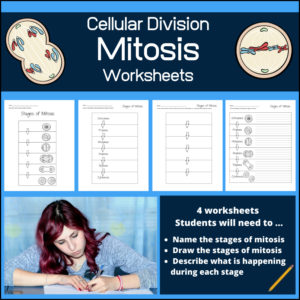
Ready to use stages of mitosis worksheets that can be used as study aids or for quizzes / tests.
There are 4 worksheets:
- #1: Students will name each stage of mitosis in order
- #2: Students will draw / illustrate each stage
- #3: Students will name and draw each stage
- #4: Students will describe what is happening / events of each stage
Answer key provided
-
$1.50Add to Cart
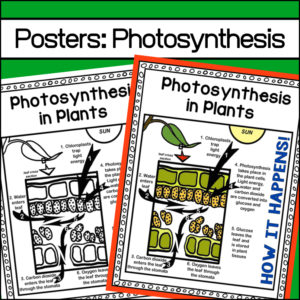
Here are 2 posters (b/w and color) of the process of photosynthesis.
-
$2.25Add to Cart
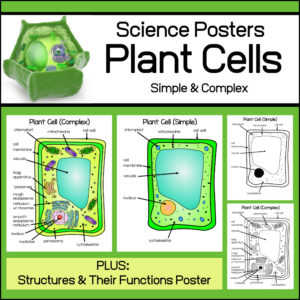
This Science / Biology resource offers 5 posters – Color posters which are perfect for bulletin boards or centers and B/W posters which are great to use as student handouts.
-
$1.25Add to Cart
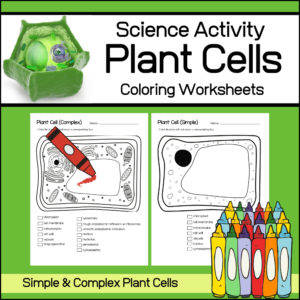
Interactive Science learning – This resource includes 2 coloring worksheets: Simple Plant Cell and Complex Plant Cell. As students color (identify) each part, they will also create a corresponding key.
Structures to be identified and colored:
1. Simple Plant Cell – cell wall, mitochondria, chloroplast, cell membrane, vacuole, nucleus, cytoskeleton
2. Complex Plant Cell – cell wall, mitochondria, chloroplast, cell membrane, vacuole, Golgi apparatus, lysosomes, rough endoplasmic reticulum w/ ribosomes, smooth endoplasmic reticulum, nucleus, nucleolus, peroxisome, cytoskeleton
-
$2.25Add to Cart
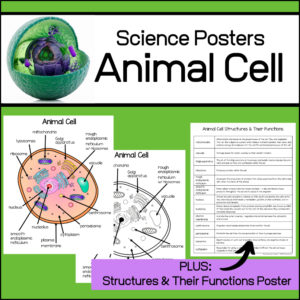
This Science / Biology resource offers 2 labeled posters showing the structures and organelles of an animal cell! I’ve also included a handout detailing the major function(s) of each structure/organelle. Structures and organelles include: centrosome, plasma membrane, mitochondria, vacuole, Golgi apparatus, ribosome, lysosomes, rough endoplasmic reticulum, smooth endoplasmic reticulum, nucleus, nucleolus, peroxisome, cytoplasm
-
$1.00Add to Cart
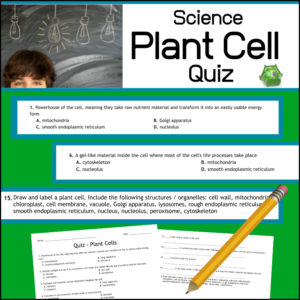
The resource is a 15 question quiz that will assess student understanding of the following structures / organelles of a plant cell: cell wall, mitochondria, chloroplast, cell membrane, vacuole, Golgi apparatus, lysosomes, rough endoplasmic reticulum w/ ribosomes, smooth endoplasmic reticulum, nucleus, nucleolus, peroxisome, cytoskeleton
-
$2.00Add to Cart
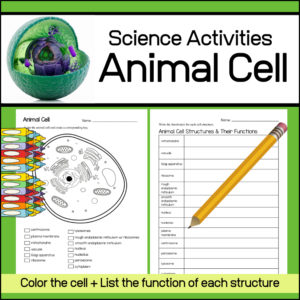
This Science / Biology resource includes 2 activity worksheets for students to help them review the structures / organelles of an animal cell and the main function(s) of each. Structures /organelles include: centrosome, plasma membrane, mitochondria, vacuole, Golgi apparatus, ribosome, lysosomes, rough endoplasmic reticulum, smooth endoplasmic reticulum, nucleus, nucleolus, peroxisome, cytoplasm
-
$2.50Add to Cart
A great introductory lesson on Cell Theory for your Science students. The text will teach students about the contributions of scientists Robert Hooke, Matthias Schleiden, Theodor Schwann and Rudolf Virchow. It lists the 3 basics of Cell Theory as well as the 3 ‘modern’ ideas that have been added to Cell Theory.
This resource includes:
- Informational Text
- Assessment of student understanding (multiple choice and short essay)
- Answer Key
- BONUS: B/W and Color posters of animal and plant cells.
-
$3.25Add to Cart
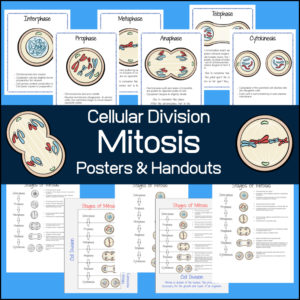
Let’s face it: Trying to explain the “dance of the chromosomes” without clear visuals is a recipe for confused faces. This resource simplifies the complex process of cellular division into digestible, visually engaging steps.
🔍 What’s Inside?
This resource covers the full cycle of mitosis, ensuring your students see the “big picture” of how cells replicate.
The Phases Outlined:
- Interphase: The prep work (DNA replication).
- Prophase: Chromosomes condense and the party starts.
- Metaphase: Everyone aligns in the middle.
- Anaphase: The great separation.
- Telophase: Two new nuclei form.
- Cytokinesis: The final split!
Included Versions:
- 🎨 Full Color: Perfect for high-impact classroom decor or digital presentations.
- 🗒️ Black & White: Ideal for student handouts, coloring activities, or saving on ink.
- ✍️ With Explanations: Includes detailed text describing the events of each phase.
💡 Why You’ll Love This
1. Visual Clarity for Abstract Concepts Mitosis is hard to visualize! These posters provide a clear “anchor” for students to refer back to when they get stuck on the difference between anaphase and telophase.
2. Differentiation Made Easy With both “labeled” and “blank” versions, you can easily scaffold your instruction. Use the labeled version for an introductory lecture and the blank version for a formative assessment.
3. Saves You Prep Time Stop scouring the internet for clear, high-quality diagrams. These are ready to print and use immediately. ☕🏫 Suggested Grade Levels & Subjects
- Grades: 6th – 10th Grade
- Subjects: Life Science, General Science, and Biology