
Category: Physics
Showing all 6 resultsSorted by latest
-
 $4.00Add to Cart
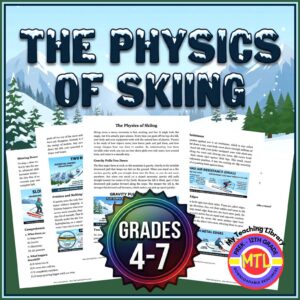
Skiing down a snowy slope looks like magic, but it is pure science in action! The Physics of Skiing is an engaging, high-interest science reading comprehension unit designed to help upper elementary and middle school students explore real-world forces, motion, and energy transformations.
Written at an accessible reading level with clear, full-color diagrams, this resource breaks down foundational physical science concepts into relatable winter sports applications.
Key Science Concepts Covered:
- Gravity and Slope Angles: How Earth’s downward pull converts into forward acceleration along an inclined plane.
- Potential vs. Kinetic Energy: How chairlifts store potential energy and how downhill descents transform it into kinetic energy.
- Friction and Hydroplaning: How friction creates microscopic surface heat, melting a thin water film that lets skis glide.
- Wind Resistance and Aerodynamics: How air drag slows skiers down and why racers use aerodynamic tucks to cut through air molecules.
- Newton’s Third Law of Motion: How sharp metal edges bite into snow to create equal and opposite reaction forces for carving turns.
- Stopping Mechanics: How beginners (snowplow/wedge) and advanced skiers (hockey stop) scrape edges sideways to dramatically increase friction and come to a safe halt.
What’s Included:
- Informational Science Text: Illustrated, easy-to-read passages packed with labeled visual diagrams illustrating each physical force.
- Student Assessment: 5 multiple-choice questions assessing core comprehension plus 2 short-answer prompts requiring students to explain energy conversion and friction.
- Teacher Answer Key: Complete with grading criteria and sample responses for quick, straightforward evaluation.
Suggested Grades: 4th – 7th Grade (Upper Elementary / Middle School)
Perfect For: Physical science units, winter STEM, homeschool lessons, sports science enrichment, co-op classes. Print-and-Go ready!
-
$1.50Add to Cart
This fun crossword puzzle is a great way for students to review what they know about matter! If students need help, page 2 contains a ‘word box’ to give students terms from which to choose! Answer Key also provided.
Sample clues:
- At 32 degrees Fahrenheit, water ___.
- This is a very light gas found in some balloons.
- The amount of matter something contains is its ___.
-
$1.00Add to Cart
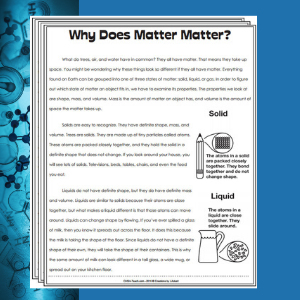
This informational text will help define matter and its 3 main stages (solid, liquid and gas). After students read the article, they will be asked comprehension questions to assess their understanding. Answer Key also included.
-
$2.00Add to Cart
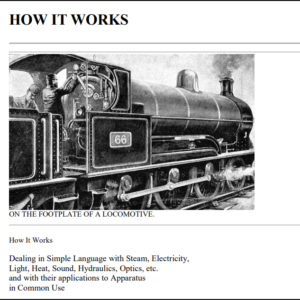
This is a downloadable copy of the book. (279 pages)
About the book: This out-of-print book will give students details ‘in simple language’ (and illustrations) dealing with steam, electricity, light, heat, sound, hydraulics, optics and other apparatus. (See more in description below) -
$0.50Add to Cart
Taking what they already know about ‘matter’, this one page worksheet will require students to ‘think deeply’ (using critical thinking skills) to answer questions. Answer key also included.
-
$2.00Add to Cart
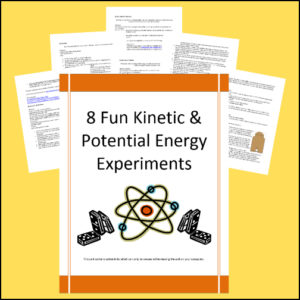
Kinetic energy is energy possessed by an object due to its motion or movement. Potential energy is the stored energy of position possessed by an object. Here are eight experiments for students to perform which display chemical energy! Experiments include:
1. Rube Goldberg Machines
2. Homemade Marble Run
3. Bucket Spin
4. Salad Spinner Art
5. Rubber Band Vehicles
6. Rubber Band Car
7. Flywheel Battery
8. Pendulum of Peril