
Category: Maps
Showing all 11 resultsSorted by latest
-
 $5.75Add to Cart
Take the Mystery Out of Map Coordinates!
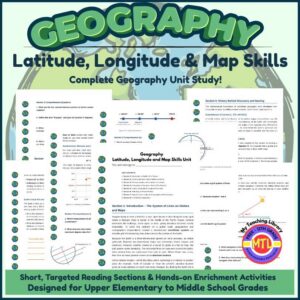
Are your students struggling to understand how latitude and longitude work? Do they get confused between parallels and meridians, or mix up the coordinate order?
This comprehensive, ready-to-print geography unit provides an all-in-one solution for teaching global coordinates, navigational history, map grids, and climate zones! Designed specifically for 5th-8th grade level learners, this unit breaks down complex spatial concepts into clear, engaging, and scannable lessons accompanied by custom visual reference diagrams for every section.
📦 What’s Included in This Downloadable PDF Packet?
This Student Workbook & Teacher Resource includes everything you need for a full geography unit:
Section 1: Introduction – The System of Lines on Globes and Maps
- Covers why mapmakers created grid systems, how 3D spherical globes differ from flattened 2D maps, and the difference between absolute location and relative location.
- Includes Figure 1.1: Globe Grid Intersection Diagram.
Section 2: Drawing the Earth Grid & Reference Points
- Defines nature’s fixed reference points (North & South Poles), the Equator (), Northern/Southern Hemispheres, Parallels, and Meridians.
- Includes Figure 2.1: Reference Points & Parallel Lines Diagram.
Section 3: Finding Latitude and Longitude Coordinates
- Breaks down the mandatory (Latitude, Longitude) ordering rule, memory tricks (“Latitude = Ladder”), degree ranges (– N/S vs – E/W), and subdivisions into minutes () and seconds () using real examples like the Statue of Liberty.
- Includes Figure 3.1: Map Coordinate Grid Plotting Diagram.
Section 4: Navigation at Sea and in the Air (The Sextant)
- Explores celestial navigation, how sailors use a sextant to measure Polaris (the North Star) for latitude, combining solar angles with Greenwich Mean Time (GMT) for longitude, and why the U.S. Navy still teaches sextants today.
- Includes Figure 4.1: Celestial Navigation Sightline & Horizon Angle Diagram.
Section 5: History Behind Discovery and Naming
- Chronicles key historical figures: Eratosthenes (calculating Earth’s size), Hipparchus ( circle grid), Ptolemy (Geographia and Latin roots latitudo / longitudo), and John Harrison’s invention of the marine chronometer to solve the “Longitude Problem”.
- Includes Figure 5.1: Historical Discovery Timeline Diagram.
Section 6: How the Prime Meridian Was Selected
- Details the International Meridian Conference of 1884 in Washington, D.C., why Greenwich, England was chosen, and how the Prime Meridian defines the Eastern and Western Hemispheres.
- Includes Figure 6.1: Prime Meridian & Eastern/Western Hemispheres Diagram.
Section 7: Special Lines of Latitude & Longitude and the Seasons
- Connects geography to Earth science! Explores the Equator, Tropics of Cancer & Capricorn (), Arctic/Antarctic Circles (), climate boundaries ( and parallels), and how Earth’s axial tilt creates the four seasons.
- Includes Figure 7.1: Earth Axial Tilt & Special Lines Diagram.
Section 8: Full Geography Unit Review Assessment
- A unit test featuring Multiple Choice (Part I), True/False (Part II), and Short Answer & Hemisphere Identification (Part III).
Complete Teacher Answer Keys
- Contains full, detailed answer keys for all section comprehension questions as well as the complete review assessment test.
🧠 Core Social Studies & Map Skills Covered
- Spatial Thinking & Coordinate Plotting: Correctly reading, writing, and pinpointing coordinates in format.
- Absolute vs. Relative Location: Differentiating between permanent mathematical coordinates and landmark-based descriptions.
- Hemispheric Geography: Categorizing global positions across Northern, Southern, Eastern, and Western Hemispheres.
- Historical Inquiry & Technology: Understanding how human innovation (from Greek astronomy to 18th-century clocks and sextants) solved global navigation challenges.
- Integrated Earth Science: Analyzing how Earth’s rotational axis tilt () and solar ray directness create distinct seasonal and climate zones along specific parallels.
💡 Why You’ll Love This Unit
- Visual Learning Centered: Every lesson includes a dedicated reference diagram (globe grids, coordinate planes, horizon sightlines, timelines, axial tilts) so visual learners grasp abstract spatial concepts immediately.
- Built-in Student Worksheets: Every section ends with 4 short-answer comprehension questions that work as exit tickets, daily quizzes, or notebook prompts.
- Zero Prep Required: Open, print, and teach!
🎯 How to Use Suggestions
- 2-Week Unit Study: Teach 1 section per day. Have students read the section text, analyze the visual figure, and complete the 4 comprehension questions. Conclude the second week with the Section 8 Review Assessment.
- Independent Unit: Perfect for self-paced independent learning. Multi-grade classrooms or families can work through the readings together and use the visual diagrams to lead discussions.
🛒 Ready to Master Geography & Navigation?
Equip your students with lifetime map-reading confidence, historical context, and spatial reasoning skills!
Includes High-Value Components:-
Structured Content: 7 full instructional reading sections covering core concept skills, history, and real-world application (e.g., sextant navigation, Greenwich conference).
-
Built-in Assessment: Section-by-section comprehension questions plus a full unit review test.
-
Convenience: Complete answer keys for all sections and tests.
-
STEM / Hands-On Enrichment: Multi-sensory lab activities (cardboard sextant lab, edible orange-peel map projection, living history journal entry)
Get yours today!
-
$1.50Add to Cart
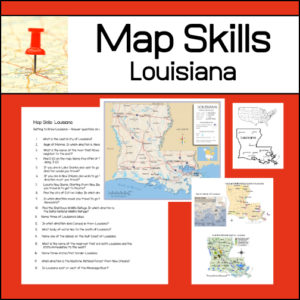
Learning to read different types of maps is a vital skill for students to learn and practice. With this resource, students will be given several maps and questions to answer using the maps. Maps and questions all center around the state of Louisiana.
-
$3.00Add to Cart
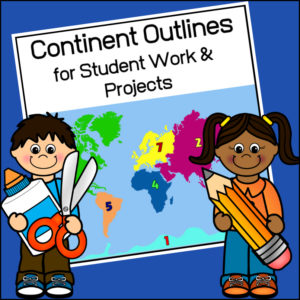
This resource, Continent Outlines for Student Work and Projects, contains 14 pages of continent outlines (7 labeled, 7 unlabeled). This is not clipart but ready to use outlines, just print and give to students to use however they need to!
-
 $8.00Add to Cart
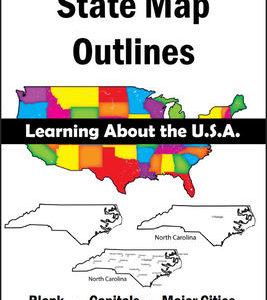
150 maps included in this download!
Each state has 3 pages / maps:
* Outline of the state
* Map showing the capital
* Map showing the major cities -
$8.75Add to Cart
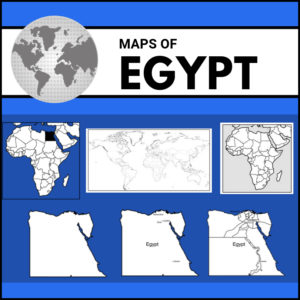
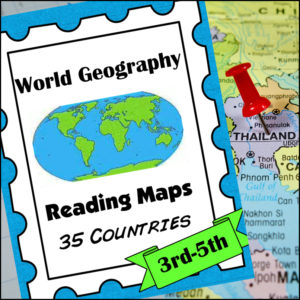
A comprehensive map-reading resource designed to help students develop essential navigation and analytical skills by focusing on 35 different countries.
Key Features:
-
Country-Specific Focus: For each country, students are given a map and asked specific questions that will require them to read the map to answer. (Questions may be things such as the location of the capital, naming rivers that are within or border the country, mountain ranges within the country, what nations border the country, etc.)
-
Critical Thinking Exercises: The worksheets go beyond simple identification, prompting students to solve navigation problems, determine cardinal directions, and estimate distances between major cities.
-
Integrated Learning: The resource connects physical geography with logical reasoning, helping students understand how environmental features like mountain ranges and bodies of water shape national landscapes and travel routes.
-
Ready-to-Use Answer Keys: The included answer keys make this an efficient tool for independent study, homeschooling, or classroom assessment.
Countries included: Algeria. Antarctica. Argentina. Australia. Bolivia. Brazil. Canada. Chile. China. Colombia. Ecuador. Egypt. Ethiopia. France. Ghana. Greece. Spain/Portugal. India. Iran. Iraq. Ireland. Italy, Japan, Kenya, Liberia, Libya, Madagascar, Mexico, Morocco, Nigeria, Peru, Russia, Saudi Arabia, South Africa, Uganda
This resource is an ideal addition to any social studies program, providing the structure needed for students to build confidence in reading maps and understanding global geography.
-
-
$6.00Add to Cart
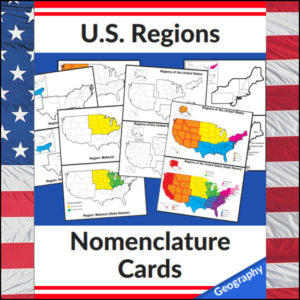
Mastering the map has never been more visual! This set of 20 professional nomenclature cards is the perfect foundational tool for any U.S. geography unit. Based on the 4 regions as defined by the U.S. Census Bureau (Northeast, Midwest, South, and West), these cards provide a clear, structured way for students to visualize how the United States is organized.
From full-color coded keys to black-and-white standalone regional maps, this versatile set helps students transition from “the big picture” to specific regional details with ease.
🧠 The “How” and “Why” (Educational Benefits)
Why use nomenclature cards for geography? It’s all about spatial recognition and scaffolded learning:
- Visual Discrimination: By seeing a region highlighted in color against a grayscale map of the whole U.S., students naturally learn exactly where that region sits in relation to the rest of the country. 📍
- Scaffolded Difficulty: Start with the cards that include state names for guided learning, then transition to the name-free cards to challenge their memory. 🎓
- Standards-Aligned: Because these follow the U.S. Census Bureau divisions, you can be confident your students are learning the most widely accepted geographic classifications used in social studies. ✅
- Versatility: The mix of color and black-and-white versions allows for high-impact visual aids or budget-friendly, student-ready worksheets.
🛠️ Ways to Use These
- Geography Centers: Laminate the color cards and use them as a “match the region” game or sorting activity. 🧩
- Interactive Notebooks: Print the black-and-white versions for students to color in, label, and glue into their social studies journals. 📓
- Flashcard Drills: Use the cards to quiz students on state locations within specific regions (e.g., “Which states are in the Midwest?”). ⚡
- Display: Create a stunning “Geography Wall” using the full-color coded keys as a reference point for students during independent work. 🖼️
🚀 Help Your Students Find Their Way!
Equip your geography explorers with the visual tools they need to master U.S. Geography. Add these US Regions Nomenclature Cards to your teaching toolkit today and watch their map-reading confidence soar! 🌟
UPGRADE and get this BUDNLE: Regions of the U.S.A. | Geography Bundle
-
$2.50Add to Cart
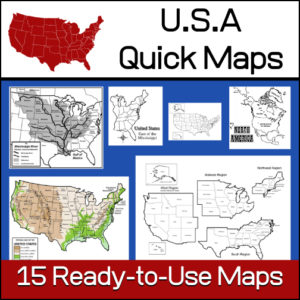
15 ready-to-use maps of the United States. Use for class projects, to create lessons or presentations.
Non-commercial use only.Includes:
– 2 maps showing the US within North America
– US maps (with states names and unnamed)
– US regional maps (with states names and unnamed)
– US east of the Mississippi (with states names and unnamed)
– US west of the Mississippi (with states names and unnamed)
– Physical Maps of the US (color and b/w)
– The Mississippi River with tributaries (states named) -
$2.50Add to Cart
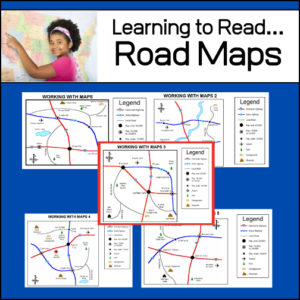
An important life skill is learning how to read maps! This resource provides 5 easy to read road maps. For each map, students will practice using the legend and answer 12-15 questions. Students will answer a total of 71 questions – Answer Keys provided.
-
$5.00Add to Cart
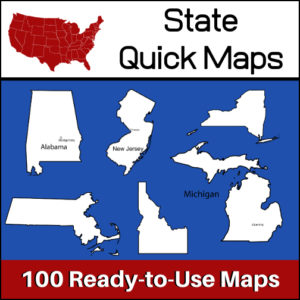
100 U.S. State outline maps – 2 maps for each state on one page:
- – Completely blank outline map
- – An outline with the state name and capital
Maps can be used for projects, bulletin boards, lesson plans and presentations.
Non-commercial use only. -
$3.00Add to Cart
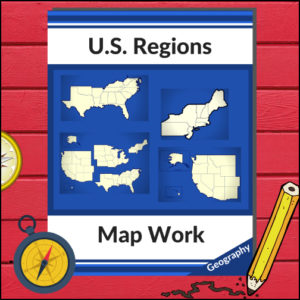
This resource will help your students learn more about U.S. Geography and the 4 main regions (as defined by the U.S. Census Bureau). Students will be working with maps of the entire United States as well as those of each region as they identify states, capitols, national parks, mountain ranges and points of interest! Great for any Social Studies class studying the U.S.A.!


&url=https://myteachinglibrary.com/product/u-s-state-map-outlines-usa-geography/&media=https://myteachinglibrary.com/wp-content/uploads/2019/08/wy-459-f.jpg)


