
Category: Reading
Showing 1–20 of 147 resultsSorted by latest
-
 $3.00Add to Cart
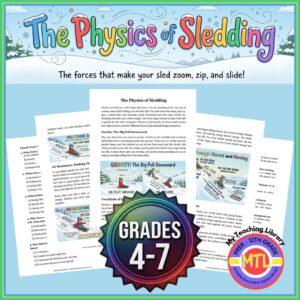
Bring real-world physical science to life this winter with The Physics of Sledding! Designed specifically for upper elementary and middle school learners (grades 4–7), this no-prep informational text makes complex physical science concepts engaging, clear, and easy to master.
Students explore the scientific principles behind sliding down snowy hills, including:
- Gravity and Slope: How Earth’s pull sets sleds into motion.
- Potential and Kinetic Energy: How stored energy at the top of a hill transforms into mechanical speed.
- Friction and Snow: How thin layers of melted water and slick runners reduce resistance.
- Air Resistance and Aerodynamics: How posture, drag, and surface area affect downhill velocity.
What’s Included:
- Complete Informational Science Text: Thorough, student-friendly reading passage explaining the forces and energy behind sledding along with informational graphics.
- Comprehension Assessment: 5 multiple-choice questions targeting key vocabulary and main concepts.
- Critical Thinking Prompts: 2 short-answer questions with ample ruled space for written explanations.
- Answer Key
Perfect for science curriculums, winter STEM units, classroom or co-op physical science, or independent study packets!
-
$3.00Add to Cart
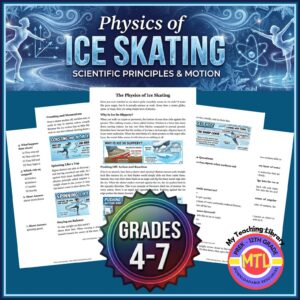
The Physics of Ice Skating is a ready-to-print, no-prep science reading that students will love! This resource breaks down complex physics principles into clear, engaging concepts that upper elementary and middle school learners can easily grasp.
Students explore the core mechanics behind gliding, stopping, and spinning across the rink, including:
- Friction & the Microscopic Water Layer: Why ice skates slide instead of sticking.
- Newton’s Third Law of Motion: How pushing back against the ice propels a skater forward.
- Inertia & Momentum: The forces at work as skaters maintain speed across the rink.
- Angular Momentum & Center of Mass: The physics behind tight, fast figure-skating spins and balanced landings.
What’s Included in This Download:
- Full-Length Reading Passage: Clear, age-appropriate science text.
- Comprehension Assessment: 5 multiple-choice questions testing core concepts and 2 short-answer questions.
- Answer Key
- Versatile Use: Ideal for physical science units, Winter Olympics lessons, co-op classes, rabbit-trail real life hobby learning, close-reading practice, or homeschool STEM
-
$4.00Add to Cart
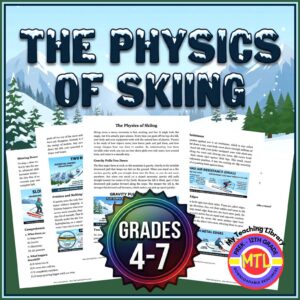
Skiing down a snowy slope looks like magic, but it is pure science in action! The Physics of Skiing is an engaging, high-interest science reading comprehension unit designed to help upper elementary and middle school students explore real-world forces, motion, and energy transformations.
Written at an accessible reading level with clear, full-color diagrams, this resource breaks down foundational physical science concepts into relatable winter sports applications.
Key Science Concepts Covered:
- Gravity and Slope Angles: How Earth’s downward pull converts into forward acceleration along an inclined plane.
- Potential vs. Kinetic Energy: How chairlifts store potential energy and how downhill descents transform it into kinetic energy.
- Friction and Hydroplaning: How friction creates microscopic surface heat, melting a thin water film that lets skis glide.
- Wind Resistance and Aerodynamics: How air drag slows skiers down and why racers use aerodynamic tucks to cut through air molecules.
- Newton’s Third Law of Motion: How sharp metal edges bite into snow to create equal and opposite reaction forces for carving turns.
- Stopping Mechanics: How beginners (snowplow/wedge) and advanced skiers (hockey stop) scrape edges sideways to dramatically increase friction and come to a safe halt.
What’s Included:
- Informational Science Text: Illustrated, easy-to-read passages packed with labeled visual diagrams illustrating each physical force.
- Student Assessment: 5 multiple-choice questions assessing core comprehension plus 2 short-answer prompts requiring students to explain energy conversion and friction.
- Teacher Answer Key: Complete with grading criteria and sample responses for quick, straightforward evaluation.
Suggested Grades: 4th – 7th Grade (Upper Elementary / Middle School)
Perfect For: Physical science units, winter STEM, homeschool lessons, sports science enrichment, co-op classes. Print-and-Go ready!
-
$2.50Add to Cart
Help your students understand the true meaning, history, and significance of Veterans Day with this comprehensive, ready-to-print reading resource. This in-depth passage provides a meaningful way to integrate social studies into your literacy block while honoring those who have served. (Written on a 5th grade reading level)
What’s Included:
- In-Depth Reading Passage: A detailed, age-appropriate text that explores the origins of Veterans Day (Armistice Day), the difference between Veterans Day and Memorial Day, and the importance of honoring military veterans.
- 5 Multiple-Choice Questions: Assess students’ basic comprehension, vocabulary in context, and ability to identify key facts from the text.
- 5 Short Answer Questions: Encourage critical thinking and text evidence analysis. Ample blank space is provided below each question to accommodate 5th-grade handwriting without feeling cramped.
- Teacher Answer Key: A complete answer key is included on its own separate page for quick and easy grading.
-
$3.00Add to Cart
Looking for a Pumpkin Reading Comprehension activity for upper elementary? Look no further than “Let’s Learn About Pumpkins – Level B!” This resource is designed for upper elementary and middle school students and is a perfect cross-curricular (language arts and science) lesson. Text is written on a 6th grade reading level. If your student(s) are not reading at a 6th grade level, you challenge them to try. While they do, have them write down any words they may not know. They can then look those words up and continue reading! Win-Win!
What’s Included:
- In-Depth Nonfiction Text (Pages 1–2): A 545-word informational text spanning two full pages. Topics covered include:
- Botanical Taxonomy & Anatomy: The Cucurbitaceae family, botanical fruit classification (pepo), monoecious flowering (male vs. female blooms and insect pollination), and specialized structural adaptations (thigmotropic climbing tendrils).
- Biochemical Pigmentation: The seasonal degradation of chlorophyll and the emergence of fat-soluble carotenoids (beta-carotene) during ripening.
- Indigenous Agriculture: The history of the “Three Sisters” companion planting method (winter squash, maize, and climbing beans) developed by Native American agriculturalists.
- Nutritional Science: The human biological synthesis of Vitamin A from dietary plant carotenoids.
- 5 Multiple-Choice Questions (Page 3): Targets upper level/middle school reading skills, including interpreting domain-specific scientific vocabulary in context, identifying reciprocal ecological relationships, and analyzing authorial purpose.
- 3 Open-Ended Questions (Page 4): Prompts students to synthesize concepts (e.g., explaining symbiotic companion planting mechanics, describing biochemical ripening transitions).
- Complete Teacher Answer Key (Page 5)
Standards & Skills Covered:
- Reading Informational Text (CCSS.ELA-LITERACY.RI.6.1, RI.6.2, RI.6.4): Citing textual evidence to support inferences, summarizing central scientific concepts, and interpreting domain-specific terminology.
- Next Generation Science Standards (NGSS MS-LS1-4, MS-LS1-5, MS-LS2-2): Specialized plant reproductive structures, factors influencing growth, and mutually beneficial interspecies interactions in agricultural ecosystems.
- Writing (CCSS.ELA-LITERACY.W.6.9): Drawing evidence from informational texts to support analytical short-answer explanations.
Download yours today!
- In-Depth Nonfiction Text (Pages 1–2): A 545-word informational text spanning two full pages. Topics covered include:
-
$2.75Add to Cart
Looking for an effective way to teach the Phases of the Moon to your middle to high school students? Looking for a no-prep, printable resource that makes teaching space science a breeze? The Phases of the Moon Reading Comprehension (informational text) resource is your perfect solution! You’ll love the ability to use this resource as a one-day, quick lesson or how easily it can integrate into your existing curriculum, providing clear explanations and reinforcing key concepts.
✨ What’s Included:
- – Detailed reading passages explaining the phases of the moon: new moon, waxing crescent, first quarter, waxing gibbous, full moon, waning gibbous, last quarter, and waning crescent.
- – Information on the days to complete the cycle and the concepts of synchronous rotation and tidal locking.
- – A comprehensive assessment featuring short answer and multiple-choice quiz questions.
- – An easy-to-use answer key for quick grading.
✅ Perfect For…
- – Introducing or reviewing the Phases of the Moon in middle school science classes.
- – No-prep science lesson
- – Reinforcing reading comprehension skills within a science context.
This resource is built upon the pedagogical approach of making real-world connections to science. By explaining the observable phenomenon of the moon’s changing appearance, students can directly relate the concepts to their everyday experiences.
📚 Learning Objectives
- Students will be able to identify and describe the eight major phases of the moon.
- Students will understand the relationship between the Earth, Moon, and Sun that causes the different moon phases.
- Students will be able to explain the concept of synchronous rotation and tidal locking.
- Students will be able to determine the approximate duration of the lunar cycle.
- Students will improve their reading comprehension skills by extracting key information from scientific text.
-
$2.50Add to Cart
Henry Ford was an inventor, innovator, industrialist, and entrepreneur. In this resource, students will read about Ford’s life and business journey.
After reading, students will be asked a series of questions (multiple choice and short answer) to assess comprehension.
Students will learn:
- – About Henry’s family and early life
- – What he did at the age of 16
- – When he went to, left and then returned to Detroit
- – How he was first involved in car manufacturing and when he started Ford Motor Company
- – How is business practices made a huge stir in the country
- – One of his biggest challenges…and more!
Answer Key included!
-
Sale!Original price was: $22.50.$18.00Current price is: $18.00.Add to Cart
Planning for your student(s) to read and study Judy Blume’s Fudge series of books? Here is a fun and engaging BUNDLE that includes unit studies for each of the books!
The 5 Fudge books covered in this bundle:
- Tales of a Fourth Grade Nothing
- Otherwise Known as Sheila the Great
- Superfudge
- Fudge-a-mania
- Double Fudge
Each unit includes:
- – Daily reading journal – Students will be asked to journal new or important words, characters in that day’s reading, a summary of what happened, to make a prediction of what will happen next and additional notes.
- – Vocabulary word wall (49 Words)
- – Vocabulary definitions worksheet
- – Crossword puzzle
- – 2 Analogy worksheets (critical thinking)
- – 2 Different comprehension assessments (can use one or both) – The first assessment is all multiple choice and covers basic story details. – The second assessment is more extensive and includes multiple choice, short and answer questions, an essay question, a character match and even a drawing component!
- – Answer keys
-
$9.00Add to Cart
This is an in-depth novel study of Louis Sachar’s Holes in which students will delve into literary elements of the book, analyze various topics and themes, write arguments and opinions, conduct research and more! This unit is designed for advanced 6th-8th graders and High School students.
(See description below for more details) -
$3.00Add to Cart
This unit is designed to give students practice reading and answering questions on the given scientific and historic informational provided in the text. The main subject of the text: Spring migration of swallows returning to the historic Mission San Juan Capistrano. After reading, students will be asked to answer multiple choice and short answer questions.
For further expansion of the lesson, there are 6 math word problems and a research, writing assignment.
Readability Grades:
- Flesch-Kincaid Grade Level: 6.1
- Gunning Fog Index: 7.7
-
$10.00Add to Cart
This generic novel study unit can be used with any book and includes multiple ways to engage students and encourage reading comprehension! It is a great tool to study literature as students focus on literary elements like setting, plot, characterization, conflict, resolution and theme in an interactive way!
View a flipbook preview here PLUS see a list of what you’ll get in this product in the description below…
-
$1.50Add to Cart
Help students learn about Washington State’s Space Needle in Seattle with this reading comprehension worksheet for 5th-7th grades. This resource includes informational text, a reading comprehension worksheet and answer key.
Flesch-Kincaid grade level: 6.0
Automated Readability Index: 5.8
Fry Readability: 6 -
$15.00Add to Cart
Complete novel study for Jane Austen’s Pride and Prejudice (196 pages). Includes:
– Author’s Biography
– Novel Introduction
– Characters and Themes
– Quotes and Analysis
– Teaching Guides dividing the novel into 5 sections w/
* Chapter Summaries, Thought Questions and Vocabulary
* Student Handouts
* Student Worksheets, Assessments & Keys
– Final AssessmentsClick here for a pdf preview instant download!
Download of the Novel here on My Teaching Library:
Pride and Prejudice (Jane Austen) -
$2.00Add to Cart
Give your students a fun way to strengthen their knowledge of literary terms. This Elements of Literature Crossword puzzle will give students definitions of 20 terms and students must complete the puzzle using the correct terms. I have included an optional word bank (separate page), for students who may need the terms.
-
$1.50Add to Cart
Help your students understand the Electoral College and how it functions in the democratic process of electing a United States president. This resource explains the process, how electors are chosen, how many electors represent each state, what happens on election day as well as January 6th, the amendment that implemented the Electoral College and more.
After students read the passage, they will answer 7 multiple choice, 1 true/false and 2 short answer questions. Answer key provided.
Flesch-Kincaid Grade Level: 5.91
Fry Readability Grade Level: 6 -
$2.50Add to Cart
Add some literary device spice into your Christmas lesson plans with this set of analogy worksheets inspired by Dickens’ A Christmas Carol. This product includes 5 worksheets: 3 short answer (with word banks) and 2 multiple choice. Answer Keys provided
-
$1.50Add to Cart
In this informational text lesson, students will learn about Christmas carol, Silent Night, which is one of the world’s most well-known Christmas songs. Written in 1816 by an Austrian priest named Father Josef Mohr, it has since been translated into more than 140 different languages and was even sung as part of the ‘Christmas Truce’ during World War I in 1914. Historic facts like these are included in this informational text.
After students read the text, they will:
1. Complete a short comprehension worksheet.
2. Write an opinion essay (choosing to write their opinion that answers one of two given questions). -
$6.00Add to Cart
Whether you are simply looking for informational text resources or you are studying landforms, if your teaching grades 5th-8th, this resource is perfect! The resource includes 25 reading pages with questions about a given landform. Questions include both short answer and true/false.
Flesch-Kincaid levels range from 5.5 – 8.3
These are short reading passages with 5 – 7 questions after each.
-
$3.00Add to Cart
This large resource (300+ pages) is filled with poems that are sought by teachers to use in the classroom. Poems from authors such as Tennyson, Van Dyke, Shakespeare, Longfellow, Kipling and many more!
-
 $2.50Add to Cart
This is a downloadable copy of the book.
About the book: Treasure Island is an adventure novel narrating a tale of “buccaneers and buried gold.” Its influence is enormous on popular perceptions of pirates, including such elements as treasure maps marked with an “X,” schooners, the Black Spot, tropical islands, and one-legged seamen bearing parrots on their shoulders. The story was originally considered a coming-of-age story and is noted for its atmosphere, characters, and action. It is one of the most frequently dramatised of all novels.About the Author: Robert Louis Stevenson (13 November 1850 – 3 December 1894) was a Scottish novelist and travel writer, most noted for Treasure Island, Kidnapped, Strange Case of Dr Jekyll and Mr Hyde, and A Child’s Garden of Verses. A celebrity in his lifetime, Stevenson’s critical reputation has fluctuated since his death, though today his works are held in general acclaim. He is currently ranked as the 26th most translated author in the world.