
Category: Interactive Learning
Showing 1–20 of 229 resultsSorted by latest
-
US 50 States Unit Study | Cross-Curricular Learning | Full Year Social Studies to Pinterest (opens in a new window)
 $50.00Add to Cart
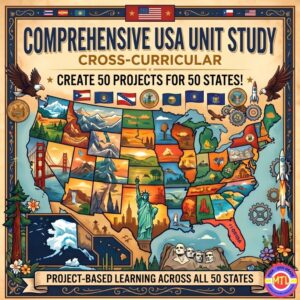
You get 50 projects for $1 each as you take your students on an unforgettable journey from sea to shining sea! 🗽
Are you looking for a way to teach U.S. Geography and History that actually sticks? Tired of dry textbooks and repetitive worksheets? The Comprehensive USA Unit Study is an interactive, cross-curricular, student-centered resource designed to transform your homeschool or classroom into a hub of discovery.
This isn’t just a packet of papers—it’s a complete investigative framework. Whether you are teaching a single second-grader, a multi-age group of middle schoolers or wanting a family style unit, this resource scales to fit your needs. Students will read, research, and report their way through all 50 states, producing 50 unique and beautiful projects along the way!
📝 What’s Inside This Massive Resource?
My Teaching Library has included everything you need to plan, execute, and evaluate a high-quality cross-curricular unit:
1. The Research & Reference Core 📚
-
A Comprehensive 50-State Guide: Detailed facts for every state, including history, capitals, nicknames, mottos, symbols, major industries, and landmarks.
-
Read Across America Literary Journey: Curated book suggestions for every single state to integrate literature into your lessons combining reading and geography!
-
Research Recording Pages: Structured notebooking pages to guide students through the investigative process.
2. Student Notebooking & Reporting ✍️
-
Wide Variety of Report Pages: From the history of the founding and lawmaking processes to local government, tourism, and economy.
-
State Symbol Spotlights: Dedicated pages for state birds, flowers, mammals, insects, rocks/minerals, and more.
-
Compare & Contrast: Use the included Venn diagrams to help students find similarities and differences between different states.
3. Maps, Flags, and Visual Aids 🎨
-
Full-Page Maps: Includes Color and B&W maps of the U.S., regional divisions, and individual state maps (blank, with capitals, and with major cities).
-
Artistic Templates: Full-page B&W images of all 50 state flags, flowers, and birds—perfect for coloring and report covers.
-
Lined State Maps: Unique templates for students to write summaries directly within the state borders, how fun!
4. Teacher Planning & Active Learning 🍎
-
“How-To” Planning Pages: Includes teacher assignment guides, a comprehensive supply list, and an evaluation rubric for easy grading.
-
Organizational Tools: Student cover pages, Table of Contents, and a reusable K-W-L chart.
-
Active Learning Games: Suggested games to keep students engaged and help them memorize state facts through play.
-
State Capital Bookmarks: A fun, functional way for students to use throughout the unit.
✨ Why You’ll Love It:
-
Multi-Age & Multi-Ability: Perfect for families homeschooling multiple children or teachers with diverse learners. Simply choose the reporting depth that fits the student’s level.
-
Cross-Curricular: Seamlessly blends Geography, History, Language Arts, Art, and Civics.
-
Student-Led: Empowers students to take ownership of their research and creativity.
-
Flexible: Use it as a full-year curriculum, a summer enrichment program, or a “State of the Week” supplement.
🚀 Ready to start your cross-country adventure?
Give your students the tools to become experts on the United States. From the rocky coasts of Maine to the tropical shores of Hawaii, the Comprehensive USA Unit Study makes history and geography come alive while seamlessly intertwining language arts, art, and civics!
Add to Cart, Download & Start Exploring & Creating Today! 🛒
-
-
Dinosaurs A-Z | Research, Report, Notebooking, Project Pages | Multi-Grade to Pinterest (opens in a new window)
 $6.75Add to Cart
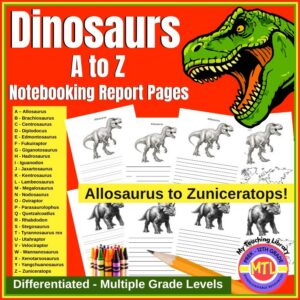
Have students wanting to learn about dinosaurs? Want to incorporate hands-on, project learning into your science lessons that will not only help student learning ‘stick’ but will allow students to walk away with beautiful projects? Get ready to roar with excitement because your problem is solved!
PLEASE NOTE: This resource does not mention the age of the earth or periods of time.
Get My Teaching Library’s “Dinosaurs A-Z | Research, Report, Notebooking, Project Pages | Multi-Grade” and watch students’ love of learning ignite!
Regardless of whether you are teaching 1st grade or 12th, this resource will work because it has been designed with pages for all ages – abilities – grades!
✨ What’s Included:
- – 4 pages for each of these dinosaurs (Multi-level, ability writing/reporting plus map work): A – Allosauru,s B – Brachiosaurus, C – Centrosaurus, D – Diplodocus, E – Edmontosaurus, F – Fukuiraptor, G – Giganotosaurus, H – Hadrosaurus, I – Iguanodon, J – Jaxartosaurus, K – Kentrosaurus, L – Lambeosaurus, M – Megalosaurus, N – Nodosaurus, O – Oviraptor, P – Parasaurolophus, Q – Quetzalcoatlus, R – Rhabdodon, S – Stegosaurus, T – Tyrannosaurus Rex, U – Utahraptor, V – Velociraptor, W – Wannanosaurus, X – Xenotarsosaurus, Y – Yangchuanosaurus ,Z – Zuniceratops
- – 5 extra pages to continue reporting on each dinosaur if needed (both writing and drawing pages).
✅ Perfect For…
- – Dinosaur enthusiasts of all ages who love to dive deep into research and creative reporting.
- – Project-based learning units focused on paleontology.
- – Inspiring hands-on science activities that connect real-world learning.
-
Sloth – Amazon Rainforest Animal Report – Writing – Project Paper to Pinterest (opens in a new window)$2.00Add to Cart
Sloth – Amazon Rainforest Animal Report – Writing – Project Paper
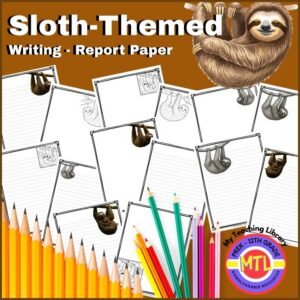
This product includes 21 pages for students to use when writing or creating a project on sloths.Details on the pages in the resource:
– 9 unlined pages with a black-and-white sloth image on each (2 include an image of a mom and her baby)
– 3 unlined pages with a color, photo realistic sloth image on each (2 include an image of a mom and her baby)
– 6 lined pages with a black-and-white sloth image on each (2 include an image of a mom and her baby)
– 3 lined pages with a color, photo realistic sloth image on each (2 include an image of a mom and her baby)You may also like: Amazon Tropical Rainforest Animals – Realistic Images | Color and Write
-
$4.00Add to Cart
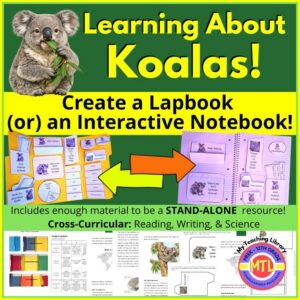
🐨 Planning to study Koalas? Marsupials? Animals of Australia/ If so, your students will love the student-centered, hands-on, cross-curricular project where they’ll learn all about Koalas while creating a lapbook or an interactive notebook!
🐨This can be used as a stand-alone unit that includes all of the informational materials, a map, and templates needed to create a beautiful project. Although this can be used completely as a stand-alone unit, a booklist is given if further research and reading is desired.
🐨Includes:
– Instructions and lapbook/notebooking examples
– Supply list
– Required elements checklist (optional for teacher assigned elements)
– Grading rubric and grading sheet
– Informational text covering:- Taxonomy
- Closest Relatives
- Anatomy
- Where they live (Habitat and Map)
- Diet
- Life Cycle
- Predators
- Fun Facts
- Vocabulary
– 11 pages of templates
– (Bonus) Nature’s Predators of the Koala Coloring Page -
$5.00Add to Cart
Here is a penguin unit study that is a student-centered, hands-on, cross-curricular project where they’ll learn all about 15 types of penguins while creating a lapbook or an interactive notebook!
🐧This can be used as a stand-alone unit that includes all of the informational materials, maps, illustrations and templates needed to create a beautiful project. However, a booklist is given if further research and reading is desired.
🐧Includes:
– Instructions and lapbook/notebooking examples
– Supply list
– Required elements checklist (optional for teacher assigned elements)
– Grading rubric and grading sheet
– Informational text covering: taxonomy, general information about penguins and unusual facts about penguins
– Detail fact sheets about the following species (includes image and location map for each): Adelie penguin, African penguin, Chinstrap penguin, Emperor penguin, Erect Crested penguin, Fiordland penguin, Galapagos penguin, Gentoo penguin, Humboldt penguin, King penguin, Little Blue penguin, Macaroni penguin, Magellanic penguin, Rockhopper penguin, Royal penguin
– Vocabulary
– Book suggestions for additional reading
– Illustration of a penguin’s basic anatomy– Illustration of the penguin life cycle
– 21 pages of templates that can be used to either create a lapbook or use in an interactive notebook -
Whale Unit Study | Life Science Lapbook and Interactive Notebook to Pinterest (opens in a new window)$6.00Add to Cart
Excite students as they learn all about whales and create an interactive project with this life science, hands-on, creative resource. This nonfiction science unit makes learning about baleen whales and toothed whales interesting and will help students develop reading, research, writing and organizational skills.
⭐Designed for 5th, 6th, 7th, and 8th grade students.
⭐Use as a fully stand-alone unit or students can research for additional information through books, videos and website.
⭐ Low-prep, comprehensive unit
⭐ Inspires reading, writing, organization, project research skills
⭐ Can be used to create a lapbook or interactive notebookWhat you get in this Whale unit:
- – How to use details
- – Images of how to create different style/size lapbooks and examples of interactive notebook pages
- – Supply list
- – Student forms: Required elements and grading rubric
- – Project grading form
- – Informational text covering topics such as classification, anatomy, behavior, communication, diet, life cycle, habitat and species-specific information for the following: Bottlenose whale, Cluver’s Beaked whale, Beluga whale, Killer whale, Narwhal, Sperm whale, Blue whale, Bowhead whale, fin whale, humpback whale and the Gray whale
- – Vocabulary
- – Whale surfacing behaviors – Images and descriptions
- – Suggested book titles for further research
- – Clipart
- – Project templates
-
Ministry Licensed – It’s All About the Heart | 16 Week Biblical Study for High School to Pinterest (opens in a new window)$100.00Add to Cart❗This product includes a Ministry / Church License must be purchased (and is not included in All-Access.)
All-Access members may not download for use within a ministry…All-Access members, CLICK HERE to download YOUR version.What is the heart? What does God’s word say about the heart? How important is it that our youth…our teens…understand what the bible teaches us about the heart?The heart is central to our relationship with God. It influences our thoughts, emotions and moral choices. Modern culture tells us to “Follow our heart” and to “Do what feels right” but is that what God’s word teaches us? The Bible uses the term “heart” to describe the core of a personal being. It includes out thoughts, emotions, will and spiritual life.Here is a 16-week bible study that helps teens explore, memorize and apply God’s Word. .
During weeks 1-15, students will take one key verse and study it in-depth and in context. Students will be required to open their bibles, to read, think, memorize, discuss and journal as they work throughout the week. Passages and explanations are provided to guide them along their journey through scripture. Week 16 will pull all that is learned together and give students a clear representation of the gospel.
Verses are provided in 3 versions: KJV, NIV and ESV-
– Day 1: Verse introduction, writing, reading in context (the entire chapter) and journaling.
-
– Day 2: Rereading the chapter, defining difficult or unfamiliar words. Begin memorizing.
-
– Day 3: Read an in-depth explanation with multiple scriptural references for understanding + journaling.
-
– Day 4: Continued memorization work and journaling a plan to implement their learning into daily life.
-
– Day 5: Recording the verse from memory, discussion with a small group leader or adult mentor + journaling
Local Ministry / Church License included.
❗This product with a Ministry / Church License must be purchased and cannot be legally downloaded by All-Access members for use within a ministry. If you are an All-Access member and would like to purchase, email: ad***@***************ry.com or purchase under a different account.
-
-
$1.00Add to Cart
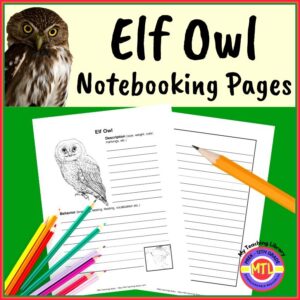
Elf Owl Notebooking pages provides students with two recording pages to report on this small owl that is the size of a sparrow! The first page includes an image to color and lines for students to describe the owl’s appearance and behavior. They will also be able to report on the range where it is found and complete map work. The second page can be duplicated as many times as necessary needed for students to write a report on the bird.
Suggested research link: Elf Owl Overview
Get My Teaching Library’s full Birds of Prey Notebooking Pages Resource!
-
It’s All About the Heart | 16 Week Biblical Study for High School to Pinterest (opens in a new window)$20.00Add to CartWhat is the heart? What does God’s word say about the heart? How important is it that our youth…our teens…understand what the bible teaches us about the heart?The heart is central to our relationship with God. It influences our thoughts, emotions and moral choices. Modern culture tells us to “Follow our heart” and to “Do what feels right” but is that what God’s word teaches us? The Bible uses the term “heart” to describe the core of a personal being. It includes out thoughts, emotions, will and spiritual life.
Here is a 16-week bible study that helps teens explore, memorize and apply God’s Word. .
During weeks 1-15, students will take one key verse and study it in-depth and in context. Students will be required to open their bibles, to read, think, memorize, discuss and journal as they work throughout the week. Passages and explanations are provided to guide them along their journey through scripture. Week 16 will pull all that is learned together and give students a clear representation of the gospel.
Verses are provided in 3 versions: KJV, NIV and ESV-
– Day 1: Verse introduction, writing, reading in context (the entire chapter) and journaling.
-
– Day 2: Rereading the chapter, defining difficult or unfamiliar words. Begin memorizing.
-
– Day 3: Read an in-depth explanation with multiple scriptural references for understanding + journaling.
-
– Day 4: Continued memorization work and journaling a plan to implement their learning into daily life.
-
– Day 5: Recording the verse from memory, discussion with parent or adult mentor + journaling
Want to use in a ministry? Purchase a Ministry License!
-
-
$1.50Add to Cart
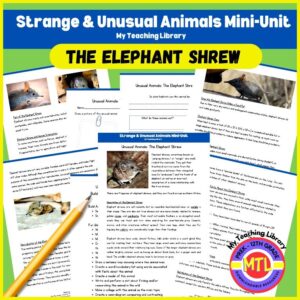
This engaging and cross-curricular mini-unit will teach students all about the elephant shrew! A strange and unusual animal, the elephant shrew is a small rodent-like mammal which gets its name from the resemblance between its elongated nose and the trunk of an elephant.
In this unit, students will read all about this little mammal…
– a description
– interesting facts
– where it lives
– what it eats
– interaction with humans
– if they make good pets
– behavior
– reproductionAfter reading all about the elephant shrew, students will complete a two-page activity in which they will draw the animal, do a little map work, answer questions and write about what they’ve learned.
Next, there are several hands-on ideas to continue building their knowledge and creating projects around this strange and unusual creature.
-
Women in U.S. History – 15 Projects | Research – Writing – Presentation to Pinterest (opens in a new window)$42.00Add to Cart
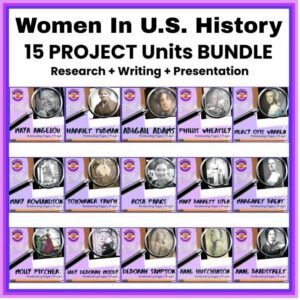
✏️Student-centered units that includes 15 projects surrounding important women in U.S. History. These units will help students learn and practice research skills, report writing, project and presentation skills.
✏️Students will use these 15 project-based units to learn about and create reports and presentations on the following people:
- Anne Hutchinson
- Anne Bradstreet
- Deborah Sampson
- Lady Deborah Moody
- Molly Pitcher
- Mary Barrett Dyer
- Margaret Brent
- Sojourner Truth
- Rosa Park
- Mary Rowlandson
- Mercy Otis Warren
- Phillis Wheatley
- Abigail Adams
- Harriet Tubman
- Maya Angelo
✏️These notebooking projects can be assigned individually or within cooperative groups. Use them within a Language Arts classroom or a Social Studies / U.S. History classroom. Very flexible and cross-curricular!
After completing the written portion of each resource, you can grade it (or) assign students to do an oral and/or audio-visual presentation based on their findings/work.
✏️What is in each unit?
- Student instructions for using biographical notebooking, project pages
- Suggested research questions
- Student notebooking, project pages (includes covers, KWL, reference recording, report writing, and more)
- Teacher pages (instructions, assignment, evaluation)
-
$5.00Add to Cart
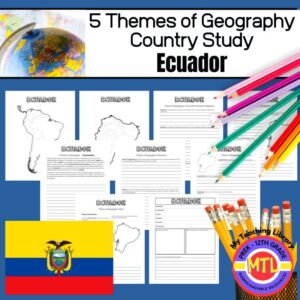
This is a project-based country study on the South American country of Ecuador focusing on the 5 Themes of Geography: location, place, regions, movement and human/environment integration! There are a lot of country studies but this one is different.
This study will ask students to ‘think like a geographer‘in their research and recording.
Using this resource, students will…
- Learn about the country of Ecuador
- Demonstrate knowledge of and ability to synthesize information and write about Ecuador through a 5 themes of geography lens.
- Create a wonderful project displaying their learning.
Sample questions include:
- – (Location) Describe the relative location of the country.
- – (Location) What is the latitude and longitude of the capital city?
- – (Place) What major landforms are found in the country?
- – (Place) What is/are the climate type(s) of the country?
- – (Regions) When considering this country, describe and give examples of at least one type of functional region within it.
- – (Movement) Describe any historically important migration patterns of information you have found about past or current migration for this country. You may include internal, external migration, emigration, immigration, return and/or seasonal migration.
- (Human/Environmental Integration) Give examples of how people who have lived in this country changed or modified the environment.
There are many more questions and this unit is designed to get your students thinking like a geographer!!
Students will need to have a good understanding of the 5 Themes of Geography to complete this project. Need teaching materials for the 5 Themes? Get My Teaching Library’s 5 Themes of Geography Bundle
-
$5.00Add to Cart
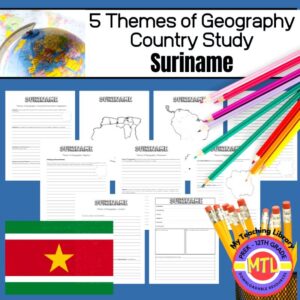
This is a project-based country study on the South American country of Suriname focusing on the 5 Themes of Geography: location, place, regions, movement and human/environment integration! There are a lot of country studies but this one is different.
This study will ask students to ‘think like a geographer‘in their research and recording.
Using this resource, students will…
- Learn about the country of Suriname
- Demonstrate knowledge of and ability to synthesize information and write about Suriname through a 5 themes of geography lens.
- Create a wonderful project displaying their learning.
Sample questions include:
- – (Location) Describe the relative location of the country.
- – (Location) What is the latitude and longitude of the capital city?
- – (Place) What major landforms are found in the country?
- – (Place) What is/are the climate type(s) of the country?
- – (Regions) When considering this country, describe and give examples of at least one type of functional region within it.
- – (Movement) Describe any historically important migration patterns of information you have found about past or current migration for this country. You may include internal, external migration, emigration, immigration, return and/or seasonal migration.
- (Human/Environmental Integration) Give examples of how people who have lived in this country changed or modified the environment.
There are many more questions and this unit is designed to get your students thinking like a geographer!!
Students will need to have a good understanding of the 5 Themes of Geography to complete this project. Need teaching materials for the 5 Themes? Get My Teaching Library’s 5 Themes of Geography Bundle
-
$5.00Add to Cart
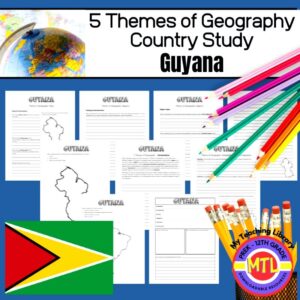
This is a project-based country study on the South American country of Guyana focusing on the 5 Themes of Geography: location, place, regions, movement and human/environment integration! There are a lot of country studies but this one is different.
This study will ask students to ‘think like a geographer‘in their research and recording.
Using this resource, students will…
- Learn about the country of Guyana
- Demonstrate knowledge of and ability to synthesize information and write about Guyana through a 5 themes of geography lens.
- Create a wonderful project displaying their learning.
Sample questions include:
- – (Location) Describe the relative location of the country.
- – (Location) What is the latitude and longitude of the capital city?
- – (Place) What major landforms are found in the country?
- – (Place) What is/are the climate type(s) of the country?
- – (Regions) When considering this country, describe and give examples of at least one type of functional region within it.
- – (Movement) Describe any historically important migration patterns of information you have found about past or current migration for this country. You may include internal, external migration, emigration, immigration, return and/or seasonal migration.
- (Human/Environmental Integration) Give examples of how people who have lived in this country changed or modified the environment.
There are many more questions and this unit is designed to get your students thinking like a geographer!!
Students will need to have a good understanding of the 5 Themes of Geography to complete this project. Need teaching materials for the 5 Themes? Get My Teaching Library’s 5 Themes of Geography Bundle
-
French Guiana Project-Based Country Study | 5 Themes of Geography to Pinterest (opens in a new window)$5.00Add to Cart
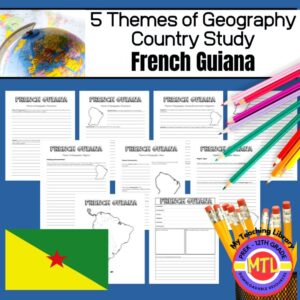
This is a project-based country study on the South American country of French Guiana focusing on the 5 Themes of Geography: location, place, regions, movement and human/environment integration! There are a lot of country studies but this one is different. This study will ask students to ‘think like a geographer‘ in their research and recording.
Using this resource, students will…
- Learn about the country of French Guiana
- Demonstrate knowledge of and ability to synthesize information and write about French Guiana through a 5 themes of geography lens.
- Create a wonderful project displaying their learning.
Sample questions include:
- – (Location) Describe the relative location of the country.
- – (Location) What is the latitude and longitude of the capital city?
- – (Place) What major landforms are found in the country?
- – (Place) What is/are the climate type(s) of the country?
- – (Regions) When considering this country, describe and give examples of at least one type of functional region within it.
- – (Movement) Describe any historically important migration patterns of information you have found about past or current migration for this country. You may include internal, external migration, emigration, immigration, return and/or seasonal migration.
- (Human/Environmental Integration) Give examples of how people who have lived in this country changed or modified the environment.
There are many more questions and this unit is designed to get your students thinking like a geographer!!
Students will need to have a good understanding of the 5 Themes of Geography to complete this project. Need teaching materials for the 5 Themes? Get My Teaching Library’s 5 Themes of Geography Bundle
-
Sale!Original price was: $34.00.$30.00Current price is: $30.00.Add to Cart
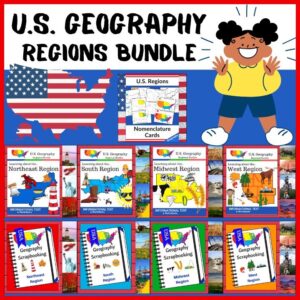
Ready to take your students on the ultimate American road trip? This U.S. Regions Geography Bundle is designed to transform “just another lesson” into an immersive, hands-on exploration of the four major regions: the Northeast, South, Midwest, and West. Gone are the days of staring at static maps! Through nomenclature cards, rich informational texts, and creative scrapbooking projects, your students will dive deep into the unique heartbeat of each region.
🧠 The “How” and “Why” (Educational Benefits)
Geography is more than just memorizing borders; it’s about understanding the relationship between people and their environment. This bundle uses a multisensory approach to ensure every learner stays engaged:
- Active Synthesis: Instead of passive reading, students synthesize information by creating “scrapbook” pages, which helps with long-term retention. ✍️
- Holistic Learning: We cover the “big six” pillars of regional identity: Land & Water, Climate, Products & Resources, Landmarks, Culture, and Food. 🌽🌉
- Vocabulary Mastery: Using Montessori-style nomenclature cards, students build the specific terminology needed to discuss geography like young professionals. 📚
- Creative Ownership: By the end of the unit, students have a beautiful, personalized notebook that they are actually proud to show off! 🎨
🛠️ How to Use This Bundle
This bundle is flexible enough for a month-long deep dive or a year-long rotating center. Here’s a suggested workflow:
- Introduce: Use the Nomenclature Cards to introduce key terms and vocabulary for the region you are studying.
- Explore: Read through the Informational Texts together. Discuss the “flavor” of the region—what do they eat? What does the air feel like? What do they build? 🦞🏜️
- Apply: Distribute the Scrapbooking/Notebooking Pages. Students fill these out using the info texts, acting as “travelers” documenting their findings.
- Review: Use the included Worksheets as a quick check for understanding or a fun end-of-unit quiz.
📦 What’s Included in This $$$ Saving Bundle:
Resource Type Included Regions/Items Foundations US Regions Nomenclature Cards 📇 Northeast Informational Text + Scrapbooking Pages 🗽 South Informational Text + Scrapbooking Pages 🤠 Midwest Informational Text + Scrapbooking Pages 🌾 West Informational Text + Scrapbooking Pages 🏔️ 🚀 Level Up Your Geography Game!
Stop teaching from a dry textbook and start building a classroom of explorers. Grab the Regions of the U.S.A. Bundle today and watch your students fall in love with the diverse landscapes and cultures of the United States! ✨
-
$30.00Add to Cart
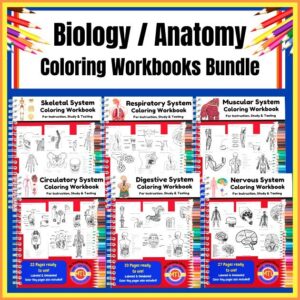
Bundle of all six of My Teaching Library’s Biology / Anatomy Coloring Workbooks. Each workbook is complete and detailed, perfect for instruction, study and even testing high school level Biology and Anatomy students.
Included illustrations (diagrams) all have three types of pages:
a: labeled (great for instruction, use as a handout, poster or answer key)
b. unlabeled with blank color key (student coloring worksheet)
c. unlabeled (student page for study or an assignment, quiz or test having students label each part)Detailed teacher notes are included which give suggestions on the use of each.
-
$5.00Add to Cart
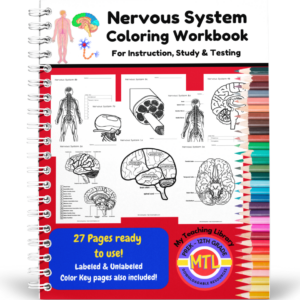
Complete and detailed, this Nervous System Coloring Workbook is perfect for instruction, study and even testing high school level Biology and Anatomy students. There are 9 different illustrations (diagrams) and each have three types of pages:
a: labeled
b. unlabeled with blank color key
c. unlabeled
Detailed teacher notes are included which give suggestions on the use of each. -
$5.00Add to Cart
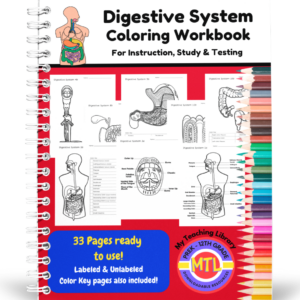
Complete and detailed, this Digestive System Coloring Workbook is perfect for instruction, study and even testing high school level Biology and Anatomy students. There are 11 different illustrations (diagrams) and each have three types of pages:
a: labeled
b. unlabeled with blank color key
c. unlabeled
Detailed teacher notes are included which give suggestions on the use of each.
(Suggested color posters and handouts to use with this resource: Digestive System | Posters and Handouts) -
$5.00Add to Cart
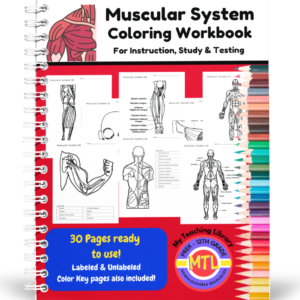
Complete and detailed, this Muscular System Coloring Workbook is perfect for instruction, study and even testing high school level Biology and Anatomy students. There are 10 different illustrations (diagrams) and each have three types of pages:
a: labeled
b. unlabeled with blank color key
c. unlabeled
Detailed teacher notes are included which give suggestions on the use of each.