
Category: Entomology: Insects
Showing all 19 resultsSorted by latest
-
Nonfiction Insect Mini-Book | Easy Reader Printable Science Activity to Pinterest (opens in a new window)
 $3.00Add to Cart
Looking for a print and go, 1st, 2nd, and 3rd grade science activity that makes learning about insects a blast? Get ready to buzz with excitement! Your search is over with this “Nonfiction Insect Mini-Book | Easy Reader Printable Science Activity.” It’s the perfect way to spark curiosity and make nonfiction science accessible and fun for your young learners.
✨ What’s Included:
- – A super fun, printable insect mini-book for students to create!
- – Engaging nonfiction content about where insects live, their body parts, and their impact on our environment.
- – Opportunities for students to color, draw, and write to deepen understanding and creativity.
- – Activities that help distinguish common insects from other creatures.
- – A wonderful way to create a special, keepsake mini-book that celebrates learning.
✅ Perfect For…
- – Introducing insects and their habitats.
- – Engaging emergent readers with nonfiction text.
- – Creating exciting project-based learning experiences.
- – Inspiring young scientists in 1st grade, 2nd grade, and 3rd grade.
This resource is crafted with a passion for making science come alive through real-world connections. My Teaching Library believes in the power of project-based learning and hands-on activities to foster a deep love for science. By allowing students to actively create, explore, and express their learning, this mini-book transforms abstract concepts into tangible, memorable experiences. It empowers students to become active learners and critical thinkers, building confidence as they discover the amazing world of insects!
📚 Learning Objectives
- – Students will be able to identify and describe the basic body parts of an insect.
- – Students will be able to explain where common insects can be found.
- – Students will be able to understand how insects impact our environment.
- – Students will be able to differentiate between common insects and other small creatures.
- – Students will practice reading comprehension and writing skills through nonfiction text.
-
$3.00Add to Cart
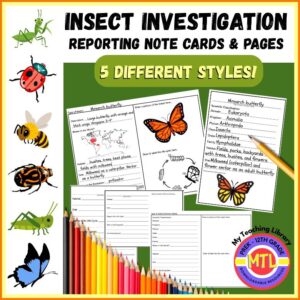
Studying insects? Doing a unit on entomology? Give students a resource to help guide an investigation as well as report what they find!
This product includes 5 different styles of insect investigation note cards and pages making it adaptable for multiple grades/levels. Depending on the information that you want students to gather and report, choose the appropriate style for the assignment. Once given the note card or page, the topics on each will help guide students as to the information they need to find and complete!
Details:
Style 1: (1/2 page note cards – 2 per page) Name of insect, habitat, diet, stages of the life cycle, role in the ecosystem and an interesting fact. Students will also draw a picture of the insect.
Style 2: (1 page) Name of insect, description, where in the world (map given to complete), habitat, diet, role in the ecosystem and an interesting fact. Students will draw a picture of the insect as well as draw and label the life cycle.
Style 3: (1/2 page note cards – 2 per page) Name of insect, scientific classification, habitat and diet. Students will draw a picture of the insect.
Style 4: (1 page) Name of insect, scientific classification, where in the world, habitat, diet, role in the ecosystem. Students will draw a picture of the insect as well as draw and label the life cycle.
Style 5: (1/4 page note cards – 4 per page) Name of insect, habitat, diet, stages of the life cycle, role in the ecosystem and an interesting fact. Students will also draw a picture of the insect. -
$2.50Add to Cart
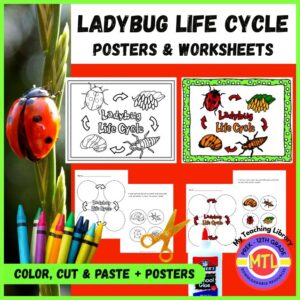
A great resource to display and to get students hands-on putting together their own life cycle of the ladybug!
⭐Benefits of this resource:
- -Low prep – print and use/
- -Children learn about the ladybug life cycle both visually (poster) and in a fun and hands-on way as they color, cut and glue (worksheets).
- -Can be used to introduce the life cycle, or as a review/assessment to check understanding.
- -Encourages fine motor/scissor skills and sequencing.
- -Differentiated can be achieved by deciding if students are allowed to have the poster as a reference when completing their own life cycle.
- -Finished worksheets can be inserted into an interactive notebook.
⭐What else is included?
- -2 Life cycle posters (Color and Black/White) You can always allow students to color the b/w poster and keep.
- -2 student pages (worksheets). Students will color and cut out the 4 stages of the ladybug life cycle from the first page and glue in the correct sequence on the second page.
-
$3.50Add to Cart
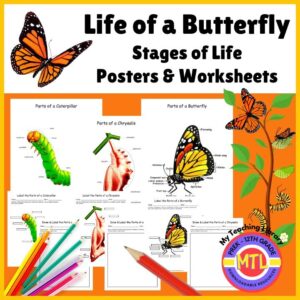
This Science / Biology resource provides colorful posters and worksheets for 3 stages of a butterfly’s life cycle: caterpillar, chrysalis, adult butterfly.
Each stage of life comes with a poster (labels showing the parts) and the following 3 worksheets:
#1: Students will label a picture of the specific stage and are given the names of the parts they are to label
#2: Students will label a picture of the specific stage but are not given the names of the parts (as they should have those memorized)
#3: Students are to both draw and label the specific stage. Parts they are to label of given.What parts are labeled for each stage?
- caterpillar: head, thorax, simple eye, mandible, walking leg, abdominal segment, proleg, anal proleg
- chrysalis: cremaster, abdomen, spiracle, wing, metathorax, mesothorax, antenna, prothorax
- adult butterfly: back leg, middle leg, front leg, spiracles, forewing, antenna, hind wing, veins, compound eye, ocellus, anus, proboscis, labial palpus
BONUS: All pages are also included in B/W format!
-
$1.75Add to Cart
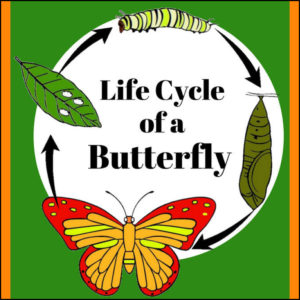
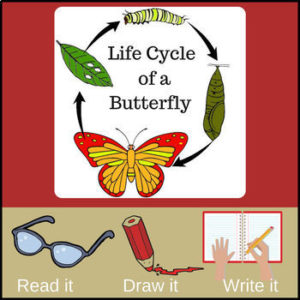
This Science resource will teach students the Life Cycle of a Butterfly and includes:
- * 2 color posters of the life cycle (1 with added details)
- * 1 b/w poster (for students to color),
- * 4 picture/information cards for each stage of the life cycle
- * 3 life cycle worksheets
-
$8.00Add to Cart
Think you know the “common” ant? Think again! With over 10,000 species crawling across the globe, these tiny powerhouses are anything but ordinary.
Ants | Hands-on Insect Science is an interactive, student-centered resource designed to transform science into a buzzing (or should we say crawling?) hub of discovery. Moving beyond simple worksheets, this unit culminates in a stunning 3D project that students can proudly display. Whether you are a homeschool parent looking for an immersive unit study or a teacher wanting to spice up your life science curriculum, this resource is built to engage.
🧠 What’s the Buzz? (The Learning Journey)
This unit dives deep into the complex world of formicaries. Students won’t just look at pictures; they’ll explore the “how” and “why” of ant life, including:
- The Life Cycle: From egg to adult.
- Anatomy: Breaking down the head, thorax, and abdomen.
- Social Structures: Understanding the hierarchy of the colony.
- Communication: How do they “talk” without voices?
- Ecosystem Impact: The good, the bad, and the tiny.
- Predators & Habitats: Who eats them and where do they hide?
📦 What’s Inside:
My Teaching Library has included everything you need to facilitate a deep-dive investigation with zero “ant-xiety”:
Feature Description Informational Text Comprehensive reading on communication, diet, and anatomy. Visual Aids Full-color posters and diagrams of the life cycle and anatomy. Species Flashcards 15 cards featuring different ants with photos and facts. Vocabulary Guide Key scientific terms with student-friendly definitions. 3D Project Templates Step-by-step instructions and templates for the final build. Fun Fact Cards Bite-sized trivia to keep engagement high. 🎨 Flexible
Whether you’re working at a kitchen table or in a 30-student classroom, this project scales to fit your needs:
- Individual Mastery: Let each student create their own 3D masterpiece.
- Cooperative Learning: Teaching multiple children? Assign roles and have students build a “super-colony” together!
Give your students a microscopic view of a massive world. 🌍
🛒 Ready to start the colony?
Add Ants | Hands-on Insect Science to your cart and download today…and watch your students’ curiosity grow!
-
$1.50Add to Cart
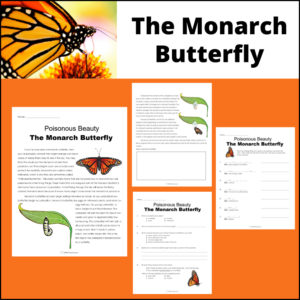
This Science article teaches students facts about the monarch butterfly! This resource includes 2 pages of informational text and 3 student activity pages.
-
$2.00Add to Cart
This Science – Language Arts resource with have students creating their very own mini-book of the life cycle of a butterfly!
Knowledge students will learn: The book will begin with the butterfly laying an egg on a leaf and continue as a caterpillar begins to grow in the egg, hatches and begins to eat. Students will learn what the caterpillar eats and that it is a type of larva. As the book progresses, students will write about the caterpillar building a cocoon and it’s life as a pupa (and a chrysalis) before emerging as a beautiful butterfly!
On each page, students will … read the text, draw a picture and then write (copy) the written text.
-
$2.00Add to Cart
This is a downloadable copy of the book.
About the book: This book was written in 1923 by Leonard Haseman and can be a good tool to use when beginning to study insects. -
$2.50Add to Cart
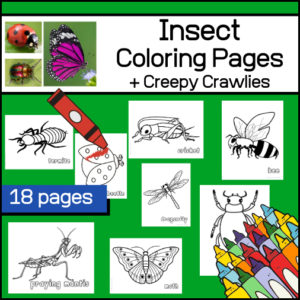
This resource is a print and go resource offering 18 coloring pages of insects plus a couple creepy crawlies! Each page has a large picture to color and the name of the ‘bug’ in font that are also ready to color.
-
$3.00Add to Cart
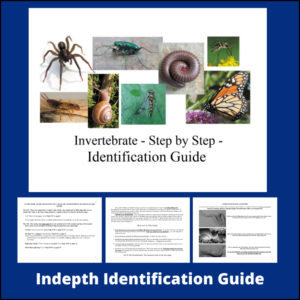
This 21 page resource will take students step by step through a guided identification process for invertebrates. This key is designed for 6th – 12th grades.
-
$3.00Add to Cart
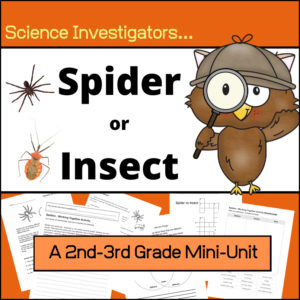
Spiders vs Insects – Science Investigator Mini-Unit has been designed to teach 2nd & 3rd grade students about the differences between these creepy crawlies!
This resource includes 2 levels of informational text (for differentiation) – reading comprehension questions for both, a couple drawing and labeling activities, a Venn diagram (compare and contrast), a crossword puzzle, a cooperative group (or partnership) activity and a short opinion essay question. Answer Keys are provided.
-
 $1.00Add to Cart
This is a small (15 page) old handout to help students learn basics about insects and how to mount them when creating an insect collection.
-
$1.25Add to Cart
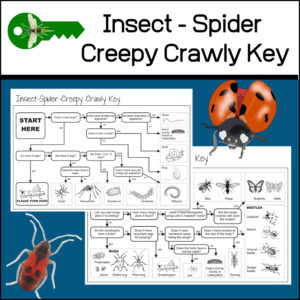
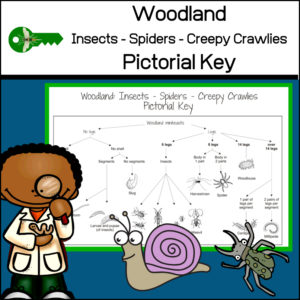
Students love entomology! What is that bug? Some may use the term MINI-BEAST. Is it an insect, a spider, a slug? “I found this bug in the woods, but what is it called?” To help answer student questions like these, here is an easy to use PICTORIAL IDENTIFICATION KEY!
Woodland minibeasts included on this picture guide: snail, worm, larvae (pupae), slug, beetle, earwig, aphid, weevil, harvestman, spider, woodlouse, centipede and millipede (all common creepy crawlies found in the woods)
-
$3.00Add to Cart
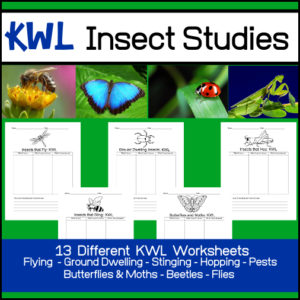
Want student to investigate a variety of different types of insects? This K-W-L resource includes 13 different KWL worksheets so that students (individually or in cooperative groups) can use as they study different bugs and creepy crawlies. Perhaps they want (or you want) the focus to be on insects that hop or ground dwelling insects. What if their study should focus on beetles only or butterflies and moths? Not only will you get worksheets for a variety of specified ‘types’ of insects but I’ve also included some that can be tailor designed to what you or your students choose to study!
-
$4.00Add to Cart
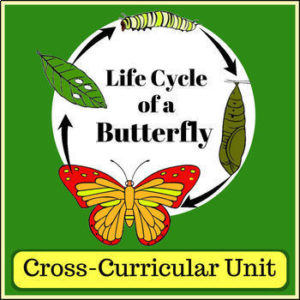
Butterfly Life Cycle Unit is a 49 page cross-curricular unit offering Language Arts, Science, Math and Art activities! By the end of your study, students will know all about the life cycle of the butterfly.
What is included? Puzzles, posters, worksheets (for tracing, matching, coloring, and completing the life cycle), coloring pages, songs, life cycle mini-book (for students to complete) and even a craft project.
-
$3.50Add to Cart
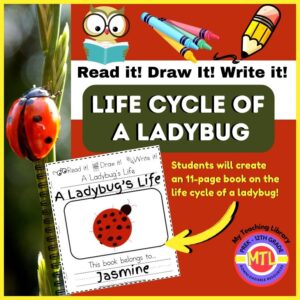
A cross-curricular (Science / Literacy – Writing) product that will have students creating their very own mini-books detailing the life cycle of a ladybug!
Knowledge students will learn:
- -The ladybug is a beetle
- -Mother ladybugs lay tiny yellow eggs in clusters under a leaf
- -When the larva hatches, it eats. What do ladybugs eat? Students will find out!
- -What the ladybug pupa looks like before attaching itself to a leaf
- -The pupa grows, molts and changes…emerging as a ladybug!
Students will:
- -Read the text
- -Draw a picture
- -Write (copy work) the written text.
Benefits of this resource:
- -Low prep – print and give to students
- -Children learn about the ladybug life cycle while reading, drawing and writing
- -Encourages fine motor skills through coloring and writing plus scissor skills as the cut out each page along the dotted lines
- -Encourages reading skills as students read and copy the text
- -Finished book can be a keepsake Science mini-book and added to end-of-the-end portfolio.
What is included? 11 ready-to-use student pages
⭐⭐Use along or with: Ladybug Life Cycle | Posters and Worksheets
-
$2.25Add to Cart
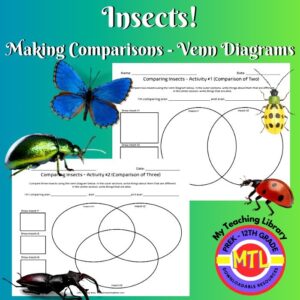
TWO ready to use Venn Diagram Science activities for students to use to compare 2 or 3 insects. On each, students will list the insects they will compare and contrast, draw a picture of each and then complete the Venn Diagram.
Extend the activity by asking students to write a paragraph or short report about their discoveries!