
Category: Language Arts
Showing 1–20 of 217 resultsSorted by latest
-
 $6.00Add to Cart
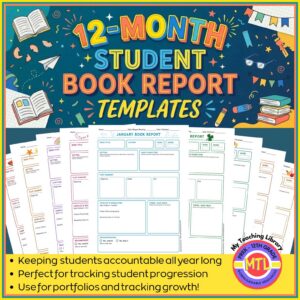
Keep your students engaged and accountable with their reading all year long with the 12-Month Student Book Report Templates. This comprehensive resource provides a structured, easy-to-follow book report template dedicated to each month of the year, from January through December. Each template is organized to help students critically analyze fiction and non-fiction texts while developing their reading comprehension and writing skills. Each monthly page guides students through a complete literary analysis.
What’s Included in Every Template:
- Basic Book Info: Sections to track the Book Title, Author, Pages, Genre, and the dates the student began and finished reading.
- Setting & Characters: Prompts to identify where and when the story takes place (such as real world, history, or fantasy), along with names and short descriptions of important people.
- Plot Summary: Dedicated spaces to break down the Beginning, Middle, and End of the story.
- Conflict & Resolution: Deep-dive sections for the Main Problem/Conflict, the Climax (the turning point), and the Resolution (how it is fixed).
- Theme & Evaluation: A section to identify the big lesson or main idea of the story, followed by a final recommendation where students can check “Yes, read it!” or “No, skip it,” and explain their reasoning.
The Benefits of “Monthly” Book Report Pages: Having a specific page designated for each month (e.g., “SEPTEMBER BOOK REPORT”) creates a highly predictable and comforting routine for young readers. This monthly format acts as an automatic portfolio builder, making it incredibly easy to track a student’s reading progression and comprehension growth across the entire calendar year. It encourages a steady reading habit rather than last-minute cramming, as students know they have exactly one focused milestone to complete each month. By the end of the school year, they will have a physical record of a full year’s literary journey.
Get your 12-Month Student Book Report Templates today!
-
$3.00Add to Cart
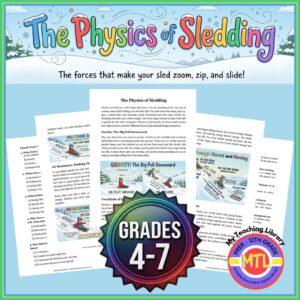
Bring real-world physical science to life this winter with The Physics of Sledding! Designed specifically for upper elementary and middle school learners (grades 4–7), this no-prep informational text makes complex physical science concepts engaging, clear, and easy to master.
Students explore the scientific principles behind sliding down snowy hills, including:
- Gravity and Slope: How Earth’s pull sets sleds into motion.
- Potential and Kinetic Energy: How stored energy at the top of a hill transforms into mechanical speed.
- Friction and Snow: How thin layers of melted water and slick runners reduce resistance.
- Air Resistance and Aerodynamics: How posture, drag, and surface area affect downhill velocity.
What’s Included:
- Complete Informational Science Text: Thorough, student-friendly reading passage explaining the forces and energy behind sledding along with informational graphics.
- Comprehension Assessment: 5 multiple-choice questions targeting key vocabulary and main concepts.
- Critical Thinking Prompts: 2 short-answer questions with ample ruled space for written explanations.
- Answer Key
Perfect for science curriculums, winter STEM units, classroom or co-op physical science, or independent study packets!
-
$3.00Add to Cart
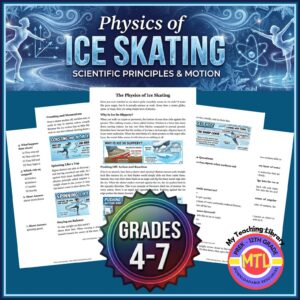
The Physics of Ice Skating is a ready-to-print, no-prep science reading that students will love! This resource breaks down complex physics principles into clear, engaging concepts that upper elementary and middle school learners can easily grasp.
Students explore the core mechanics behind gliding, stopping, and spinning across the rink, including:
- Friction & the Microscopic Water Layer: Why ice skates slide instead of sticking.
- Newton’s Third Law of Motion: How pushing back against the ice propels a skater forward.
- Inertia & Momentum: The forces at work as skaters maintain speed across the rink.
- Angular Momentum & Center of Mass: The physics behind tight, fast figure-skating spins and balanced landings.
What’s Included in This Download:
- Full-Length Reading Passage: Clear, age-appropriate science text.
- Comprehension Assessment: 5 multiple-choice questions testing core concepts and 2 short-answer questions.
- Answer Key
- Versatile Use: Ideal for physical science units, Winter Olympics lessons, co-op classes, rabbit-trail real life hobby learning, close-reading practice, or homeschool STEM
-
$4.00Add to Cart
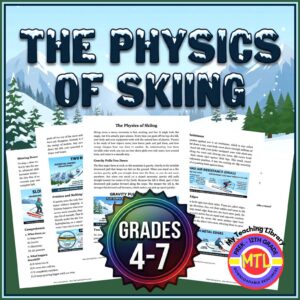
Skiing down a snowy slope looks like magic, but it is pure science in action! The Physics of Skiing is an engaging, high-interest science reading comprehension unit designed to help upper elementary and middle school students explore real-world forces, motion, and energy transformations.
Written at an accessible reading level with clear, full-color diagrams, this resource breaks down foundational physical science concepts into relatable winter sports applications.
Key Science Concepts Covered:
- Gravity and Slope Angles: How Earth’s downward pull converts into forward acceleration along an inclined plane.
- Potential vs. Kinetic Energy: How chairlifts store potential energy and how downhill descents transform it into kinetic energy.
- Friction and Hydroplaning: How friction creates microscopic surface heat, melting a thin water film that lets skis glide.
- Wind Resistance and Aerodynamics: How air drag slows skiers down and why racers use aerodynamic tucks to cut through air molecules.
- Newton’s Third Law of Motion: How sharp metal edges bite into snow to create equal and opposite reaction forces for carving turns.
- Stopping Mechanics: How beginners (snowplow/wedge) and advanced skiers (hockey stop) scrape edges sideways to dramatically increase friction and come to a safe halt.
What’s Included:
- Informational Science Text: Illustrated, easy-to-read passages packed with labeled visual diagrams illustrating each physical force.
- Student Assessment: 5 multiple-choice questions assessing core comprehension plus 2 short-answer prompts requiring students to explain energy conversion and friction.
- Teacher Answer Key: Complete with grading criteria and sample responses for quick, straightforward evaluation.
Suggested Grades: 4th – 7th Grade (Upper Elementary / Middle School)
Perfect For: Physical science units, winter STEM, homeschool lessons, sports science enrichment, co-op classes. Print-and-Go ready!
-
$2.50Add to Cart
Help your students understand the true meaning, history, and significance of Veterans Day with this comprehensive, ready-to-print reading resource. This in-depth passage provides a meaningful way to integrate social studies into your literacy block while honoring those who have served. (Written on a 5th grade reading level)
What’s Included:
- In-Depth Reading Passage: A detailed, age-appropriate text that explores the origins of Veterans Day (Armistice Day), the difference between Veterans Day and Memorial Day, and the importance of honoring military veterans.
- 5 Multiple-Choice Questions: Assess students’ basic comprehension, vocabulary in context, and ability to identify key facts from the text.
- 5 Short Answer Questions: Encourage critical thinking and text evidence analysis. Ample blank space is provided below each question to accommodate 5th-grade handwriting without feeling cramped.
- Teacher Answer Key: A complete answer key is included on its own separate page for quick and easy grading.
-
$3.00Add to Cart
Looking for a Pumpkin Reading Comprehension activity for upper elementary? Look no further than “Let’s Learn About Pumpkins – Level B!” This resource is designed for upper elementary and middle school students and is a perfect cross-curricular (language arts and science) lesson. Text is written on a 6th grade reading level. If your student(s) are not reading at a 6th grade level, you challenge them to try. While they do, have them write down any words they may not know. They can then look those words up and continue reading! Win-Win!
What’s Included:
- In-Depth Nonfiction Text (Pages 1–2): A 545-word informational text spanning two full pages. Topics covered include:
- Botanical Taxonomy & Anatomy: The Cucurbitaceae family, botanical fruit classification (pepo), monoecious flowering (male vs. female blooms and insect pollination), and specialized structural adaptations (thigmotropic climbing tendrils).
- Biochemical Pigmentation: The seasonal degradation of chlorophyll and the emergence of fat-soluble carotenoids (beta-carotene) during ripening.
- Indigenous Agriculture: The history of the “Three Sisters” companion planting method (winter squash, maize, and climbing beans) developed by Native American agriculturalists.
- Nutritional Science: The human biological synthesis of Vitamin A from dietary plant carotenoids.
- 5 Multiple-Choice Questions (Page 3): Targets upper level/middle school reading skills, including interpreting domain-specific scientific vocabulary in context, identifying reciprocal ecological relationships, and analyzing authorial purpose.
- 3 Open-Ended Questions (Page 4): Prompts students to synthesize concepts (e.g., explaining symbiotic companion planting mechanics, describing biochemical ripening transitions).
- Complete Teacher Answer Key (Page 5)
Standards & Skills Covered:
- Reading Informational Text (CCSS.ELA-LITERACY.RI.6.1, RI.6.2, RI.6.4): Citing textual evidence to support inferences, summarizing central scientific concepts, and interpreting domain-specific terminology.
- Next Generation Science Standards (NGSS MS-LS1-4, MS-LS1-5, MS-LS2-2): Specialized plant reproductive structures, factors influencing growth, and mutually beneficial interspecies interactions in agricultural ecosystems.
- Writing (CCSS.ELA-LITERACY.W.6.9): Drawing evidence from informational texts to support analytical short-answer explanations.
Download yours today!
- In-Depth Nonfiction Text (Pages 1–2): A 545-word informational text spanning two full pages. Topics covered include:
-
$2.75Add to Cart
Looking for an effective way to teach the Phases of the Moon to your middle to high school students? Looking for a no-prep, printable resource that makes teaching space science a breeze? The Phases of the Moon Reading Comprehension (informational text) resource is your perfect solution! You’ll love the ability to use this resource as a one-day, quick lesson or how easily it can integrate into your existing curriculum, providing clear explanations and reinforcing key concepts.
✨ What’s Included:
- – Detailed reading passages explaining the phases of the moon: new moon, waxing crescent, first quarter, waxing gibbous, full moon, waning gibbous, last quarter, and waning crescent.
- – Information on the days to complete the cycle and the concepts of synchronous rotation and tidal locking.
- – A comprehensive assessment featuring short answer and multiple-choice quiz questions.
- – An easy-to-use answer key for quick grading.
✅ Perfect For…
- – Introducing or reviewing the Phases of the Moon in middle school science classes.
- – No-prep science lesson
- – Reinforcing reading comprehension skills within a science context.
This resource is built upon the pedagogical approach of making real-world connections to science. By explaining the observable phenomenon of the moon’s changing appearance, students can directly relate the concepts to their everyday experiences.
📚 Learning Objectives
- Students will be able to identify and describe the eight major phases of the moon.
- Students will understand the relationship between the Earth, Moon, and Sun that causes the different moon phases.
- Students will be able to explain the concept of synchronous rotation and tidal locking.
- Students will be able to determine the approximate duration of the lunar cycle.
- Students will improve their reading comprehension skills by extracting key information from scientific text.
-
$42.00Add to Cart
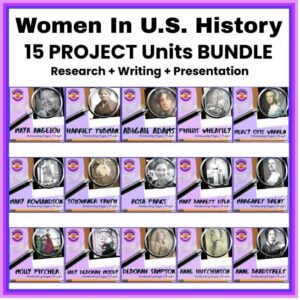
✏️Student-centered units that includes 15 projects surrounding important women in U.S. History. These units will help students learn and practice research skills, report writing, project and presentation skills.
✏️Students will use these 15 project-based units to learn about and create reports and presentations on the following people:
- Anne Hutchinson
- Anne Bradstreet
- Deborah Sampson
- Lady Deborah Moody
- Molly Pitcher
- Mary Barrett Dyer
- Margaret Brent
- Sojourner Truth
- Rosa Park
- Mary Rowlandson
- Mercy Otis Warren
- Phillis Wheatley
- Abigail Adams
- Harriet Tubman
- Maya Angelo
✏️These notebooking projects can be assigned individually or within cooperative groups. Use them within a Language Arts classroom or a Social Studies / U.S. History classroom. Very flexible and cross-curricular!
After completing the written portion of each resource, you can grade it (or) assign students to do an oral and/or audio-visual presentation based on their findings/work.
✏️What is in each unit?
- Student instructions for using biographical notebooking, project pages
- Suggested research questions
- Student notebooking, project pages (includes covers, KWL, reference recording, report writing, and more)
- Teacher pages (instructions, assignment, evaluation)
-
$2.50Add to Cart
Henry Ford was an inventor, innovator, industrialist, and entrepreneur. In this resource, students will read about Ford’s life and business journey.
After reading, students will be asked a series of questions (multiple choice and short answer) to assess comprehension.
Students will learn:
- – About Henry’s family and early life
- – What he did at the age of 16
- – When he went to, left and then returned to Detroit
- – How he was first involved in car manufacturing and when he started Ford Motor Company
- – How is business practices made a huge stir in the country
- – One of his biggest challenges…and more!
Answer Key included!
-
Sale!Original price was: $22.50.$18.00Current price is: $18.00.Add to Cart
Planning for your student(s) to read and study Judy Blume’s Fudge series of books? Here is a fun and engaging BUNDLE that includes unit studies for each of the books!
The 5 Fudge books covered in this bundle:
- Tales of a Fourth Grade Nothing
- Otherwise Known as Sheila the Great
- Superfudge
- Fudge-a-mania
- Double Fudge
Each unit includes:
- – Daily reading journal – Students will be asked to journal new or important words, characters in that day’s reading, a summary of what happened, to make a prediction of what will happen next and additional notes.
- – Vocabulary word wall (49 Words)
- – Vocabulary definitions worksheet
- – Crossword puzzle
- – 2 Analogy worksheets (critical thinking)
- – 2 Different comprehension assessments (can use one or both) – The first assessment is all multiple choice and covers basic story details. – The second assessment is more extensive and includes multiple choice, short and answer questions, an essay question, a character match and even a drawing component!
- – Answer keys
-
$5.75Add to Cart
Bring the beauty, colors, and rhythm of autumn into your writing block! This comprehensive Fall-Themed Haiku Poetry Pack is designed to teach students the traditional art of haiku poetry while sparking their creativity through vibrant, nature-inspired visual prompts. From colorful foliage and forest wildlife to pumpkin patches and harvest tables, this resource gives learners everything they need to brainstorm, draft, and publish their own seasonal masterpieces.
📦 What’s Included in This Resource?
- Haiku Instruction & Anchor Chart Page: A clear, student-friendly reference guide breaking down the origins of Japanese haiku, the traditional focus on nature, the 5-7-5 syllable structure, and mentor poem examples.
- 20 Full-Color Photo Prompts: Breathtaking, autumn-themed photography prompts featuring winding forest boardwalks, mountain foliage, waterfalls, wildlife (owls, deer, wolves, foxes/cats, wild turkeys, squirrels), orchard harvests, trains through autumn trees, and Thanksgiving displays.
- 11 Student Drawing & Writing Template Pages: Formatted drawing pages where students can sketch, illustrate, or paste their own fall observations before writing.
- 26 Additional Themed Publishing Pages:
- 9 Full-Color Pages with Borders and/or Images: Illustrated pages featuring vibrant autumn leaves, seasonal berries, harvest motifs, and arched window frames.
- 17 Black-and-White Color-In Pages: Engaging line art featuring pumpkins, autumn leaves swirling in the wind, scarecrows, acorns, pinecones, cozy hedgehogs, turkeys, bare trees, and Thanksgiving harvest feasts.
✨ Benefits of Using This Resource
- Eliminates Writer’s Block: High-quality visual prompts immediately trigger sensory details, making it easy for reluctant writers to find words and imagery.
- Strengthens Syllabication & Phonological Awareness: Counting out the 5-7-5 syllable pattern builds word awareness, pronunciation skills, and intentional vocabulary selection.
- Multi-Age & Differentiated Friendly: Simple enough for early elementary students learning basic syllable counts, yet rich enough for middle-grade writers refining figurative language and concise imagery.
- Display-Ready Work: The decorative color and color-in publishing sheets double as beautiful bulletin board displays, portfolio additions, or keepsake poetry gifts for families.
- Zero Prep: Just print and teach!
🎯 Common Core Standards Covered
- CCSS.ELA-LITERACY.RF.1.3 / RF.2.3 / RF.3.3: Phonological Awareness & Word Recognition (identifying syllables, breaking words into syllable segments).
- CCSS.ELA-LITERACY.W.1.5 / W.2.5 / W.3.5 / W.4.5: Writing Process (planning, drafting, revising, and focusing on concise word choice).
- CCSS.ELA-LITERACY.RL.2.4 / RL.3.4 / RL.4.4: Craft and Structure (identifying how rhythm, structure, and poetic forms create imagery and meaning).
- CCSS.ELA-LITERACY.L.3.5 / L.4.5 / L.5.5: Vocabulary Acquisition and Use (exploring figurative language, sensory descriptions, and word nuances).
✏️ How to Use in the Classroom or Homeschool
- Introduce & Model: Display the introductory reference sheet. Review the 5-7-5 syllable rule and clap out syllables together using the mentor examples.
- Brainstorm with Visuals: Project one of the 20 photo prompt cards or pass them out to small groups. Have students jot down descriptive adjectives, autumn verbs, and sensory words based on what they see.
- Draft & Count: Students arrange their ideas into three distinct lines, tapping or clapping to verify their syllable counts.
- Publish & Illustrate: Choose from the full-color decorative pages or let students personalize one of the black-and-white coloring pages to frame their finished haiku. Alternatively, use the blank frame sheets for an outdoor nature-walk sketch activity!
🛒 Ready to Inspire Your Young Poets? Add a splash of autumn wonder to your language arts lessons today!
👉 Download your Fall-Themed Haiku Poetry Pack now and watch your students’ seasonal creativity take flight! 🍁📝✨
-
$9.00Add to Cart
This is an in-depth novel study of Louis Sachar’s Holes in which students will delve into literary elements of the book, analyze various topics and themes, write arguments and opinions, conduct research and more! This unit is designed for advanced 6th-8th graders and High School students.
(See description below for more details) -
$3.00Add to Cart
This unit is designed to give students practice reading and answering questions on the given scientific and historic informational provided in the text. The main subject of the text: Spring migration of swallows returning to the historic Mission San Juan Capistrano. After reading, students will be asked to answer multiple choice and short answer questions.
For further expansion of the lesson, there are 6 math word problems and a research, writing assignment.
Readability Grades:
- Flesch-Kincaid Grade Level: 6.1
- Gunning Fog Index: 7.7
-
$10.00Add to Cart
This generic novel study unit can be used with any book and includes multiple ways to engage students and encourage reading comprehension! It is a great tool to study literature as students focus on literary elements like setting, plot, characterization, conflict, resolution and theme in an interactive way!
View a flipbook preview here PLUS see a list of what you’ll get in this product in the description below…
-
$2.00Add to Cart
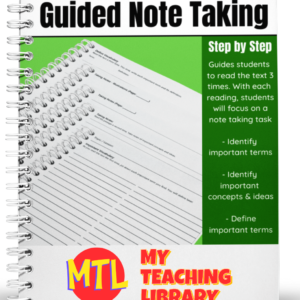
Help students dive into new text and get the most from their reading by using Guided Note Taking.
This resource will walk students through a process of reading the text 3 times.
Each time they read, they will be asked to perform a specific task:
- – The first time they read, students are asked to identify and write down important terms.
- – During the second reading, they are asked to identify important concepts and ideas. For this task, they are given lined paper as well as a page for illustrations.
- – During the third reading, students are asked to define the important terms they identified during their first reading.
This product can be used for any subject and used again and again!
-
$1.50Add to Cart
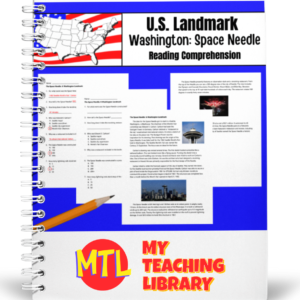
Help students learn about Washington State’s Space Needle in Seattle with this reading comprehension worksheet for 5th-7th grades. This resource includes informational text, a reading comprehension worksheet and answer key.
Flesch-Kincaid grade level: 6.0
Automated Readability Index: 5.8
Fry Readability: 6 -
$5.00Add to Cart
Help students learn over 200 new vocabulary words as they read Jane Austen’s novel Pride and Prejudice. Includes student handouts, puzzles and assessments. This resource breaks up new vocabulary by chapter and is in 5 different sections. Each section contains a student handout of words with definitions, crossword puzzles and section quizzes. At the end, there are two different vocabulary finals (each with 100 questions). Answer keys to all puzzles, quizzes and assessments are included!
This resource is not a complete novel study guide but only focuses on the vocabulary within the book. If you are looking for a complete novel study, go to:
Pride and Prejudice Novel Study
(Please Note: This vocabulary resource is contained within the complete novel study. You do not need this resource if you have the complete novel study.)
Download of the Novel here on My Teaching Library:
Pride and Prejudice (Jane Austen) -
$15.00Add to Cart
Complete novel study for Jane Austen’s Pride and Prejudice (196 pages). Includes:
– Author’s Biography
– Novel Introduction
– Characters and Themes
– Quotes and Analysis
– Teaching Guides dividing the novel into 5 sections w/
* Chapter Summaries, Thought Questions and Vocabulary
* Student Handouts
* Student Worksheets, Assessments & Keys
– Final AssessmentsClick here for a pdf preview instant download!
Download of the Novel here on My Teaching Library:
Pride and Prejudice (Jane Austen) -
$5.00Add to Cart
This is a country study resource on the South American country of Uruguay focusing on the 5 Themes of Geography! There are a lot of country studies but this one is different.
This study will ask students to ‘think like a geographer‘ in their research and recording. Using this resource, students will…
- – Learn about the country of Uruguay
- – Demonstrate knowledge of and ability to synthesize information and write about Uruguay through a 5 themes of geography lens.
- – Create a wonderful project displaying their learning.
Sample questions include:
- – (Location) Describe the relative location of the country.
- – (Location) What is the latitude and longitude of the capital city?
- – (Place) What major landforms are found in the country?
- – (Place) What is/are the climate type(s) of the country?
- – (Regions) When considering this country, describe and give examples of at least one type of functional region within it.
- – (Movement) Describe any historically important migration patterns of information you have found about past or current migration for this country. You may include internal, external migration, emigration, immigration, return and/or seasonal migration.
- – (Human/Environmental Integration) Give examples of how people who have lived in this country chanted or modified the environment.
There are many more questions and this unit is designed to get your students thinking like a geographer!!
-
$1.00Add to Cart
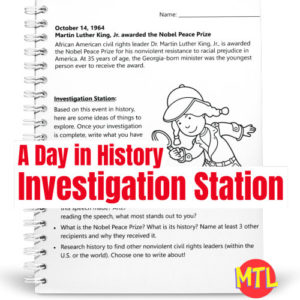
A Day in History – Investigation Station is a series of fun sleuthing research and writing activities based on a single event on a specific day in history! This resource focuses on the day that Martin Luther King, Jr. received the Nobel Peace Prize (October 14, 1964).
Students will learn about an event and be given several topics from which to choose to ‘investigate’. After some exploration, students are asked to write what they have discovered and name used sources.
So…with each lesson, students will:
▪ (Read) Learn one ‘On this Day in History’ fact.
▪ (Investigate) Take a related topic and explore it through the use of different forms of media (i.e. books, internet).
▪ (Write) Summarize and write what they have discovered. This also should include the recording of sources.