
Category: 9th-12th
Showing 1–20 of 421 resultsSorted by latest
-
 $6.75Add to Cart
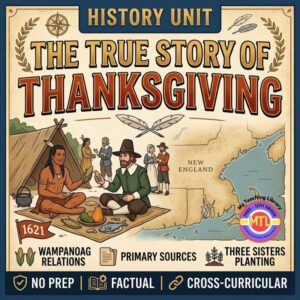
Move beyond the elementary myths and engage your middle and high school students with a strictly factual exploration of the 1621 Plymouth feast and how it evolved into what we celebrate today.
Written on a 9th-grade reading level, this comprehensive, no-prep unit challenges the popular narrative of the “First Thanksgiving” by diving into primary sources, demographic shifts, and the complex diplomatic alliance between the English Separatists and the Wampanoag people.
Whether you are teaching in a traditional classroom or facilitating a flexible, child-centered learning journey at home, this unit provides an objective, neutral, and highly detailed historical account.
📖 What is Covered?
This unit is broken down into 6 detailed reading sections, perfectly chunked for deep learning and retention:
- Origins of Thanksgiving Celebrations: Indigenous agricultural traditions (The Three Sisters) and early European harvest festivals.
- The 1621 Plymouth Feast: The factual timeline of the three-day diplomatic gathering, native crop yields, and historical menus.
- The Wampanoag & The English: The devastating impact of the “Great Dying” (1616-1619) and the strategic 1621 mutual defense treaty.
- The Evolution of the Holiday: How regional colonial prayer days evolved into a national holiday under George Washington and Abraham Lincoln.
- Broader Historical Context: Economic shifts, land demands, and the eruption of King Philip’s War (1675).
- Historical Source Analysis: Understanding the events of 1621 through the primary accounts of William Bradford and Edward Winslow.
📝 Types of Activities Included:
- Detailed Reading Passages: 6 highly focused, neutral, and fact-based sections.
- Short Answer Comprehension: 5 dedicated short-answer questions immediately following every single section to check for understanding.
- Timeline: Key events spanning from the 1500s to 1863.
- Comprehensive End-of-Unit Assessment: Includes Multiple Choice, True/False, and Short Answer questions.
- Essay Prompts: 3 distinct analytical essay choices.
- Enrichment Activities: 3 extended learning options (Primary Source Transcription, Agricultural Modeling, and Demographic Graphing).
- Complete Answer Key: A full teacher key for all section questions, assessments, and grading rubrics for essay questions.
💡 How to Use This Resource:
- Independent Study: Perfect for homeschoolers who thrive on independent, self-paced reading and research.
- Whole-Class Instruction: Read sections together and use the essay prompts for vibrant classroom debates and discussions.
- Station Work: Break the 6 sections into different classroom or co-op stations for collaborative group learning.
⭐ Benefits of Use:
- Zero Prep: Simply print and hand out. The student sections include no background shading or boxes means it is incredibly printer-friendly! Primary resource documents will have minimal shading to highlight specific sections.
- Strictly Factual & Objective: Relies entirely on historical data, crop yields, and primary source timelines without leaning into modern political or cultural opinions.
- Encourages Critical Thinking: Pushes older students to analyze how history is recorded, adapted, and remembered.
- Highly Flexible: Easily adaptable to fit a strict daily classroom schedule or a customized homeschooling pace.
📚 Core Standards Covered:
This unit aligns seamlessly with High School Common Core State Standards for Literacy in History/Social Studies:
- CCSS.ELA-LITERACY.RH.9-10.1: Cite specific textual evidence to support analysis of primary and secondary sources, attending to such features as the date and origin of the information.
- CCSS.ELA-LITERACY.RH.9-10.2: Determine the central ideas or information of a primary or secondary source; provide an accurate summary of how key events or ideas develop over the course of the text.
- CCSS.ELA-LITERACY.RH.9-10.9: Compare and contrast treatments of the same topic in several primary and secondary sources.
🛒 Ready to bring rigorous, factual history into your lesson plans? Buy now!
-
Deep Roots of Revolution | A Project Based Study of 5 Major Events to Pinterest (opens in a new window)$9.75Add to Cart
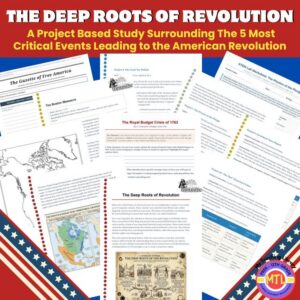
Bring American history to life with this comprehensive, ready-to-print, project-based learning (PBL) unit! Designed like a premium textbook but written at an accessible level, this curriculum guide details the volatile relationship between Great Britain and the 13 Colonies.
Instead of memorizing dry facts, students transform into historical detectives, royal treasurers, investigative journalists, and creative authors as they unpack the escalating tensions that sparked a new nation. 📥 With student text, adaptive project sheets, data matrices, and fully integrated evaluation rubrics, you will have everything you need to guide your students through history!
🎯 Target Grade Levels
This curriculum is carefully scaled to accommodate cross-curricular needs across two distinct educational tiers:
- Intermediate Elementary (Grades 4–5): Tailored reading comprehension levels (5th-grade readability indices) matching foundational geography, art expression, basic chronological math, and descriptive historical fiction.
- Middle School / Early High School (Grades 6–9): Advanced analytical prompts covering media literacy, economic systems, civil debate, and complex narrative prose.
⭐ Key Benefits of Using This Unit
- 🔍 Informational Text Included: The text gives complete factual coverage for all five major events—detailing exact calendar dates, geographic hot spots, and specific historical actors (e.g., Crispus Attucks, Captain John Parker, Chief Pontiac, Samuel Adams).
- 🏡 Flexible for Homeschool or Classroom: Every project comes with a dedicated Adaptability Note providing clear deployment strategies for either single-student kitchen-table instruction or interactive peer-to-peer classroom groups.
- 🎨 True Cross-Curricular Learning: Seamlessly blends History with STEM (buoyancy physics), Mathematics, Economics, Fine Arts, Journalism, and Creative Writing.
- 📐 Stress-Free Grading: Every project assignment includes its own comprehensive 3-tier matrix rubric embedded on its own page!
🛠️ Suggestions on How to Use
- The Master Guide: Distribute or read the cohesive historical text tracking the 5 crucial events:
- Event 1: The French and Indian War (1754–1763)
- Event 2: The Stamp Act (1765)
- Event 3: The Boston Massacre (1770)
- Event 4: The Boston Tea Party (1773)
- Event 5: The Battles of Lexington and Concord (1775)
- The Imperial Budget Challenge: Use the Royal Budget Crisis of 1763 Worksheet after studying the French and Indian War. Have students compute the British deficit and draft a 3-step legislative tax plan to balance the empire’s ledgers.
- The Media Literacy Lab: Print the Propaganda Analysis Sheet alongside the full-page colored copy of Paul Revere’s original engraving. Have students examine the image to find the deliberate inaccuracies used to influence public opinion.
- The STEM Lab Experiment: Set up a water basin and gather craft sticks, foil, and clay to execute the Physics of the Plunge Lab Worksheet. This activity guides students through displacement physics to discover why the patriots had to smash open the tea chests with axes.
- The Journalism Workshop: Use the 3 Newspaper Layout Examples to let students act as colonial reporters detailing the breaking escalation at Lexington Green or Griffin’s Wharf.
🔥 Don’t spend hours piecing together separate worksheets, primary sources, and rubrics. Bring deep historical immersion and high-engagement project learning straight to lessons today.
👉 Get yours today!
-
How to Draw Flowers | 20 Directed Drawings – Nature Study, Spring, Botany, & Art to Pinterest (opens in a new window)$3.75Add to Cart
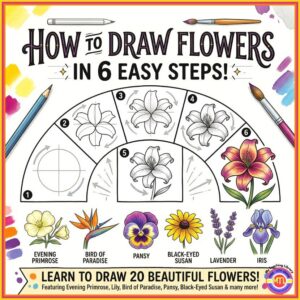
Unlock student creativity with this comprehensive How to Draw Flowers directed drawing bundle! This resource features 20 different flowers, each broken down into 6 easy-to-follow steps.
Perfect for art lessons, biology units, Mother’s Day cards, or time fillers, these worksheets help students build confidence in their fine motor skills and artistic abilities. Directed drawing is a fantastic way to engage students of all ages by providing a structured path to success. Whether you are teaching a unit on botany, plant life cycles, or spring themes, these drawing guides are a must-have addition to your lesson plan toolkit.
What’s Included?
This pack includes step-by-step drawing instructions for a diverse variety of 20 popular flowers:
- Spring Favorites: Tulip, Daffodil, Easter Lily, Crocus, Lily of the Valley.
- Garden Classics: Rose, Daisy, Sunflower, Poppy, Pansy, Petunia.
- Wildflowers & Unique Blooms: Evening Primrose, Black-Eyed Susan, Iris, Violet, Aster, Orchid, Morning Glory, Bird of Paradise, and Water Lily.
Why Use Directed Drawing in Your Classroom?
- Builds Confidence: Students see complex shapes broken down into simple lines.
- Improves Focus: Encourages students to follow multi-step directions.
- Versatile: Great for science journals, art projects, or calming “morning work.”
- No Prep: Just print and go!
-
$2.75Add to Cart
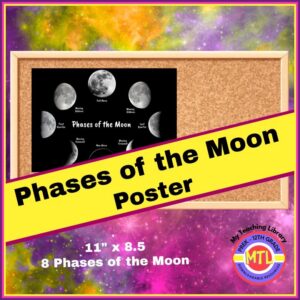
Teaching Earth and Space Science? Looking for a way to visually teach students the different phases of the moon? This “Phases of the Moon: Printable Poster” is for you!
✨ What’s Included:
- – A 1 page black and white, informative poster illustrating the eight phases of the moon.
- – Clear visual representations of the following phases: new moon, waxing crescent, first quarter, waxing gibbous, full moon, waning gibbous, last quarter, and waning crescent.
- – Perfect for a bulletin board display
✅ Perfect ror inspiring curiosity about Earth and space science.
-
$2.75Add to Cart
Looking for an effective way to teach the Phases of the Moon to your middle to high school students? Looking for a no-prep, printable resource that makes teaching space science a breeze? The Phases of the Moon Reading Comprehension (informational text) resource is your perfect solution! You’ll love the ability to use this resource as a one-day, quick lesson or how easily it can integrate into your existing curriculum, providing clear explanations and reinforcing key concepts.
✨ What’s Included:
- – Detailed reading passages explaining the phases of the moon: new moon, waxing crescent, first quarter, waxing gibbous, full moon, waning gibbous, last quarter, and waning crescent.
- – Information on the days to complete the cycle and the concepts of synchronous rotation and tidal locking.
- – A comprehensive assessment featuring short answer and multiple-choice quiz questions.
- – An easy-to-use answer key for quick grading.
✅ Perfect For…
- – Introducing or reviewing the Phases of the Moon in middle school science classes.
- – No-prep science lesson
- – Reinforcing reading comprehension skills within a science context.
This resource is built upon the pedagogical approach of making real-world connections to science. By explaining the observable phenomenon of the moon’s changing appearance, students can directly relate the concepts to their everyday experiences.
📚 Learning Objectives
- Students will be able to identify and describe the eight major phases of the moon.
- Students will understand the relationship between the Earth, Moon, and Sun that causes the different moon phases.
- Students will be able to explain the concept of synchronous rotation and tidal locking.
- Students will be able to determine the approximate duration of the lunar cycle.
- Students will improve their reading comprehension skills by extracting key information from scientific text.
-
$2.75Add to Cart
Students will love to learn how to draw, step by step these woodland animals: 2 rabbits, cardinal, pileated woodpecker, fox, mouse, badger, hedgehog, wolf, raccoon and skunk.
Each page will illustrate how to draw one animal, starting with a single line and continue by adding additional lines and details as the drawing progresses. By the end, students will have drawn a woodland animal!
-
$35.00Add to Cart
Easy Economics – This student text and teacher’s guide is an easy to understand and follow curriculum and can be used for both middle and high school students.
Students will gain a working knowledge of the world of economics, economic systems, supply and demand, institutions, government revenue and (finally) will examine the American economy. (Student text: 233 pages)
The teacher’s guide will follow along with the student text giving guidance on the focus of each unit, suggestions for enrichment and includes unit assessments and answer keys. (Teacher’s: 127 pages)
-
Constellations | Astronomy – Space Science | Northern Hemisphere BUNDLE to Pinterest (opens in a new window)$11.00Add to Cart
Study the ⭐STARS ⭐with this constellation bundle! Includes a complete unit with informational text, visuals, flashcards and assessment quizzes. See description below for full details!
-
Ministry Licensed – It’s All About the Heart | 16 Week Biblical Study for High School to Pinterest (opens in a new window)$100.00Add to Cart❗This product includes a Ministry / Church License must be purchased (and is not included in All-Access.)
All-Access members may not download for use within a ministry…All-Access members, CLICK HERE to download YOUR version.What is the heart? What does God’s word say about the heart? How important is it that our youth…our teens…understand what the bible teaches us about the heart?The heart is central to our relationship with God. It influences our thoughts, emotions and moral choices. Modern culture tells us to “Follow our heart” and to “Do what feels right” but is that what God’s word teaches us? The Bible uses the term “heart” to describe the core of a personal being. It includes out thoughts, emotions, will and spiritual life.Here is a 16-week bible study that helps teens explore, memorize and apply God’s Word. .
During weeks 1-15, students will take one key verse and study it in-depth and in context. Students will be required to open their bibles, to read, think, memorize, discuss and journal as they work throughout the week. Passages and explanations are provided to guide them along their journey through scripture. Week 16 will pull all that is learned together and give students a clear representation of the gospel.
Verses are provided in 3 versions: KJV, NIV and ESV-
– Day 1: Verse introduction, writing, reading in context (the entire chapter) and journaling.
-
– Day 2: Rereading the chapter, defining difficult or unfamiliar words. Begin memorizing.
-
– Day 3: Read an in-depth explanation with multiple scriptural references for understanding + journaling.
-
– Day 4: Continued memorization work and journaling a plan to implement their learning into daily life.
-
– Day 5: Recording the verse from memory, discussion with a small group leader or adult mentor + journaling
Local Ministry / Church License included.
❗This product with a Ministry / Church License must be purchased and cannot be legally downloaded by All-Access members for use within a ministry. If you are an All-Access member and would like to purchase, email: ad***@***************ry.com or purchase under a different account.
-
-
It’s All About the Heart | 16 Week Biblical Study for High School to Pinterest (opens in a new window)$20.00Add to CartWhat is the heart? What does God’s word say about the heart? How important is it that our youth…our teens…understand what the bible teaches us about the heart?The heart is central to our relationship with God. It influences our thoughts, emotions and moral choices. Modern culture tells us to “Follow our heart” and to “Do what feels right” but is that what God’s word teaches us? The Bible uses the term “heart” to describe the core of a personal being. It includes out thoughts, emotions, will and spiritual life.
Here is a 16-week bible study that helps teens explore, memorize and apply God’s Word. .
During weeks 1-15, students will take one key verse and study it in-depth and in context. Students will be required to open their bibles, to read, think, memorize, discuss and journal as they work throughout the week. Passages and explanations are provided to guide them along their journey through scripture. Week 16 will pull all that is learned together and give students a clear representation of the gospel.
Verses are provided in 3 versions: KJV, NIV and ESV-
– Day 1: Verse introduction, writing, reading in context (the entire chapter) and journaling.
-
– Day 2: Rereading the chapter, defining difficult or unfamiliar words. Begin memorizing.
-
– Day 3: Read an in-depth explanation with multiple scriptural references for understanding + journaling.
-
– Day 4: Continued memorization work and journaling a plan to implement their learning into daily life.
-
– Day 5: Recording the verse from memory, discussion with parent or adult mentor + journaling
Want to use in a ministry? Purchase a Ministry License!
-
-
$3.00Add to Cart
Ready to study Ancient Greece? This unit emphasizes the history and contributions of the ancient Greeks and how the Greeks have influenced modern culture.
Unit Focus:
– Characteristics of Greek culture
– Achievements of Alexander the Great
– Characteristics of Athens and Sparta
– Contributions of ancient Greek civilizationIncludes:
– Student text: Easy to read and understand. Includes vocabulary, maps, illustrations, student text and practice (both vocabulary and comprehension) questions.
– Teacher’s guide: Active, hands-on suggestions for enrichment including research ideas, game and art ideas, group activities, map work and more.
– Answer KeysWant a full-year of World History? Click here!
-
$30.00Add to Cart
This BUNDLE includes both the student textbook and teacher’s guide for World History 1.
It includes 21 units from Ancient Egypt to the rise of nationalism in the 1800’s.See unit details below in description.
-
Sale!Original price was: $20.00.$15.00Current price is: $15.00.Add to Cart
Studying mammals? Want students to research and create reports on these amazing animals? This is the BUNDLE for you!
It includes EIGHT products (Flying, Arboreal, Fossorial, Saltatorial, Natatorial, Arboreal, Fossorial, and Saltatorial Mammals) and each are designed to guide students through the process of researching and reporting what they have found.
Students will be given specific questions to research plus they will be asked to give the full classification of their selected species, to draw a picture of it and to indicate on a world map where it resides, within each of the individual products.
If you choose, you may also assign them to research and report multiple animals for each product by simply having them complete the pages for each animal.
-
$3.50Add to Cart
Art…Students love it but when it comes to drawing, most need a drawing guide to help. This resource will guide students in their drawing of many favorite parts about fall! Perfect for children and adults of all ages.
In this guide, you will find over 60 different fall images divided into categories:
– In the Kitchen
– Home Decor
– Autumn Foliage
– Layering Up for Cooler Weather
– October Themes
– On the FarmIn addition to the drawing guide, you will also find a template for students to draw their favorite part about autumn and also write about it. The perfect ELA cross curricular connection! (See description below for a detailed list images included in this drawing guide.)
-
$15.00Add to Cart
Having a math notebook to refer to while working independently will boost confidence and productivity. Designed for Middle and High School students.
Includes sections for:
– Number Sense
– Algebraic Reasoning
– Data Analysis & Probability
– Geometry
– Ratios, Proportions and Scale(Please refer to description below for a complete listing of notes.)
-
Women in U.S. History – 15 Projects | Research – Writing – Presentation to Pinterest (opens in a new window)$42.00Add to Cart
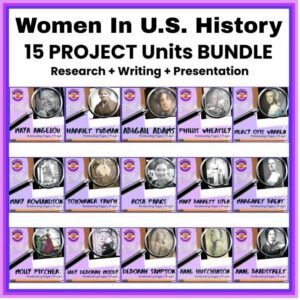
✏️Student-centered units that includes 15 projects surrounding important women in U.S. History. These units will help students learn and practice research skills, report writing, project and presentation skills.
✏️Students will use these 15 project-based units to learn about and create reports and presentations on the following people:
- Anne Hutchinson
- Anne Bradstreet
- Deborah Sampson
- Lady Deborah Moody
- Molly Pitcher
- Mary Barrett Dyer
- Margaret Brent
- Sojourner Truth
- Rosa Park
- Mary Rowlandson
- Mercy Otis Warren
- Phillis Wheatley
- Abigail Adams
- Harriet Tubman
- Maya Angelo
✏️These notebooking projects can be assigned individually or within cooperative groups. Use them within a Language Arts classroom or a Social Studies / U.S. History classroom. Very flexible and cross-curricular!
After completing the written portion of each resource, you can grade it (or) assign students to do an oral and/or audio-visual presentation based on their findings/work.
✏️What is in each unit?
- Student instructions for using biographical notebooking, project pages
- Suggested research questions
- Student notebooking, project pages (includes covers, KWL, reference recording, report writing, and more)
- Teacher pages (instructions, assignment, evaluation)
-
$5.00Add to Cart
This is a project-based country study on the South American country of Ecuador focusing on the 5 Themes of Geography: location, place, regions, movement and human/environment integration! There are a lot of country studies but this one is different.
This study will ask students to ‘think like a geographer‘in their research and recording.
Using this resource, students will…
- Learn about the country of Ecuador
- Demonstrate knowledge of and ability to synthesize information and write about Ecuador through a 5 themes of geography lens.
- Create a wonderful project displaying their learning.
Sample questions include:
- – (Location) Describe the relative location of the country.
- – (Location) What is the latitude and longitude of the capital city?
- – (Place) What major landforms are found in the country?
- – (Place) What is/are the climate type(s) of the country?
- – (Regions) When considering this country, describe and give examples of at least one type of functional region within it.
- – (Movement) Describe any historically important migration patterns of information you have found about past or current migration for this country. You may include internal, external migration, emigration, immigration, return and/or seasonal migration.
- (Human/Environmental Integration) Give examples of how people who have lived in this country changed or modified the environment.
There are many more questions and this unit is designed to get your students thinking like a geographer!!
Students will need to have a good understanding of the 5 Themes of Geography to complete this project. Need teaching materials for the 5 Themes? Get My Teaching Library’s 5 Themes of Geography Bundle
-
$5.00Add to Cart
This is a project-based country study on the South American country of Suriname focusing on the 5 Themes of Geography: location, place, regions, movement and human/environment integration! There are a lot of country studies but this one is different.
This study will ask students to ‘think like a geographer‘in their research and recording.
Using this resource, students will…
- Learn about the country of Suriname
- Demonstrate knowledge of and ability to synthesize information and write about Suriname through a 5 themes of geography lens.
- Create a wonderful project displaying their learning.
Sample questions include:
- – (Location) Describe the relative location of the country.
- – (Location) What is the latitude and longitude of the capital city?
- – (Place) What major landforms are found in the country?
- – (Place) What is/are the climate type(s) of the country?
- – (Regions) When considering this country, describe and give examples of at least one type of functional region within it.
- – (Movement) Describe any historically important migration patterns of information you have found about past or current migration for this country. You may include internal, external migration, emigration, immigration, return and/or seasonal migration.
- (Human/Environmental Integration) Give examples of how people who have lived in this country changed or modified the environment.
There are many more questions and this unit is designed to get your students thinking like a geographer!!
Students will need to have a good understanding of the 5 Themes of Geography to complete this project. Need teaching materials for the 5 Themes? Get My Teaching Library’s 5 Themes of Geography Bundle
-
$5.00Add to Cart
This is a project-based country study on the South American country of Guyana focusing on the 5 Themes of Geography: location, place, regions, movement and human/environment integration! There are a lot of country studies but this one is different.
This study will ask students to ‘think like a geographer‘in their research and recording.
Using this resource, students will…
- Learn about the country of Guyana
- Demonstrate knowledge of and ability to synthesize information and write about Guyana through a 5 themes of geography lens.
- Create a wonderful project displaying their learning.
Sample questions include:
- – (Location) Describe the relative location of the country.
- – (Location) What is the latitude and longitude of the capital city?
- – (Place) What major landforms are found in the country?
- – (Place) What is/are the climate type(s) of the country?
- – (Regions) When considering this country, describe and give examples of at least one type of functional region within it.
- – (Movement) Describe any historically important migration patterns of information you have found about past or current migration for this country. You may include internal, external migration, emigration, immigration, return and/or seasonal migration.
- (Human/Environmental Integration) Give examples of how people who have lived in this country changed or modified the environment.
There are many more questions and this unit is designed to get your students thinking like a geographer!!
Students will need to have a good understanding of the 5 Themes of Geography to complete this project. Need teaching materials for the 5 Themes? Get My Teaching Library’s 5 Themes of Geography Bundle
-
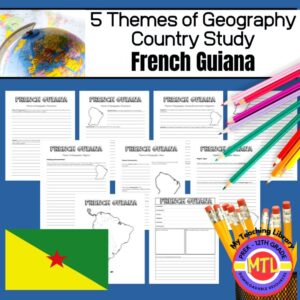
French Guiana Project-Based Country Study | 5 Themes of Geography to Pinterest (opens in a new window)$5.00Add to Cart
This is a project-based country study on the South American country of French Guiana focusing on the 5 Themes of Geography: location, place, regions, movement and human/environment integration! There are a lot of country studies but this one is different. This study will ask students to ‘think like a geographer‘ in their research and recording.
Using this resource, students will…
- Learn about the country of French Guiana
- Demonstrate knowledge of and ability to synthesize information and write about French Guiana through a 5 themes of geography lens.
- Create a wonderful project displaying their learning.
Sample questions include:
- – (Location) Describe the relative location of the country.
- – (Location) What is the latitude and longitude of the capital city?
- – (Place) What major landforms are found in the country?
- – (Place) What is/are the climate type(s) of the country?
- – (Regions) When considering this country, describe and give examples of at least one type of functional region within it.
- – (Movement) Describe any historically important migration patterns of information you have found about past or current migration for this country. You may include internal, external migration, emigration, immigration, return and/or seasonal migration.
- (Human/Environmental Integration) Give examples of how people who have lived in this country changed or modified the environment.
There are many more questions and this unit is designed to get your students thinking like a geographer!!
Students will need to have a good understanding of the 5 Themes of Geography to complete this project. Need teaching materials for the 5 Themes? Get My Teaching Library’s 5 Themes of Geography Bundle