
Category: Astronomy
Showing all 4 resultsSorted by latest
-
Stars and Constellations Unit Study | Early Elementary Science, History & Art to Pinterest (opens in a new window)
 $7.50Add to Cart
Bring astronomy to life with a comprehensive, no-prep Stars and Constellations Unit Study designed specifically for early elementary students (1st–3rd grade / 2nd-grade reading level)!
Whether you are a classroom teacher, co-op leader, or homeschool parent, this cross-curricular astronomy unit seamlessly integrates Science, Geography, History, Social Studies, Language Arts, Math, and Art into one engaging learning bundle.
🔬 What Is Included in This Resource?
This downloadable PDF unit features 10 complete lesson sections, a dedicated early elementary booklist, and a full answer key:
- What is a Star? (Science & Vocabulary)
- Life Cycle of a Star (Science & History)
- The Sun (Science & Social Studies)
- What is a Constellation? (Geography & History)
- Polaris / The North Star (Geography & Navigation)
- Cassiopeia (History & Art)
- Orion the Hunter (Science)
- Draco the Dragon (History & Geography)
- Ursa Major / The Great Bear (Science & World Cultures)
- The Big Dipper (Science & American History)
- Recommended Early Reader Booklist
- Complete Answer Key
🌟 Every Single Lesson Topic Features:
- Age-Appropriate Informational Text: Easy-to-read passages crafted for a 2nd-grade reading level with clear vocabulary.
- (Oral) Discussion Question: Thought-provoking verbal prompts designed to foster critical thinking and lively classroom discussions.
- 2 Short Answer Questions: Comprehension questions with 2.0 double-spaced primary writing lines for comfortable handwriting practice (Found in the included Student Activity Journal)
- 2-Level Math or Literacy Enrichment: Differentiated questions (Level 1 for targeted practice, Level 2 for an extra challenge) so you can easily adapt for varying skill levels.
- Detailed Visual Diagrams: Illustrations for visual learners. For constellation topics, the star patterns are uniquely drawn inside the outline of the figure or animal they represent!
- Hands-On Art & Craft Activity: Simple, creative extension projects using common household or classroom supplies (crayons, cotton balls, popsicles, chalk, marshmallows).
🌟 What You’ll Find in the Study Activity Journal Section
- Writing Lines: Double-spaced response lines for each Short Answer question and for the Literacy/Math Enrichment questions.
- Drawing Box: A designated outline area for students to recreate their own version of the diagram/constellation figure shown in the unit.
- Art Activity Check-In: A [ ] YES / [ ] NO selection box followed by 5 double-spaced lines for students to describe their hands-on art project experience.
💡 Key Benefits for Teachers & Homeschoolers
- True All-in-One Cross-Curricular Integration: Stop juggling five different workbooks! Teach reading, history, math, science, art, and geography around a single, fascinating topic.
- Zero Prep & Ink-Saver Design: No solid black backgrounds or unnecessary shading to drain your printer ink. Open, print, and teach instantly.
- Built-in Differentiation: Multi-level math and literacy questions allow you to teach siblings or multi-level classrooms simultaneously without extra planning.
- Fosters Independent Work: Clear layout formatting and comfortable 1.5 line spacing encourage young learners to read and complete worksheets independently.
✨ What Makes This Unit Stand Out?
Unlike standard astronomy worksheets that focus solely on simple star charts or isolated vocabulary:
- Visual Constellation Context: Instead of abstract dot patterns that confuse young kids, our diagrams show stars embedded inside the actual imagery (such as Queen Cassiopeia on her throne, Orion’s body frame, and Draco’s winding serpent body).
- Historical & Social Connections: Goes beyond basic science to explore how ancient explorers navigated by Polaris, how world cultures viewed constellations, and how the “Drinking Gourd” guided freedom seekers in American history.
📚 Educational Standards Covered (NGSS & CCSS Alignment)
This cross-curricular unit helps meet standard educational goals for 1st, 2nd, and 3rd grades:
☀️ Next Generation Science Standards (NGSS)
- 1-ESS1-1 / 5-ESS1-1: Observe and describe patterns of objects in the sky (the Sun, stars, and constellations) and their apparent brightness due to distance.
- 3-ESS2-1: Represent data in tables/graphical displays to describe typical weather patterns and seasonal sky variations.
📖 Common Core State Standards – Reading & Language Arts (CCSS.ELA-LITERACY)
- RI.2.1 / RI.2.2: Ask and answer key questions (Who, What, Where, Why) to demonstrate understanding of main ideas in informational texts.
- RI.2.4: Determine the meaning of words and phrases in a text relevant to a Grade 2 topic or subject area.
- L.2.1 / L.2.2: Demonstrate command of the conventions of standard English grammar, capitalization, punctuation, and spelling during short answer writing.
🔢 Common Core State Standards – Mathematics (CCSS.MATH.CONTENT)
- 2.OA.A.1: Use addition and subtraction within 100 to solve one- and two-step word problems involving real-world contexts.
- 2.NBT.B.5: Fluently add and subtract within 100 using strategies based on place value and properties of operations.
🌍 Social Studies & Geography Standards
- Spatial Thinking & Navigation: Understanding cardinal directions (North, South, East, West) using Polaris and compass concepts.
- Historical Perspectives: Examining how ancient cultures, sea captains, and historical figures used sky maps for travel and storytelling.
✏️ Ideas & Suggestions for Use
- Daily Unit Study Mainstay: Complete one section per day over a two-week science and social studies block.
- Morning Work or Bell Ringers: Use the short answer passages and enrichment questions for quiet morning work.
- Learning Centers & Sub Plans: Place the visual diagrams and art activities at independent science or art stations.
- Homeschool Group Co-Op: Read the passages together, complete the discussion questions in a group, and finish the hands-on art project in class!
🛒 Ready to Explore the Night Sky?
Transform your space unit into an unforgettable, multi-subject learning adventure…Buy now!
-
$2.75Add to Cart
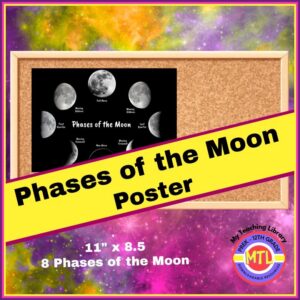
Teaching Earth and Space Science? Looking for a way to visually teach students the different phases of the moon? This “Phases of the Moon: Printable Poster” is for you!
✨ What’s Included:
- – A 1 page black and white, informative poster illustrating the eight phases of the moon.
- – Clear visual representations of the following phases: new moon, waxing crescent, first quarter, waxing gibbous, full moon, waning gibbous, last quarter, and waning crescent.
- – Perfect for a bulletin board display
✅ Perfect ror inspiring curiosity about Earth and space science.
-
$2.75Add to Cart
Looking for an effective way to teach the Phases of the Moon to your middle to high school students? Looking for a no-prep, printable resource that makes teaching space science a breeze? The Phases of the Moon Reading Comprehension (informational text) resource is your perfect solution! You’ll love the ability to use this resource as a one-day, quick lesson or how easily it can integrate into your existing curriculum, providing clear explanations and reinforcing key concepts.
✨ What’s Included:
- – Detailed reading passages explaining the phases of the moon: new moon, waxing crescent, first quarter, waxing gibbous, full moon, waning gibbous, last quarter, and waning crescent.
- – Information on the days to complete the cycle and the concepts of synchronous rotation and tidal locking.
- – A comprehensive assessment featuring short answer and multiple-choice quiz questions.
- – An easy-to-use answer key for quick grading.
✅ Perfect For…
- – Introducing or reviewing the Phases of the Moon in middle school science classes.
- – No-prep science lesson
- – Reinforcing reading comprehension skills within a science context.
This resource is built upon the pedagogical approach of making real-world connections to science. By explaining the observable phenomenon of the moon’s changing appearance, students can directly relate the concepts to their everyday experiences.
📚 Learning Objectives
- Students will be able to identify and describe the eight major phases of the moon.
- Students will understand the relationship between the Earth, Moon, and Sun that causes the different moon phases.
- Students will be able to explain the concept of synchronous rotation and tidal locking.
- Students will be able to determine the approximate duration of the lunar cycle.
- Students will improve their reading comprehension skills by extracting key information from scientific text.
-
Constellations | Astronomy – Space Science | Northern Hemisphere BUNDLE to Pinterest (opens in a new window)$11.00Add to Cart
Study the ⭐STARS ⭐with this constellation bundle! Includes a complete unit with informational text, visuals, flashcards and assessment quizzes. See description below for full details!