

Category: 9th-12th
Showing 121–127 of 127 resultsSorted by latest
-
 $20.00Add to Cart
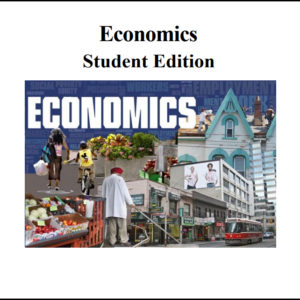
Complete Economics Curriculum for 7th-12th – Student Edition
-
$3.00Add to Cart
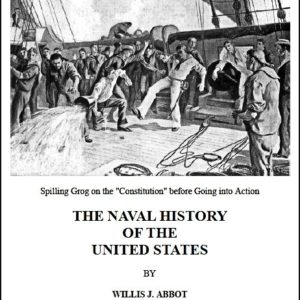
This is a downloadable copy of the book, The Naval History of the United States (Vol 1)
About the book: From the era of pirates and the beginning of the navy to the events of 1776 and 1813
About the Author: Willis John Abbot (March 16, 1863 – May 19, 1934) was an American journalist, and a prolific author of war, army, navy, marine corps and merchant marine books.
-
$2.50Add to Cart
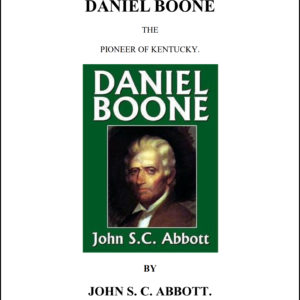
Daniel Boone is regarded as the first real American folk hero. Without his cunning bravery, settlement west of the Appalachians may not have been made possible for years. Boone’s Wilderness Road, which is still used today, helped bridge the Cumberland Gap, granting access to the state of Kentucky from Pennsylvania.
Thanks to the writing of John S. C. Abbot, the life and genius of Boone can truly be appreciated through Daniel Boone: The Pioneer of Kentucky. Find out just how Boone crafted his Wilderness Trail, what he did to make it happen, and how he overcame the struggles of life in late eighteenth century America.
-
$3.00Add to Cart
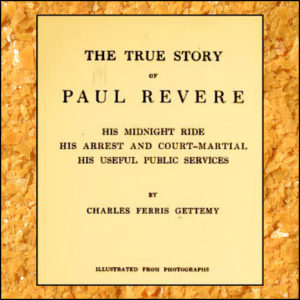
This is a downloadable copy of the book. (358 pages)
About the book: Published in 1905, Gettemy writes of Paul Revere’s midnight ride, his arrest, court-martial plus his ‘useful public services’. Paul Revere ( December 21, 1734 – May 10, 1818) was an American silversmith, engraver, early industrialist, and a patriot in the American Revolution. He is most famous for alerting the Colonial militia to the approach of British forces before the battles of Lexington and Concord, as dramatized in Henry Wadsworth Longfellow’s poem, “Paul Revere’s Ride”. Revere was a prosperous and prominent Boston silversmith, who helped organize an intelligence and alarm system to keep watch on the British military. Revere later served as a Massachusetts militia officer, though his service culminated after the Penobscot Expedition, one of the most disastrous campaigns of the American Revolutionary War, for which he was absolved of blame. Following the war, Revere returned to his silversmith trade and used the profits from his expanding business to finance his work in iron casting, bronze bell and cannon casting, and the forging of copper bolts and spikes. Finally in 1800 he became the first American to successfully roll copper into sheets for use as sheathing on naval vessels.
-
$15.00Add to Cart
An American Government Curriculum – Student Text edition
Units include:
- Structure and Function
- Foundations of American Government
- The Federal System
- The Three Branches
- Influencing Government
- Civil Rights
- Government Transformation (20s-30s)
- Domestic Policy and Foreign Affairs
- The Politics of Democracy
- Personal Involvement
-
$1.00Add to Cart
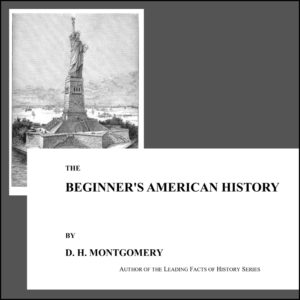
This 257-page book holds an 1893 copyright and was written to give information about historical figures living just before and during the beginning of United States history. It is not meant to be used as a textbook but rather a supplement to add stories and facts about the people written about within the pages. It is recommended for 5th-12th grades.
Suggested uses: Use with your regular curriculum to add another layer of information or give to students to use as a source information when doing research and/or projects.
Because of the 1893 copyright, this is a public domain resource. All-Access members may download it for free (as with all resources on our site). Non-members are asked to purchase this resource at a very low cost to help cover data storage and transfer costs.
-
$3.00Add to Cart
✏️A student-centered resource to help students learn and practice research skills, report writing, project and presentation skills.
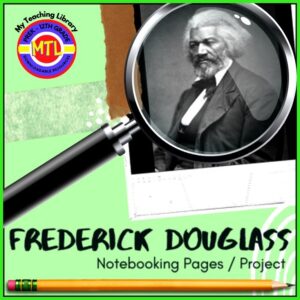
Students will use this project-based unit to learn about and report on Frederick Douglass. Frederick Douglass was an American social reformer, abolitionist, orator, writer, and statesman. After escaping from slavery in Maryland, he became a national leader of the abolitionist movement in Massachusetts and New York, gaining note for his oratory and incisive antislavery writings.
✏️This notebooking project unit can be assigned individually or within cooperative groups. Use it within a Language Arts classroom or a Social Studies / U.S. History classroom. Very flexible and cross-curricular! After completing the written portion of this resource, you can grade it (or) assign students to do an oral and/or audio-visual presentation based on their findings/work.
✏️What is in this resource?
- Student instructions for using biographical notebooking, project pages
- Suggested research questions
- Student notebooking, project pages (includes covers, KWL, reference recording, report writing, and more)
- Teacher pages (instructions, assignment, evaluation)


&url=https://myteachinglibrary.com/product/the-naval-history-of-the-united-states/&media=https://myteachinglibrary.com/wp-content/uploads/2019/08/wy-298-a.jpg)


