
Tag: pumpkins
Showing all 4 resultsSorted by latest
-
 $3.00Add to Cart
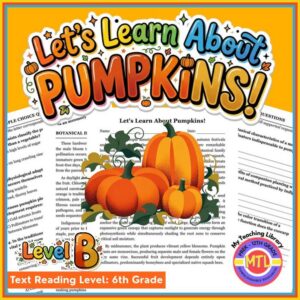
Looking for a Pumpkin Reading Comprehension activity for upper elementary? Look no further than “Let’s Learn About Pumpkins – Level B!” This resource is designed for upper elementary and middle school students and is a perfect cross-curricular (language arts and science) lesson. Text is written on a 6th grade reading level. If your student(s) are not reading at a 6th grade level, you challenge them to try. While they do, have them write down any words they may not know. They can then look those words up and continue reading! Win-Win!
What’s Included:
- In-Depth Nonfiction Text (Pages 1–2): A 545-word informational text spanning two full pages. Topics covered include:
- Botanical Taxonomy & Anatomy: The Cucurbitaceae family, botanical fruit classification (pepo), monoecious flowering (male vs. female blooms and insect pollination), and specialized structural adaptations (thigmotropic climbing tendrils).
- Biochemical Pigmentation: The seasonal degradation of chlorophyll and the emergence of fat-soluble carotenoids (beta-carotene) during ripening.
- Indigenous Agriculture: The history of the “Three Sisters” companion planting method (winter squash, maize, and climbing beans) developed by Native American agriculturalists.
- Nutritional Science: The human biological synthesis of Vitamin A from dietary plant carotenoids.
- 5 Multiple-Choice Questions (Page 3): Targets upper level/middle school reading skills, including interpreting domain-specific scientific vocabulary in context, identifying reciprocal ecological relationships, and analyzing authorial purpose.
- 3 Open-Ended Questions (Page 4): Prompts students to synthesize concepts (e.g., explaining symbiotic companion planting mechanics, describing biochemical ripening transitions).
- Complete Teacher Answer Key (Page 5)
Standards & Skills Covered:
- Reading Informational Text (CCSS.ELA-LITERACY.RI.6.1, RI.6.2, RI.6.4): Citing textual evidence to support inferences, summarizing central scientific concepts, and interpreting domain-specific terminology.
- Next Generation Science Standards (NGSS MS-LS1-4, MS-LS1-5, MS-LS2-2): Specialized plant reproductive structures, factors influencing growth, and mutually beneficial interspecies interactions in agricultural ecosystems.
- Writing (CCSS.ELA-LITERACY.W.6.9): Drawing evidence from informational texts to support analytical short-answer explanations.
Download yours today!
- In-Depth Nonfiction Text (Pages 1–2): A 545-word informational text spanning two full pages. Topics covered include:
-
$2.75Add to Cart
Looking for a Pumpkin Reading Comprehension activity? Look no further than “Let’s Learn About Pumpkins!” This resource is designed for lower elementary students and is a perfect cross-curricular (language arts and science) lesson. Text is written on a 3rd grade reading level. If your student(s) are not reading at a 3rd grade level, you can use this by reading the passage to them and openly discuss what they’ve learned!
What’s Included:
- Informational Reading Passage (Page 1): A 222-word, 3rd-grade leveled nonfiction text covering key pumpkin concepts: botanical classification (squash/gourd family), vine growth and tendrils, life cycle stages from seed to harvest, and practical uses. Includes a student name/date header and accent line art.
- 5 Multiple-Choice Questions (Page 2): Assesses core reading comprehension skills, including identifying the main idea, vocabulary in context, finding text evidence, and recall of key scientific details.
- 3 Extended Short-Answer Questions (Page 3): Encourages critical thinking and written expression.
- Complete Teacher Answer Key (Page 4):
Standards & Skills Addressed:
- Reading Informational Text (RI.3.1, RI.3.2, RI.3.4): Asking and answering questions using direct text evidence, determining central messages, and defining domain-specific vocabulary.
- Science Connections: Plant life cycles, botanical structures (vines, seeds, fruit vs. vegetable classification), and seasonal growth.
Download yours today!
-
$3.00Add to Cart
This unit is full of hands-on, interactive science exploration and discovery! Students will work with 4 items commonly associated with autumn: a pumpkin, an apple, an acorn and a gourd.
Using each, they will be guided through several activities to observe, hypothesize, describe and explore the items. They will also draw, color and write throughout. Fall fun activities that will excite your young scientists. (14 pages)
-
$3.00Add to Cart
Looking for a fun and creative pumpkin themed activity? This resource will excite and motivate students to write. With 6 funny pumpkin faces and 3 differentiated writing papers, students will love writing and publishing an imaginative story.