
Tag: Unit Study
Showing all 3 resultsSorted by latest
-
 $5.00Add to Cart
Here is a penguin unit study that is a student-centered, hands-on, cross-curricular project where they’ll learn all about 15 types of penguins while creating a lapbook or an interactive notebook!
🐧This can be used as a stand-alone unit that includes all of the informational materials, maps, illustrations and templates needed to create a beautiful project. However, a booklist is given if further research and reading is desired.
🐧Includes:
– Instructions and lapbook/notebooking examples
– Supply list
– Required elements checklist (optional for teacher assigned elements)
– Grading rubric and grading sheet
– Informational text covering: taxonomy, general information about penguins and unusual facts about penguins
– Detail fact sheets about the following species (includes image and location map for each): Adelie penguin, African penguin, Chinstrap penguin, Emperor penguin, Erect Crested penguin, Fiordland penguin, Galapagos penguin, Gentoo penguin, Humboldt penguin, King penguin, Little Blue penguin, Macaroni penguin, Magellanic penguin, Rockhopper penguin, Royal penguin
– Vocabulary
– Book suggestions for additional reading
– Illustration of a penguin’s basic anatomy– Illustration of the penguin life cycle
– 21 pages of templates that can be used to either create a lapbook or use in an interactive notebook -
Whale Unit Study | Life Science Lapbook and Interactive Notebook to Pinterest (opens in a new window)$6.00Add to Cart
Excite students as they learn all about whales and create an interactive project with this life science, hands-on, creative resource. This nonfiction science unit makes learning about baleen whales and toothed whales interesting and will help students develop reading, research, writing and organizational skills.
⭐Designed for 5th, 6th, 7th, and 8th grade students.
⭐Use as a fully stand-alone unit or students can research for additional information through books, videos and website.
⭐ Low-prep, comprehensive unit
⭐ Inspires reading, writing, organization, project research skills
⭐ Can be used to create a lapbook or interactive notebookWhat you get in this Whale unit:
- – How to use details
- – Images of how to create different style/size lapbooks and examples of interactive notebook pages
- – Supply list
- – Student forms: Required elements and grading rubric
- – Project grading form
- – Informational text covering topics such as classification, anatomy, behavior, communication, diet, life cycle, habitat and species-specific information for the following: Bottlenose whale, Cluver’s Beaked whale, Beluga whale, Killer whale, Narwhal, Sperm whale, Blue whale, Bowhead whale, fin whale, humpback whale and the Gray whale
- – Vocabulary
- – Whale surfacing behaviors – Images and descriptions
- – Suggested book titles for further research
- – Clipart
- – Project templates
-
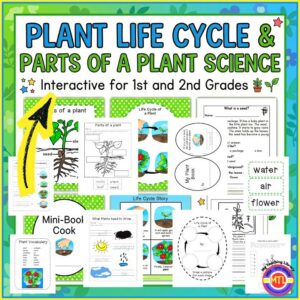
Plant Life Cycle & Parts of a Plant Science | Interactive for 1st and 2nd Grades to Pinterest (opens in a new window)$6.00Add to Cart
Watch your students’ curiosity bloom with Let’s Learn About Plants! Whether you are looking for a comprehensive standalone unit or a high-quality supplement to your existing science curriculum, this resource is designed to keep young learners growing.
This pack moves beyond simple reading—it’s an interactive experience. Students will be actively engaged as they cut, color, paste, and write their way through the fascinating world of botany. From the tiny secrets of a seed to the full cycle of a flowering plant, your classroom will transform into a garden of discovery! 🪴
🔍 What’s Inside the Greenhouse?
This resource is packed with everything you need to provide a multi-sensory learning experience:
- 16 Vocabulary Word Cards: Perfect for word walls or pocket charts.
- 3 Sets of Sequencing Cards: Master the plant life cycle through visual storytelling.
- Sequencing Worksheets: Reinforce the “what comes next” logic.
- 4 Vibrant Plant Posters: Beautifully illustrated to brighten up your science center.
- Mini-Book Activity: A project students will be proud to keep read.
- 20+ Comprehensive Worksheets: Covering everything from anatomy to growth needs.
📖 Building a Scientific Vocabulary
Help your students speak like real scientists! This unit covers 16 essential terms:
Seed, Sprout, Seedling, Plant, Roots, Stem, Leaf, Soil, Sunlight, Water, Air, Flower, Bud, Trunk, Branch, and Crown.
🛠️ Skills-Based Learning
This isn’t just “busy work.” While exploring biology, students will sharpen critical developmental skills, including:
- Fine Motor: Tracing, precision cutting, and gluing.
- Literacy: Copy work and vocabulary retention.
- Scientific Inquiry: Investigation journaling and data measuring.
🏫 Perfect For…
- ✅ Science Centers: Independent exploration stations.
- ✅ Homeschooling: Easy-to-follow, “grab-and-go” lessons.
- ✅ Seatwork & Review: Engaging tasks for morning work or early finishers.
- ✅ Cooperative Learning: Fun group activities and sequencing games.
🌻 Ready to watch your science lessons grow?
Give your students the tools they need to investigate the natural world around them.
👉 Get “Plant Life Cycle & Parts of a Plant Science” Today and Start Digging into Science! 🚀