
Only logged in customers who have purchased this product may leave a review.
Products
- Home
- /
- Shop
- /
- Newest Resources
- /
- What's New?
- /
- Newest Resources
- /
- Field Trip Advance Planning Forms
Field Trip Advance Planning Forms
$2.00
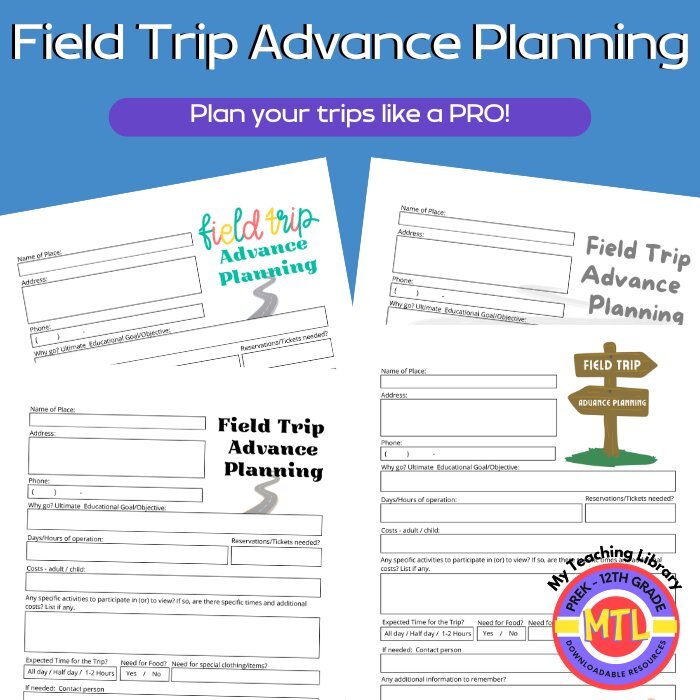
Great field trips are planned and these forms will help you gather the information you need to plan memorable, educational trips!
With these forms, you can record important data such as:
– Name
– Address
– Days/hours of operation
– Costs
– Goals/Objectives
– Specific activities (costs)
– Special items needed
….and more!
Related products
-
$0.50Add to Cart
Form designed to record yearly goal setting for any student. Can be used by teacher, parent or student.
-
$0.50Add to Cart
Designed for 3rd, 4th, 5th and 6th Grades, this resource can be used in one of two ways…
- Reading List Log: Students will list each book they read. Students will record book title, author, date they completed reading the book and type of book section. (fiction or nonfiction).
- Reading List: You, the teacher, will assign the book (title and author) which students are to read. Once students complete a book they will complete the date and type of book section ( ‘F’ or ‘NF’ – fiction / nonfiction section).
-
$3.00Add to Cart
Maria Montessori educational methods: She adapted the traditional teacher-taught subjects in the arts and science so that the children could use materials to guide their open-ended research and to follow their individual interests, working to a much higher level than was previously (and is presently!) thought possible for children of this age. The elementary child, when allowed to work independently instead of being taught in groups led by a teacher, and in classes with a mixed age group of 6-12- year-old students inspiring and teaching each other, masters academic subjects usually not taught until middle or high school.
She believed that each child is born with a unique potential to be revealed, rather than as a “blank slate” waiting to be written upon. Her main contributions to the work of those of us raising and educating children are in these areas:
-
Preparing the most natural and life-supporting environments for the child
-
Observing the child living freely in this environment
-
Continually adapting the environment in order that the chid may fulfill his or her greatest potential, physically, mentally, emotionally, and spiritually.
-
-
$2.50Add to Cart
Maria Montessori educational methods: She adapted the traditional teacher-taught subjects in the arts and science so that the children could use materials to guide their open-ended research and to follow their individual interests, working to a much higher level than was previously (and is presently!) thought possible for children of this age. The elementary child, when allowed to work independently instead of being taught in groups led by a teacher, and in classes with a mixed age group of 6-12- year-old students inspiring and teaching each other, masters academic subjects usually not taught until middle or high school.
She believed that each child is born with a unique potential to be revealed, rather than as a “blank slate” waiting to be written upon. Her main contributions to the work of those of us raising and educating children are in these areas:
-
Preparing the most natural and life-supporting environments for the child
-
Observing the child living freely in this environment
-
Continually adapting the environment in order that the chid may fulfill his or her greatest potential, physically, mentally, emotionally, and spiritually.
-


Reviews
There are no reviews yet.