
Only logged in customers who have purchased this product may leave a review.
Products
- Home
- /
- Shop
- /
- Miscellaneous
- /
- Holiday Themed Learning
- /
- Christmas
- /
- Gingerbread House | Paper Craft
Gingerbread House | Paper Craft
$3.00
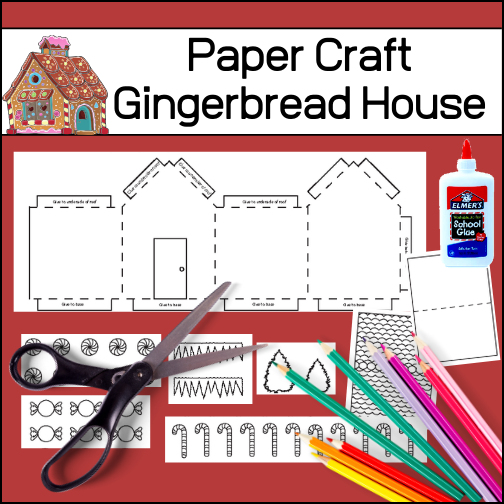
Here is a fun Art project for the month of December! Includes templates to build a cute gingerbread house from paper.
- – House template with roof
- – Window templates
- – Candy templates
- – Tree templates
- – Icicle templates
Related products
-
$3.25Add to Cart
Help students practice their money recognition skills while having fun with this “Go Fish” card game! * Gamified learning *
Money Cards include: penny, nickel, dime, quarter, half dollar, dollar, five-dollar bill, ten-dollar bill, twenty-dollar bill, fifty-dollar bill.For younger students, you can use only the picture cards if appropriate and have them match picture with picture. For older students, have them match the picture with the correct matching naming cards.
-
$1.50Add to Cart
Three classroom posters to display to help students learning to recognize / identify three Math signs:
- – Greater than
- – Less than
- – Equal to
-
Christmas Around the World | 6 Continents, 24 Places, Reading, Recipes and Crafts to Pinterest (opens in a new window)$12.97Add to Cart
Take your students on an unforgettable journey across 6 continents to discover how Christmas is celebrated worldwide! This complete global studies unit invites learners to explore holiday history, geography, and diverse cultural traditions through reading, hands-on crafts, authentic recipes, and targeted assessments.
📦 What’s Included: This all-in-one printable curriculum covers 24 select places around the world:
- Europe: Germany, Sweden, Denmark, Switzerland, Vatican City, Lapland (Finland), United Kingdom, France, Italy, Spain, Norway
- The Americas: Mexico, Brazil, El Salvador, Canada, United States
- Asia & Oceania: Philippines, Japan, Australia
- Middle East & Africa: Bethlehem (West Bank), Egypt, Ethiopia, Uganda, South Africa
Every Single Study Includes:
- Informational Reading Passage: Engaging text blending historical origins, religious observances, and cultural holiday customs.
- Authentic Recipe: Kid-friendly, traditional culinary dishes complete with clear ingredient lists and step-by-step cooking/baking directions (e.g., Mexican Buñuelos, German Lebkuchen, Swedish Pepparkakor, Australian Pavlova).
- Festive Craft or Activity: Hands-on cultural projects designed with accessible materials and detailed steps (e.g., Danish pleated hearts, Filipino paról stars, Italian Befana stockings).
- Sectional Reading Checks: 3 short-answer comprehension questions with generous, 2.5-spaced solid writing lines for handwriting, plus 2 multiple-choice questions for every place!
Comprehensive Final Review:
- 48-Question Cumulative Assessment: A mixed-review multiple-choice exam (2 questions per country) testing retention and compare-and-contrast reasoning.
- Complete Master Answer Key: Fast, stress-free grading.
- Printer-Friendly Formatting: Clean, black-and-white text layout. Colored recipe and craft images are included but can be printed in all black and white.
💡 Versatile Ways to Use This Unit
- Holiday “Flight” or Passport Stations: Set up rotating stations where students “travel” to 1–2 countries per day throughout December.
- Daily Advent / December Bell Ringer: Read one country study each morning as an interactive read-aloud or independent warm-up.
- Multi-Sensory Unit Study: Dive deep by reading the lesson, cooking the featured dish for lunch or dinner, and crafting.
- Holiday Cultural Fair / Jigsaw Project: Assign students or small groups (classroom or co-op) a specific country to research, prepare the craft, and present to classmates or parents.
- Independent Work: Print individual country packets for seamless, zero-prep reading comprehension during the busy holiday season.
🌟 Why This Unit Is Important
Holiday seasons provide an authentic, high-interest doorway into global learning. Rather than treating holiday celebrations as one-size-fits-all, this curriculum broadens students’ worldviews by highlighting:
- How geography and climate shape traditions (such as summer Christmas in the Southern Hemisphere).
- The rich variety of folklore, religious roots, and cultural storytelling around the globe.
- Universal human themes—kindness, community, charity, family, and light—that bridge different cultures.
🎯 Skills Developed
- Reading for Information: Locating text evidence, identifying main ideas, and summarizing cultural details.
- Written Expression: Formulating complete-sentence short answers using textual details.
- Comparative Thinking: Comparing and contrasting traditions across different hemispheres and continents.
- Procedural Literacy: Following multi-step sequential instructions in recipes and craft tutorials.
- Fine Motor & Culinary Application: Measuring, cutting, folding, and basic kitchen participation.
How to use in different grade levels/abilities:
Grades 1–2 (Early Elementary / Multi-Age Homeschool)
- Read-Aloud & Shared Listening: Use the informational texts as teacher- or parent-led read-alouds, pausing to highlight unfamiliar terms and point out locations on a world map or globe.
- Oral Comprehension: Rather than having students write out the short-answer responses on the lines, ask the questions aloud and have students answer verbally or draw their responses on paper.
- Sensory & Fine Motor Focus: Center the lessons around the hands-on crafts (cutting, folding, and gluing) and sensory kitchen experiences with the recipes.
- Simplified Assessment: Use the multiple-choice questions as group voting games (e.g., “Thumbs up for A, thumbs down for B”) rather than formal written quizzes.
Grade 3 (Approaching Grade-Level Reading)
- Paired / Partner Reading: Have students read the country passages with a reading buddy, alternating paragraphs to build fluency and confidence.
- Scaffolded Short Answers: Use the short-answer sections to practice restating the question and finding explicit text evidence together as a class or in small guided reading groups.
- Passport Booklet: Have students assemble a mini “passport” or notebook, stamping or coloring a flag for each country after completing the reading check.
- Selected Assessment: Use the country-level multiple-choice questions for formative checks, while using the final 48-question exam as an open-book scavenger hunt.
Grades 5–6 (Upper Elementary / Middle School Transition)
- Independent Research & Jigsaw Teaching: Assign small groups or individuals 2–3 countries to study independently. Have students prepare the craft or recipe at home and “teach” their assigned country’s traditions to the rest of the class if using in a traditional classroom setting.
- Comparative Geography & Writing Extensions: Have students compare two regions across different hemispheres (e.g., Australia vs. Norway, or Mexico vs. Japan) in a multi-paragraph Venn diagram or essay analyzing how climate, geography, and religion shape holiday customs.
- Culinary Math & Science: Have older students scale the recipes up or down (halving or doubling fractions) or research the food science behind specific cooking methods (like leavening in gingerbread or egg whites in meringue).
- Strict Independent Assessment: Administer the 48-question cumulative exam closed-book as a formal test of reading retention and social studies recall.
Multi-Grade Homeschooling & Co-Ops
- One Core Spine for the Whole Family: Gather all ages together for the daily country reading and mapping activity.
- Tiered Output: Older siblings complete the independent reading, short-answer questions, and final exam; younger siblings participate in the discussion, follow along with the craft tutorial, and assist with measuring and mixing in the kitchen.
- End-of-Unit Cultural Showcase: Wrap up the unit by hosting a family or co-op “Global Holiday Feast,” preparing 3–4 dishes from the unit and displaying the crafts made throughout December.📚 Common Core State Standards (CCSS) Covered (Written on a 4th grade reading level)
- CCSS.ELA-LITERACY.RI.4.1: Refer to details and examples in a text when explaining what the text says explicitly and when drawing inferences.
- CCSS.ELA-LITERACY.RI.4.2: Determine the main idea of a text and explain how it is supported by key details; summarize the text.
- CCSS.ELA-LITERACY.RI.4.3: Explain events, procedures, ideas, or concepts in a historical, scientific, or technical text, including what happened and why, based on specific information in the text.
- CCSS.ELA-LITERACY.RI.4.4: Determine the meaning of general academic and domain-specific words or phrases in a text relevant to a grade 4 topic.
- CCSS.ELA-LITERACY.W.4.9: Draw evidence from literary or informational texts to support analysis, reflection, and research.
🛒 Ready to Pack Your Bags? Bring the wonder of global holiday traditions straight to your classroom or homeschool table!
👉 Download your copy of Christmas Around the World today!
-
$3.00Add to Cart
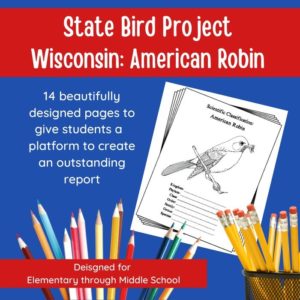
Studying the state of Wisconsin and state symbols? What is the state bird of Wisconsin?
This project-based unit is designed to help students study and record information about Wisconsin’s state bird: American Robin
What type of pages are contained in this set:
– A map page (for the state)
– Scientific classification page
– A page for students to give details about the bird’s physical description, habitat, diet, life span and reproduction
– A page where students will do additional map work to show where in the U.S. the bird lives in addition to migration information
– Coloring page
– Several pages on which students can use for expository and/or creative writing as well as sections in which students may draw.14 pages in all and is designed for different levels / abilities.
My Teaching Library has a notebooking set for each of all 50 states. In addition, you can get all of them bundled!
Here are other bird related products you’ll love…
- North American Birds of Prey Research / Report Pages
- Birds if Prey Flashcards
- Audubon’s Birds – Coloring Book (80 species)
- U.S. State Birds Coloring Book


Reviews
There are no reviews yet.