
Category: Animals
Showing 1–20 of 49 resultsSorted by latest
-
 $4.00Buy Now
🦥 Slow Down and Discover: The Ultimate Sloths Unit Study!
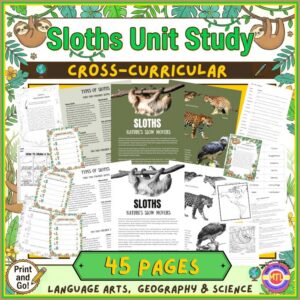
Take your students on a deep dive into the canopy with this comprehensive Sloths Unit Study! Designed to move beyond standard worksheets, this “boutique” style unit offers a rich, cross-curricular learning journey that explores the fascinating world of nature’s slowest movers. 🌿
Perfect for homeschooling families and classroom teachers alike, this unit is packed with high-quality informational text, stunning visuals, and cross-curricular activities that keep students engaged from start to finish.
📖 What’s Inside?
This unit provides a thorough exploration of sloth biology, geography, and ecology. Students won’t just learn about “sloths”—they will become experts on the specific species that inhabit our world!
Informational Text & Geography:
- 🦥Detailed Reading Passages: Includes both full-color and ink-friendly black and white pages covering:
- Nature’s Slow Movers: General sloth facts and biology.
- The Six Species: Detailed looks at the Pygmy, Maned, Brown-throated, Pale-throated, Hoffmann’s, and Linnaeus’s sloths.
- Predators: Understanding the threats sloths face in the wild.
-
🦥Visual Learning: High-quality images of sloths and their predators to bring the lessons to life. 📸
-
🦥Map Work: Detailed maps showing the specific locations of different sloth types, paired with student map work pages to reinforce geography skills. 🗺️
Language Arts & Literacy:
-
🦥Vocabulary Suite: Includes vocabulary cards, a definition handout, and a dedicated vocabulary quiz to ensure mastery. 🧠
-
🦥Writing & Paraphrasing: 5 specific paragraph exercises where students read a passage, create an original title, and practice the essential skill of paraphrasing in their own words.
-
🦥Creative Expression: Acrostic poetry pages and “Color and Write” prompts. ✍️
-
🦥Copy Work: Beautifully designed pages for handwriting practice.
Science & Research:
-
🦥Notebooking & Report Pages: Flexible templates for students to record their research and findings. 📓
-
🦥Curated Book List: A hand-picked selection of book suggestions for additional reading to expand the study. 📚
Art & Logic Fun:
-
🦥Directed Drawing: A step-by-step guide to drawing a sloth. 🎨
-
🦥Brain Games: Includes a themed Maze, Word Search, and Crossword Puzzle. 🧩
Assessment & Ease of Use:
-
🦥Sloths Quiz: A comprehensive end-of-unit quiz to check for understanding.
-
🦥Answer Keys: Fully included to save you time and make grading a breeze! ✅
✨ Why You’ll Love It
Whether you are looking for a deep-dive science unit or a way to integrate reading and writing into a high-interest topic, this study provides the tools you need. It’s designed to be flexible enough for various grade levels while remaining academically rigorous.Bring the wonders of the rainforest into your lesson plans today! 🦥🍃
(PREVIEW VIDEO BELOW)
- 🦥Detailed Reading Passages: Includes both full-color and ink-friendly black and white pages covering:
-
 $2.00Buy Now
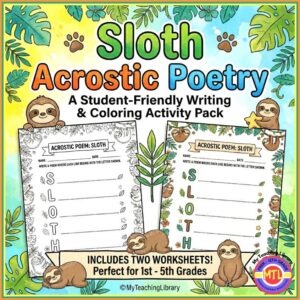
Get your students slowly (or quickly!) excited about poetry with this super cute and engaging Sloth Acrostic Poetry Writing Pack! 🦥 This student-friendly resource is designed to make poetry accessible, creative, and above all, FUN for young writers. With an adorable jungle theme featuring sleeping and star-holding sloths, it’s a perfect addition to your lesson plans to get students’ creativity flowing!
📖 What is an Acrostic Poem?
An acrostic poem is a fun and simple form of poetry! The first letter of each line spells out a key word or phrase (in this case, SLOTH). Students then write a word or phrase for each letter, creating a unique poem that describes the core word. It’s a great structural exercise for beginning poets and can build confidence in reluctant writers. ✍️
💡 Benefits to Students:
This resource goes beyond just being cute! It offers numerous learning benefits, including:
-
🎨 Creativity & Imagination: Encourages students to think creatively to find words that fit the sloth theme.
-
📚 Vocabulary Building: Promotes the use of descriptive language, adjectives, and strong verbs.
-
🔡 Spelling & Phonics: Reinforces initial letter sounds and spelling.
-
📝 Writing Practice: Provides a structured and guided way to practice writing short sentences or phrases.
-
🧐 Structural Understanding: Helps students understand different forms of poetry.
-
🖍️ Fine Motor Skills: The included B&W version is perfect for a creative coloring break.
-
🥰 High Engagement: Sloths are an incredibly popular animal, making this resource highly motivating!
-
🌟 Adaptable for All Levels: Reluctant writers feel successful with this simple, guided format. Reluctant poets feel successful with this pattern.
📦 What’s Included in this Pack?
You will receive:
-
🦥 Two (2) Printable Worksheets: (As seen in the product image)
-
🖍️ One (1) Black & White Line Art Version: Ideal for students to color, personalize, and then write their unique sloth poems.
-
🎨 One (1) Full Color Version: Perfect for a quick writing session or for students who prefer to write and go.
-
🍃 Both versions feature a charming sloth-and-tropical-leaf border with clear title fields (“ACROSTIC POEM: SLOTH”).
-
-
$6.75Buy Now
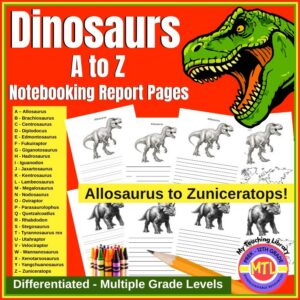
Have students wanting to learn about dinosaurs? Want to incorporate hands-on, project learning into your science lessons that will not only help student learning ‘stick’ but will allow students to walk away with beautiful projects? Get ready to roar with excitement because your problem is solved!
PLEASE NOTE: This resource does not mention the age of the earth or periods of time.
Get My Teaching Library’s “Dinosaurs A-Z | Research, Report, Notebooking, Project Pages | Multi-Grade” and watch students’ love of learning ignite!
Regardless of whether you are teaching 1st grade or 12th, this resource will work because it has been designed with pages for all ages – abilities – grades!
✨ What’s Included:
- – 4 pages for each of these dinosaurs (Multi-level, ability writing/reporting plus map work): A – Allosauru,s B – Brachiosaurus, C – Centrosaurus, D – Diplodocus, E – Edmontosaurus, F – Fukuiraptor, G – Giganotosaurus, H – Hadrosaurus, I – Iguanodon, J – Jaxartosaurus, K – Kentrosaurus, L – Lambeosaurus, M – Megalosaurus, N – Nodosaurus, O – Oviraptor, P – Parasaurolophus, Q – Quetzalcoatlus, R – Rhabdodon, S – Stegosaurus, T – Tyrannosaurus Rex, U – Utahraptor, V – Velociraptor, W – Wannanosaurus, X – Xenotarsosaurus, Y – Yangchuanosaurus ,Z – Zuniceratops
- – 5 extra pages to continue reporting on each dinosaur if needed (both writing and drawing pages).
✅ Perfect For…
- – Dinosaur enthusiasts of all ages who love to dive deep into research and creative reporting.
- – Project-based learning units focused on paleontology.
- – Inspiring hands-on science activities that connect real-world learning.
-
$2.00Buy Now
Sloth – Amazon Rainforest Animal Report – Writing – Project Paper
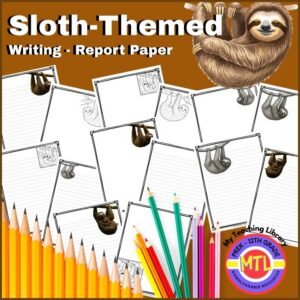
This product includes 21 pages for students to use when writing or creating a project on sloths.Details on the pages in the resource:
– 9 unlined pages with a black-and-white sloth image on each (2 include an image of a mom and her baby)
– 3 unlined pages with a color, photo realistic sloth image on each (2 include an image of a mom and her baby)
– 6 lined pages with a black-and-white sloth image on each (2 include an image of a mom and her baby)
– 3 lined pages with a color, photo realistic sloth image on each (2 include an image of a mom and her baby)You may also like: Amazon Tropical Rainforest Animals – Realistic Images | Color and Write
-
$2.75Buy Now
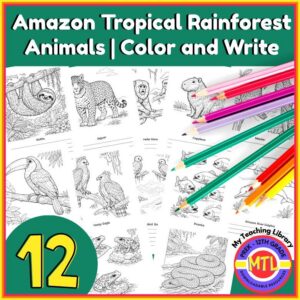
Students will love these Amazon Tropical Rainforest Animals Color and Write pages. It features twelve detailed, realistic black-and-white drawings of animals commonly found in the Amazon tropical rainforest. Can be used as a Language Arts, Geography and/or Science resource. Cross-curricular!
Each page includes a realistic, ready-to-color illustration of the animal and lines for students to write a paragraph about the animal.
Animals included:
– sloth
– jaguar
– capybara
– howler monkey
– macaw
– toucan
– harpy eagle
– resplendent quetzal
– green anaconda
– poison dart frog
– river dolphin
– piranhaSpace is provided for students to write a paragraph about each animal. You can assign what you’d like for them to include or you can allow them to choose what they include. Teachers often as students to describe the animal’s appearance, its habitat, unique behaviors, and any interesting facts they know or discover when reading about the animal(s) using outside materials.
Benefits of this resource:
- – Encourages children to learn about each animal.
- – Encourages children to express themselves through coloring and writing.
- – Reinforces writing, reading comprehension (through the gathering of information from outside resources to gather information to write) and science learning.
- – Improves attention span and concentration, as it requires careful attention to detail while coloring and while reading for detail (using outside resources).
- – Can reduce stress and anxiety when coloring.
- – Helps develop fine motor skills, hand-eye coordination, and dexterity through coloring.
- – Educational when using realistic images such as the ones in this resource
-
$4.00Buy Now
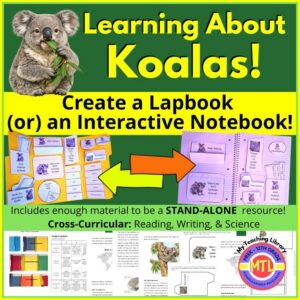
🐨 Planning to study Koalas? Marsupials? Animals of Australia/ If so, your students will love the student-centered, hands-on, cross-curricular project where they’ll learn all about Koalas while creating a lapbook or an interactive notebook!
🐨This can be used as a stand-alone unit that includes all of the informational materials, a map, and templates needed to create a beautiful project. Although this can be used completely as a stand-alone unit, a booklist is given if further research and reading is desired.
🐨Includes:
– Instructions and lapbook/notebooking examples
– Supply list
– Required elements checklist (optional for teacher assigned elements)
– Grading rubric and grading sheet
– Informational text covering:- Taxonomy
- Closest Relatives
- Anatomy
- Where they live (Habitat and Map)
- Diet
- Life Cycle
- Predators
- Fun Facts
- Vocabulary
– 11 pages of templates
– (Bonus) Nature’s Predators of the Koala Coloring Page -
$5.00Buy Now
Here is a penguin unit study that is a student-centered, hands-on, cross-curricular project where they’ll learn all about 15 types of penguins while creating a lapbook or an interactive notebook!
🐧This can be used as a stand-alone unit that includes all of the informational materials, maps, illustrations and templates needed to create a beautiful project. However, a booklist is given if further research and reading is desired.
🐧Includes:
– Instructions and lapbook/notebooking examples
– Supply list
– Required elements checklist (optional for teacher assigned elements)
– Grading rubric and grading sheet
– Informational text covering: taxonomy, general information about penguins and unusual facts about penguins
– Detail fact sheets about the following species (includes image and location map for each): Adelie penguin, African penguin, Chinstrap penguin, Emperor penguin, Erect Crested penguin, Fiordland penguin, Galapagos penguin, Gentoo penguin, Humboldt penguin, King penguin, Little Blue penguin, Macaroni penguin, Magellanic penguin, Rockhopper penguin, Royal penguin
– Vocabulary
– Book suggestions for additional reading
– Illustration of a penguin’s basic anatomy– Illustration of the penguin life cycle
– 21 pages of templates that can be used to either create a lapbook or use in an interactive notebook -
$1.00Buy Now
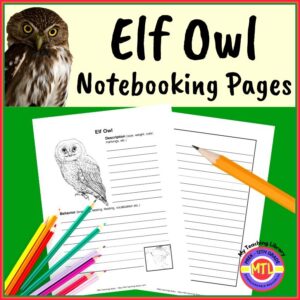
Elf Owl Notebooking pages provides students with two recording pages to report on this small owl that is the size of a sparrow! The first page includes an image to color and lines for students to describe the owl’s appearance and behavior. They will also be able to report on the range where it is found and complete map work. The second page can be duplicated as many times as necessary needed for students to write a report on the bird.
Suggested research link: Elf Owl Overview
Get My Teaching Library’s full Birds of Prey Notebooking Pages Resource!
-
$1.50Buy Now
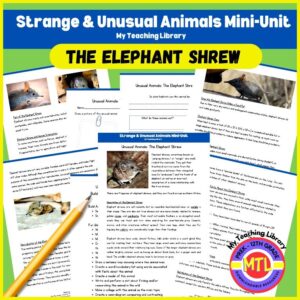
This engaging and cross-curricular mini-unit will teach students all about the elephant shrew! A strange and unusual animal, the elephant shrew is a small rodent-like mammal which gets its name from the resemblance between its elongated nose and the trunk of an elephant.
In this unit, students will read all about this little mammal…
– a description
– interesting facts
– where it lives
– what it eats
– interaction with humans
– if they make good pets
– behavior
– reproductionAfter reading all about the elephant shrew, students will complete a two-page activity in which they will draw the animal, do a little map work, answer questions and write about what they’ve learned.
Next, there are several hands-on ideas to continue building their knowledge and creating projects around this strange and unusual creature.
-
$8.00Buy Now
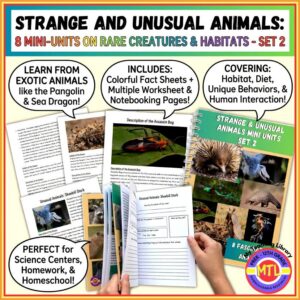
Dive Deep into the Extraordinary: Strange and Unusual Animals – Set 2! 🌍🦒👾
Ready to take your students on a journey to explore the most bizarre, fascinating, and rare creatures on Earth? Welcome to Set 2 of Strange and Unusual Animals Mini-Units! This sequel is packed with biodiversity that will leave your students (and maybe you!) completely fascinated.
This set features 8 comprehensive mini-units, each designed to introduce students to an animal that challenges the definition of “normal.” Forget lions and tigers; we’re talking about creatures with unique defenses, strange behaviors, and habitats that are off the beaten path.
🧬 What is a Mini-Unit?
Each of the 8 mini-units is a self-contained exploration into the lives of these uncommon species. They are packed with engaging information, vivid, colorful photos, and active learning opportunities to make science come to life! Students will dive deep into:
-
What they look like: Discover their bizarre appearances and strange adaptations. 🦎
-
Where they live (Habitat and Location): Follow them to unique ecosystems and global coordinates. 🗺️
-
What they eat: Uncover unique diets and predatory strategies. 🌿
-
Interesting, “strange” facts: The “weird and wonderful” details that make them unforgettable! 💡
-
Interactions with humans: Are they helpful, dangerous, or elusive? 🏠
-
Pets or Wild? Learn if these creatures have ever been domesticated (or if that’s even a good idea!). 🏡
🐊 Featured Animals in Set 2:
Meet the new “wild” cast that will spark curiosity:
-
Assassin Bug (The silent, deadly hunter) 🎯
-
Moloch (The thorny devil of the desert) 🌵
-
Quetzal (The iridescent, sacred bird) ✨
-
Sea Dragon (The master of ocean camouflage) 🌊
-
Shoebill Stork (The ancient, powerful predator) 🕊️
-
Armadillo (The tank-like digger) 🛡️
-
Pangolin (The armored, walking pinecone) 🐉
-
Echidna (The egg-laying, spiky mammal) 🐣
📝 What You’ll Love:
-
Vibrant Visuals: Every page features high-quality, colorful photos that keep students interested and engaged. 📸
-
Active Comprehension: Each animal study includes 2 student notebooking pages per creature, encouraging research, recording facts, and illustrating key concepts.
-
Flexible Learning: Perfect for independent study, science centers, or a “Creature of the Week” feature in your classroom or homeschool. 🏠
-
Comprehensive Animal Study: This set offers more than just facts; it provides holistic research opportunities into rare species. 🔬
✨ Keep the Adventure Going!
If your students fall in love with these rare creatures and haven’t already completed Set 1, get it now!
Grab Strange and Unusual Animals | Set 1 -
-
$8.00Buy Now
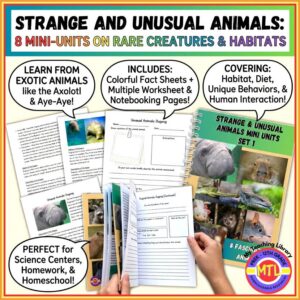
🐾 Discover the Extraordinary: Strange and Unusual Animals Mini-Units (Set 1) 🌍
Are you looking to spice up your science curriculum? Spark student curiosity and wonder with this deep dive into the world’s most peculiar creatures!
This comprehensive set features 8 mini-units designed to take students on a journey to meet animals they won’t find in a typical textbook. From the depths of the water to the heights of the rainforest canopy, your students will become experts on the “weird and wonderful.”
🧬 What’s Inside?
Each of the 8 mini-units is packed with engaging information and vibrant, colorful photos to keep young learners hooked. Students will explore:
-
Physical Characteristics: What makes them look so unique? 🦎
-
Habitats & Locations: Where in the world do they hide? 🗺️
-
Dietary Habits: What’s on the menu for a Fossa or a Dugong? 🌿
-
Human Interaction: Are they pets, or are they better left in the wild? 🏠
-
Mind-Blowing Facts: The “strange” details that make these animals unforgettable! 💡
🐊 Featured Animals in Set 1:
-
Gharial (The long-snouted crocodilian)
-
Dugong (The “sea cow” of the ocean)
-
Capybara (The world’s largest, chillest rodent)
-
Blue-Tongued Skink (A reptile with a colorful surprise)
-
Axolotl (The smiling salamander)
-
Aye-Aye (The mysterious primate of Madagascar)
-
Elephant Shrew (Tiny, fast, and trunk-nosed)
-
Fossa (The elusive predator of the forest)
📝 What You’ll Love:
-
Vibrant Visuals: Real-life photos bring the science to life! 📸
-
Active Learning: Every unit includes 2 notebooking pages per animal to test comprehension and encourage research.
-
Extension Activities: Includes a “Taking it Further” section with creative suggestions for projects and deep-dives to keep the momentum going! 🚀
-
Low Prep: Just print and go—perfect for science centers, independent study, or a “Creature of the Week” feature.
✨ Keep the Adventure Going!
If your students fall in love with these rare creatures, don’t stop here!
Grab Strange and Unusual Animals | Set 2 -
-
$2.50Buy Now
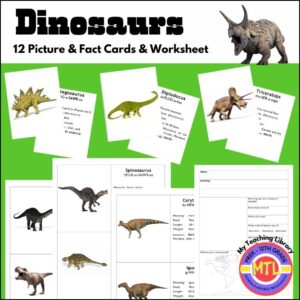
Studying dinosaurs? Here are 12 picture and fact cards plus a worksheet for students to use as the report on each dinosaur!
Dinosaurs included: Spinosaurus, Ankylosaurus, Stegosaurus, Pteranodon, Velociraptor, Triceratops, Corythosaurus, Iguanodon, Diplodocus, Dimetrodon (not a true dinosaur but often covered in textbooks), Apatosaurus, Tyrannosaurus. -
$2.00Buy Now
In this resource, students will learn about living things, (plants and animals) and what they need to survive within their habitats. Students will investigate the dependence of plants on air, water, nutrients, and light. They will also learn about pollination and how many plants depend on animals for pollination and the dispersal of seeds. Students will learn about various animal habitats and how some animals change with the seasons.
This resource includes both student and teacher materials.
Number of Lessons – Depending on how you divide up and teach lesson segments, there will be 12 to 20 lessons of 30-45 minutes each. Science video links are included in the teacher materials.
-
$3.00Buy Now
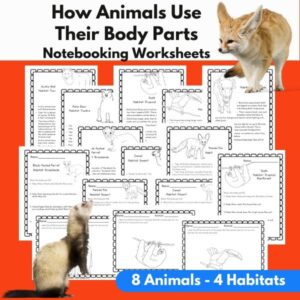
In this unit study, students will learn how 8 different animals (4 different habitats) use many of their body parts to live and survive. For each animal, students will be given a fact sheet, a short answer worksheet and a worksheet on which they will label and describe the specific body parts and how they are used.
Animals covered in this unit are:
– Desert Habitat: Camel, Fennec Fox
– Grasslands: Black-footed Ferret, Bison
– Tropical Rainforest: Sloth, Toucan
– Tundra: Polar Bear, Arctic Wolf -
$2.50Buy Now
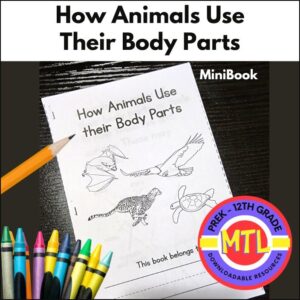
A fun to create, Science mini-book teaching students how different animals use their body parts as tools to live and survive! Once students finish creating this 10 page mini-book, they will be able to give examples of how 7 animals use their body parts to get nourished, move within its environment and even stay protected from predators!
Animals included in this project are the cheetah, bat, loggerhead turtle, badger, kangaroo, deer and tundra swan. There is also a image of a wolf with showing various body parts often used to accomplish an animal’s survival.
Students will color, draw and write to complete the book.
-
$2.50Buy Now
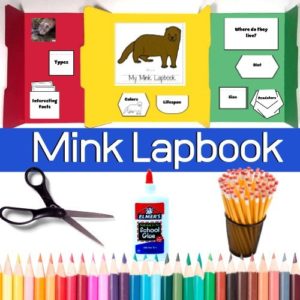
Students will love this hands-on resource designed to create a fun Mink Lapbook!
Includes Lapbooking instructions, templates to use as they record what they know or are learning about minks, (such as where they live, the types, size, predators, diet and more) and a lapbooking rubric.
Designed to use with multiple age / grade levels.
-
$2.00Buy Now
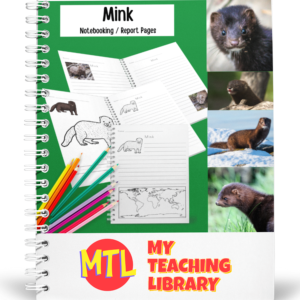
Planning a study on the mink? Minks are dark-colored, semiaquatic, carnivorous mammals of the genera Neogale and Mustela and part of the family Mustelidae! If you are planning to have students study the mink, help them be creative by providing them with these pages to create a report on the mink.
When is a good time to introduce such a project? Perhaps when you are studying semiaquatic habitats or carnivorous mammals! This is a cross-curricular resource that will require students to research and learn about the life of a mink (science), record and write what they have learned (language arts) and complete map work (geography).
-
$4.00Buy Now
Students will learn all about hedgehogs, their life, habitats, life cycle and more with these activities and worksheets!
They will learn about where they live (habitats) their life cycle, that they are mammals, omnivores, nocturnal and about hibernation! This unit includes informational text with questions, tracing and copy work, creative and expository writing, plus activities including mini-book creation, ‘cut and glue’, drawing and more. All designed for the 1st and 2nd grader in mind to help build vital language arts skills as well as geography and science knowledge.
-
$2.00Buy Now
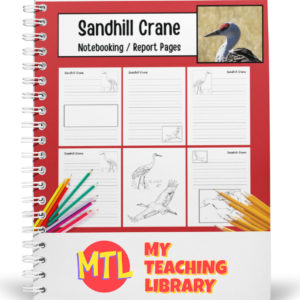
Sandhill Cranes are large birds that live in open habitats across North America. Students can use these pages to produce a beautiful report or project on these magnificent birds! Includes 5 notebooking pages (one with a North American map) and 1 coloring page.
-
$2.00Buy Now
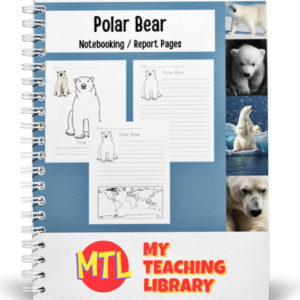
Students will love using these pages to create a report on the polar bear! Perfect to use during a study of the arctic region, tundra animals or as a cross-curricular unit that will have students reading, writing, completing map work (geography) and learning about the life of the polar bear (science).
Check out My Teaching Library’s article: Learning about the Polar Bear!