
Tag: informational text
Showing all 17 resultsSorted by latest
-
 $4.00Add to Cart
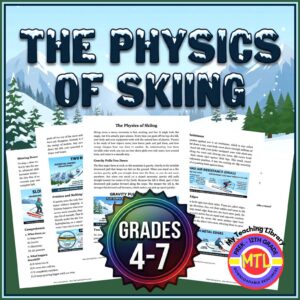
Skiing down a snowy slope looks like magic, but it is pure science in action! The Physics of Skiing is an engaging, high-interest science reading comprehension unit designed to help upper elementary and middle school students explore real-world forces, motion, and energy transformations.
Written at an accessible reading level with clear, full-color diagrams, this resource breaks down foundational physical science concepts into relatable winter sports applications.
Key Science Concepts Covered:
- Gravity and Slope Angles: How Earth’s downward pull converts into forward acceleration along an inclined plane.
- Potential vs. Kinetic Energy: How chairlifts store potential energy and how downhill descents transform it into kinetic energy.
- Friction and Hydroplaning: How friction creates microscopic surface heat, melting a thin water film that lets skis glide.
- Wind Resistance and Aerodynamics: How air drag slows skiers down and why racers use aerodynamic tucks to cut through air molecules.
- Newton’s Third Law of Motion: How sharp metal edges bite into snow to create equal and opposite reaction forces for carving turns.
- Stopping Mechanics: How beginners (snowplow/wedge) and advanced skiers (hockey stop) scrape edges sideways to dramatically increase friction and come to a safe halt.
What’s Included:
- Informational Science Text: Illustrated, easy-to-read passages packed with labeled visual diagrams illustrating each physical force.
- Student Assessment: 5 multiple-choice questions assessing core comprehension plus 2 short-answer prompts requiring students to explain energy conversion and friction.
- Teacher Answer Key: Complete with grading criteria and sample responses for quick, straightforward evaluation.
Suggested Grades: 4th – 7th Grade (Upper Elementary / Middle School)
Perfect For: Physical science units, winter STEM, homeschool lessons, sports science enrichment, co-op classes. Print-and-Go ready!
-
$3.00Add to Cart
Looking for a Pumpkin Reading Comprehension activity for upper elementary? Look no further than “Let’s Learn About Pumpkins – Level B!” This resource is designed for upper elementary and middle school students and is a perfect cross-curricular (language arts and science) lesson. Text is written on a 6th grade reading level. If your student(s) are not reading at a 6th grade level, you challenge them to try. While they do, have them write down any words they may not know. They can then look those words up and continue reading! Win-Win!
What’s Included:
- In-Depth Nonfiction Text (Pages 1–2): A 545-word informational text spanning two full pages. Topics covered include:
- Botanical Taxonomy & Anatomy: The Cucurbitaceae family, botanical fruit classification (pepo), monoecious flowering (male vs. female blooms and insect pollination), and specialized structural adaptations (thigmotropic climbing tendrils).
- Biochemical Pigmentation: The seasonal degradation of chlorophyll and the emergence of fat-soluble carotenoids (beta-carotene) during ripening.
- Indigenous Agriculture: The history of the “Three Sisters” companion planting method (winter squash, maize, and climbing beans) developed by Native American agriculturalists.
- Nutritional Science: The human biological synthesis of Vitamin A from dietary plant carotenoids.
- 5 Multiple-Choice Questions (Page 3): Targets upper level/middle school reading skills, including interpreting domain-specific scientific vocabulary in context, identifying reciprocal ecological relationships, and analyzing authorial purpose.
- 3 Open-Ended Questions (Page 4): Prompts students to synthesize concepts (e.g., explaining symbiotic companion planting mechanics, describing biochemical ripening transitions).
- Complete Teacher Answer Key (Page 5)
Standards & Skills Covered:
- Reading Informational Text (CCSS.ELA-LITERACY.RI.6.1, RI.6.2, RI.6.4): Citing textual evidence to support inferences, summarizing central scientific concepts, and interpreting domain-specific terminology.
- Next Generation Science Standards (NGSS MS-LS1-4, MS-LS1-5, MS-LS2-2): Specialized plant reproductive structures, factors influencing growth, and mutually beneficial interspecies interactions in agricultural ecosystems.
- Writing (CCSS.ELA-LITERACY.W.6.9): Drawing evidence from informational texts to support analytical short-answer explanations.
Download yours today!
- In-Depth Nonfiction Text (Pages 1–2): A 545-word informational text spanning two full pages. Topics covered include:
-
$2.75Add to Cart
Looking for a Pumpkin Reading Comprehension activity? Look no further than “Let’s Learn About Pumpkins!” This resource is designed for lower elementary students and is a perfect cross-curricular (language arts and science) lesson. Text is written on a 3rd grade reading level. If your student(s) are not reading at a 3rd grade level, you can use this by reading the passage to them and openly discuss what they’ve learned!
What’s Included:
- Informational Reading Passage (Page 1): A 222-word, 3rd-grade leveled nonfiction text covering key pumpkin concepts: botanical classification (squash/gourd family), vine growth and tendrils, life cycle stages from seed to harvest, and practical uses. Includes a student name/date header and accent line art.
- 5 Multiple-Choice Questions (Page 2): Assesses core reading comprehension skills, including identifying the main idea, vocabulary in context, finding text evidence, and recall of key scientific details.
- 3 Extended Short-Answer Questions (Page 3): Encourages critical thinking and written expression.
- Complete Teacher Answer Key (Page 4):
Standards & Skills Addressed:
- Reading Informational Text (RI.3.1, RI.3.2, RI.3.4): Asking and answering questions using direct text evidence, determining central messages, and defining domain-specific vocabulary.
- Science Connections: Plant life cycles, botanical structures (vines, seeds, fruit vs. vegetable classification), and seasonal growth.
Download yours today!
-
$2.75Add to Cart
Looking for an effective way to teach the Phases of the Moon to your middle to high school students? Looking for a no-prep, printable resource that makes teaching space science a breeze? The Phases of the Moon Reading Comprehension (informational text) resource is your perfect solution! You’ll love the ability to use this resource as a one-day, quick lesson or how easily it can integrate into your existing curriculum, providing clear explanations and reinforcing key concepts.
✨ What’s Included:
- – Detailed reading passages explaining the phases of the moon: new moon, waxing crescent, first quarter, waxing gibbous, full moon, waning gibbous, last quarter, and waning crescent.
- – Information on the days to complete the cycle and the concepts of synchronous rotation and tidal locking.
- – A comprehensive assessment featuring short answer and multiple-choice quiz questions.
- – An easy-to-use answer key for quick grading.
✅ Perfect For…
- – Introducing or reviewing the Phases of the Moon in middle school science classes.
- – No-prep science lesson
- – Reinforcing reading comprehension skills within a science context.
This resource is built upon the pedagogical approach of making real-world connections to science. By explaining the observable phenomenon of the moon’s changing appearance, students can directly relate the concepts to their everyday experiences.
📚 Learning Objectives
- Students will be able to identify and describe the eight major phases of the moon.
- Students will understand the relationship between the Earth, Moon, and Sun that causes the different moon phases.
- Students will be able to explain the concept of synchronous rotation and tidal locking.
- Students will be able to determine the approximate duration of the lunar cycle.
- Students will improve their reading comprehension skills by extracting key information from scientific text.
-
$3.00Add to Cart
This unit is designed to give students practice reading and answering questions on the given scientific and historic informational provided in the text. The main subject of the text: Spring migration of swallows returning to the historic Mission San Juan Capistrano. After reading, students will be asked to answer multiple choice and short answer questions.
For further expansion of the lesson, there are 6 math word problems and a research, writing assignment.
Readability Grades:
- Flesch-Kincaid Grade Level: 6.1
- Gunning Fog Index: 7.7
-
Sale!Original price was: $4.00.$3.50Current price is: $3.50.Add to Cart
This Abraham Lincoln Informational Text Bundle includes two products:
- Abraham Lincoln | Informational Text and Activities
- Lincoln Memorial | Informational Text and Activities
(See description below for details of each)
-
$1.50Add to Cart
Help students learn about Washington State’s Space Needle in Seattle with this reading comprehension worksheet for 5th-7th grades. This resource includes informational text, a reading comprehension worksheet and answer key.
Flesch-Kincaid grade level: 6.0
Automated Readability Index: 5.8
Fry Readability: 6 -
$6.00Add to Cart
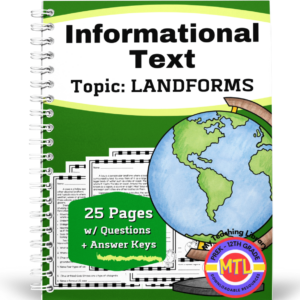
Whether you are simply looking for informational text resources or you are studying landforms, if your teaching grades 5th-8th, this resource is perfect! The resource includes 25 reading pages with questions about a given landform. Questions include both short answer and true/false.
Flesch-Kincaid levels range from 5.5 – 8.3
These are short reading passages with 5 – 7 questions after each.
-
$1.99Add to Cart
This cross-curricular resource will inform and assess students’ understanding of the basic process of photosynthesis. Includes both close reading and a cloze activity.
-
$4.00Add to Cart
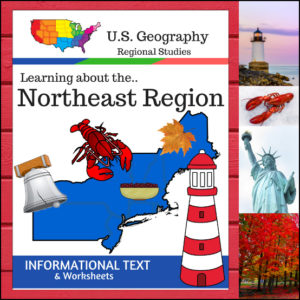
Take your students on a journey through the historic and rugged Northeast Region! This 12-page resource provides a comprehensive “textbook-style” experience without the bulk of a heavy manual. From the Appalachian Mountains to the bustling Atlantic harbors, students will explore the unique identity of this vital corner of the United States.
This resource is designed to be a “one-stop shop” for regional literacy, covering Land and Water, Climate, Products and Natural Resources, Landmarks, Culture, and Food.
🧠 The “How” and “Why” (Educational Benefits)
Why choose this informational text set? It’s built on proven instructional strategies:
- Activates Prior Knowledge: The Anticipation Activity primes the brain for learning, helping students make connections between what they think they know and the new facts they are about to discover. 💡
- Targeted Comprehension: By breaking the text into specific categories (like Climate or Culture), students learn how to scan for information and master the art of non-fiction reading. 📖
- Critical Thinking: The category-specific questions require students to synthesize the text rather than just skimming for a single word.
- Skill Reinforcement: The “State Name Unscramble” provides a fun, low-stakes way to reinforce spelling and geographical recognition of the Northeast states. 🧩
🛠️ Ways to Use This in Your Classroom
- The Foundation of a Unit: Use the informational text as your primary reading material for a week-long deep dive into the Northeast.
- Guided Reading Groups: Break into small groups, assign each group one category (like “Landmarks” or “Food”) to read and present back to the class. If homeschooling, this can be done as a family. 🏫
- Create an Independent Research Station: Place the worksheets in a center or folder for students to complete at their own pace.
- Easy Plans: With clear text, structured questions, and included answer keys, this is the perfect “grab-and-go” resource. 🍎
📝 What’s Inside This 12-Page Resource:
- Textbook-Style Informational Text: High-quality content covering all major regional pillars.
- Anticipation Activity: Get those gears turning before the reading begins!
- Comprehensive Student Worksheets: Detailed questions for every category.
- State Name Unscramble: A fun challenge to wrap up the unit.
- Full Answer Keys: For quick, easy grading. ✅
Pro Tip: For the ultimate hands-on experience, pair this resource with the US Geography – Northeast Scrapbooking Pages! Students can use the facts they learn here to create their own beautiful regional journals.
🚀 Ready to Explore the Northeast?
Give your students a clear, structured, and engaging way to master U.S. Geography.Add the Regions of the U.S. – Northeast Region to your curriculum today and start the adventure!
⭐ This product is included in a $$$ SAVING BUNDLE: Regions of the U.S.A. | Geography Bundle
-
$2.00Add to Cart
This informational resource on Abraham Lincoln is designed to give 5th – 7th graders practice reading and comprehending content area text. There are two pages of text which will cover Lincoln’s life beginning in Kentucky and progresses through his life touching on his family, his career as a lawyer, his election in 1860 and finally his death by the hands of John Wilkes Booth. After reading both the text and two charts (quick facts and fun facts), students will complete a comprehension worksheet. Finally, there is a fun postcard writing activity asking them to write to President Lincoln.
-
$6.00Add to Cart
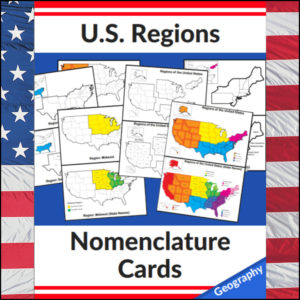
Mastering the map has never been more visual! This set of 20 professional nomenclature cards is the perfect foundational tool for any U.S. geography unit. Based on the 4 regions as defined by the U.S. Census Bureau (Northeast, Midwest, South, and West), these cards provide a clear, structured way for students to visualize how the United States is organized.
From full-color coded keys to black-and-white standalone regional maps, this versatile set helps students transition from “the big picture” to specific regional details with ease.
🧠 The “How” and “Why” (Educational Benefits)
Why use nomenclature cards for geography? It’s all about spatial recognition and scaffolded learning:
- Visual Discrimination: By seeing a region highlighted in color against a grayscale map of the whole U.S., students naturally learn exactly where that region sits in relation to the rest of the country. 📍
- Scaffolded Difficulty: Start with the cards that include state names for guided learning, then transition to the name-free cards to challenge their memory. 🎓
- Standards-Aligned: Because these follow the U.S. Census Bureau divisions, you can be confident your students are learning the most widely accepted geographic classifications used in social studies. ✅
- Versatility: The mix of color and black-and-white versions allows for high-impact visual aids or budget-friendly, student-ready worksheets.
🛠️ Ways to Use These
- Geography Centers: Laminate the color cards and use them as a “match the region” game or sorting activity. 🧩
- Interactive Notebooks: Print the black-and-white versions for students to color in, label, and glue into their social studies journals. 📓
- Flashcard Drills: Use the cards to quiz students on state locations within specific regions (e.g., “Which states are in the Midwest?”). ⚡
- Display: Create a stunning “Geography Wall” using the full-color coded keys as a reference point for students during independent work. 🖼️
🚀 Help Your Students Find Their Way!
Equip your geography explorers with the visual tools they need to master U.S. Geography. Add these US Regions Nomenclature Cards to your teaching toolkit today and watch their map-reading confidence soar! 🌟
UPGRADE and get this BUDNLE: Regions of the U.S.A. | Geography Bundle
-
$7.00Add to Cart
This American Revolution series has been designed for use in both Language Arts and History classes. It includes 10 informational articles for students to read. Each article has a multiple-choice worksheets as well as a short answer worksheet to check student understanding / comprehension of the passages. Answer Keys Provided.
Article Topics:
- Causes of the American Revolution
- The Boston Massacre
- The Boston Tea Party
- Declaration of Independence
- Colonial Leaders of the American Revolution
- British Leaders of the American Revolution
- American Victories of the Revolution
- Independence from Great Britain
- The Treaty of Paris
- Articles of Confederation
Readability levels: 6th-12th Grade
This series is included in The American Revolution | 4th-8th Grades
-
$1.50Add to Cart
This resource includes informational text (1 page) about the U.S. Constitution. It includes a brief history of the document, the basics of what it accomplishes and the intent behind it. The 2nd page includes 5 multiple choice questions. The 3rd includes 5 short answer questions. Answer Key provided.
Flesch-Kincaid Grade Level: 6.0
-
$6.50Add to Cart
This 47-page resource, “Thanksgiving Notebooking Project”, will provide a month full of learning including expository and creative writing, vocabulary and more!
Included:
- Student Project Pages (Cover, Table of Contents, Project KWL and others)
- Informational Text:
– What is Thanksgiving Day?
– Presidential Thanksgiving Proclamations (Washington’s and Lincoln’s)
– History of Thanksgiving
– Symbols of Thanksgiving - Vocabulary List and Cards
(You choose which words fit your students abilities!) - A variety of note-taking, report creating pages designed for multi-age / ability use
– Some are blank with pictures
– Some with these titles: “I’m Thankful for…”, “Life as a Pilgrim”, “Thanksgiving Traditions”, “Thanksgiving History” - 3 Acrostic Poetry pages (Thanksgiving, Turkey, Pilgrim)
- Several FUN pages including 2 word search puzzles
Watch a preview video.
Use year after year! -
$3.25Add to Cart
Bird of the Arctic – Willow Ptarmigan is a cross-curricular resource (Reading, Writing, Science and Geography) that you can use as a stand alone product or as a supplement to related thematic and/or unit studies. Great to use if you are studying: Habitats, Arctic animals, Alaska, Birds, State birds, Ornithology