


Description
All-Access members do not pay for this or any resource.
Become an All-Access member today!
________________________
|
Get the MOST from My Teaching Library by connecting with us here: |

$2.00
Students love to learn about animals and this resource will have students reading about the sloth, an elusive Amazon rainforest animal!
First, students will read information text that will tell students about sloths: habitat, diet, behavior and predators.
After reading, students may be assigned one or both included worksheets: (Fill-in the Blank | Short Answer)
There is also an image students may color.
Answer keys included
You may also like:
All-Access members do not pay for this or any resource.
Become an All-Access member today!
________________________
|
Get the MOST from My Teaching Library by connecting with us here: |
Only logged in customers who have purchased this product may leave a review.
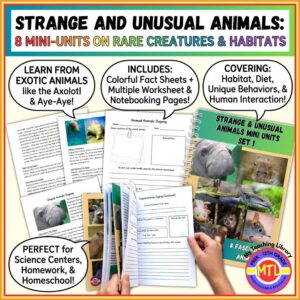
Are you looking to spice up your science curriculum? Spark student curiosity and wonder with this deep dive into the world’s most peculiar creatures!
This comprehensive set features 8 mini-units designed to take students on a journey to meet animals they won’t find in a typical textbook. From the depths of the water to the heights of the rainforest canopy, your students will become experts on the “weird and wonderful.”
Each of the 8 mini-units is packed with engaging information and vibrant, colorful photos to keep young learners hooked. Students will explore:
Physical Characteristics: What makes them look so unique? 🦎
Habitats & Locations: Where in the world do they hide? 🗺️
Dietary Habits: What’s on the menu for a Fossa or a Dugong? 🌿
Human Interaction: Are they pets, or are they better left in the wild? 🏠
Mind-Blowing Facts: The “strange” details that make these animals unforgettable! 💡
Gharial (The long-snouted crocodilian)
Dugong (The “sea cow” of the ocean)
Capybara (The world’s largest, chillest rodent)
Blue-Tongued Skink (A reptile with a colorful surprise)
Axolotl (The smiling salamander)
Aye-Aye (The mysterious primate of Madagascar)
Elephant Shrew (Tiny, fast, and trunk-nosed)
Fossa (The elusive predator of the forest)
Vibrant Visuals: Real-life photos bring the science to life! 📸
Active Learning: Every unit includes 2 notebooking pages per animal to test comprehension and encourage research.
Extension Activities: Includes a “Taking it Further” section with creative suggestions for projects and deep-dives to keep the momentum going! 🚀
Low Prep: Just print and go—perfect for science centers, independent study, or a “Creature of the Week” feature.
If your students fall in love with these rare creatures, don’t stop here!
Grab Strange and Unusual Animals | Set 2

This informational article will teach students about a very important Christian holiday – Easter. After reading a one page article, students will have two worksheets to assess their reading comprehension and understanding of the material.
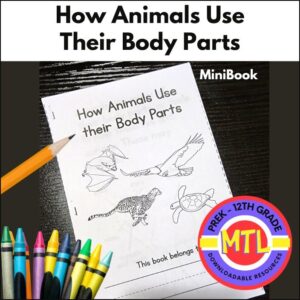
A fun to create, Science mini-book teaching students how different animals use their body parts as tools to live and survive! Once students finish creating this 10 page mini-book, they will be able to give examples of how 7 animals use their body parts to get nourished, move within its environment and even stay protected from predators!
Animals included in this project are the cheetah, bat, loggerhead turtle, badger, kangaroo, deer and tundra swan. There is also a image of a wolf with showing various body parts often used to accomplish an animal’s survival.
Students will color, draw and write to complete the book.
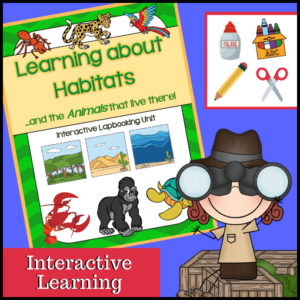
This unit on habitats and the animals that live in each is an interactive learning unit that allows students to be hands-on and create a beautiful project be the completion of the study! Use as a mini-course, in a Science center or in conjunction with another habitat study.
Use the complete unit (or) use only parts of it. Designed for 2nd-4th grades so it has been designed to work well with multiple ages/grades.
Includes:
– Instructions
– Informational text (Definition of habitat plus information on these 8 different habitats: desert, forest, ocean, arctic, wetlands, grasslands, rainforest and jungle)
– Suggested book recommendations for further study
– Project pieces (cover pages, vocabulary, definitions, habitat cards, mini-book, habitat flapbooks, habitat pockets to insert included animal cards, basic needs spinning template, favorite animal templates plus clip art)
Comes in both black/white pages as well as color (so you decide if you want to print using color ink or not as well as if you want your students to color or not).
See included habitats and animals in description below.


Reviews
There are no reviews yet.