
Shop
Showing 241–260 of 1927 resultsSorted by latest
-
 $1.50Add to Cart
One of the first capitalization rules taught is to always capitalize the first word of a sentence! This resource gives students the ability to practice identifying the capitalization of first words as well as practice using the rule when copying given sentences.
-
 $1.50Add to Cart
Give students the practice they need to correctly use commas in a series with this resource! Includes two worksheets, one that will ask students to identify commas correctly used in a series and one that will have students place commas where they should be. Use as practice during initial learning, for review or as an assessment.
-
 $1.50Add to Cart
Give students the practice they need to correctly use commas when writing dates with this resource! Includes two worksheets that will ask students to write given dates using commas in the correct places: after the day of the week, and between the date and the year. Use as practice during initial learning, for review or as an assessment.
-
 $2.00Add to Cart
Six posters to help students understand the following punctuation marks: apostrophe, quotation marks, comma, question mark, exclamation point and a period. Each poster has a cute picture, an explanation of when the specific punctuation is used and at least one example.
-
 $1.50Add to Cart
An early grammar skill for students to learn is to identify by name three types of punctuation: a period, question mark and exclamation mark. Here are two worksheets that will help students demonstrate their knowledge and ability to do just that!
-
 $1.50Add to Cart
An early grammar skill for students to learn is to identify a word versus a sentence, using those terms. Here are two worksheets that will help students demonstrate their knowledge and ability to do just that!
-
 $2.25Add to CartThis “What is a Sentence?” resource includes two colorful teaching posters and 6 different student pages for students to demonstrate what they have learned! Students will learn the definition of a simple sentence, that a sentence has two parts, the first word is capitalized and always ends with punctuation.The first 3 student pages will give a simple sentence and students are asked to identify (circle) the first word, underline the capital letter of that first word and circle the punctuation. They will then copy the sentence and draw a picture to represent the sentence.The last 3 student pages will give a simple sentence and students are asked to identify both the ‘naming part’ and the ‘telling part’ of the sentence. They will then copy the sentence and draw a picture to represent the sentence.
-
 $9.00Add to Cart
This is an in-depth novel study of Louis Sachar’s Holes in which students will delve into literary elements of the book, analyze various topics and themes, write arguments and opinions, conduct research and more! This unit is designed for advanced 6th-8th graders and High School students.
(See description below for more details) -
 $3.00Add to Cart
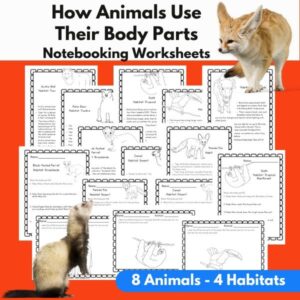
In this unit study, students will learn how 8 different animals (4 different habitats) use many of their body parts to live and survive. For each animal, students will be given a fact sheet, a short answer worksheet and a worksheet on which they will label and describe the specific body parts and how they are used.
Animals covered in this unit are:
– Desert Habitat: Camel, Fennec Fox
– Grasslands: Black-footed Ferret, Bison
– Tropical Rainforest: Sloth, Toucan
– Tundra: Polar Bear, Arctic Wolf -
 $3.00Add to Cart
This unit is designed to give students practice reading and answering questions on the given scientific and historic informational provided in the text. The main subject of the text: Spring migration of swallows returning to the historic Mission San Juan Capistrano. After reading, students will be asked to answer multiple choice and short answer questions.
For further expansion of the lesson, there are 6 math word problems and a research, writing assignment.
Readability Grades:
- Flesch-Kincaid Grade Level: 6.1
- Gunning Fog Index: 7.7
-
 $2.50Add to Cart
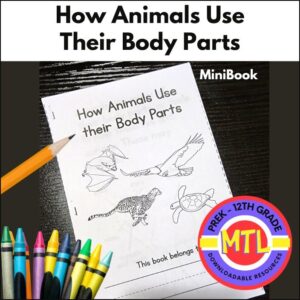
A fun to create, Science mini-book teaching students how different animals use their body parts as tools to live and survive! Once students finish creating this 10 page mini-book, they will be able to give examples of how 7 animals use their body parts to get nourished, move within its environment and even stay protected from predators!
Animals included in this project are the cheetah, bat, loggerhead turtle, badger, kangaroo, deer and tundra swan. There is also a image of a wolf with showing various body parts often used to accomplish an animal’s survival.
Students will color, draw and write to complete the book.
-
 $1.50Add to Cart
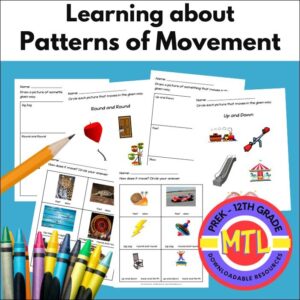
Learning about various patterns of movement is an important Kindergarten and 1st grade Science concept that is introduced in these worksheets! The movements covered include:
– fast / slow
– ziz zag
– round and round
– straight line
– up and down
– back and forth -
 $3.00Add to Cart
Create your very own homeschool ID cards with this product, both an educator and a student ID! All you need is to download this resource, open with a pdf program, click the various fields to type in your information, upload a current photos and print! (Directions included)
-
 $2.25Add to Cart
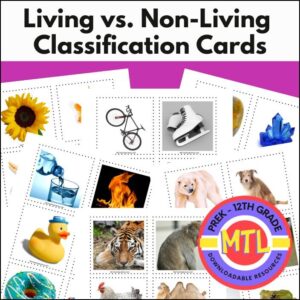
Here is a set of 36 science classification cards to give students the ability to classify living and nonliving things! These cards include beautiful color photos of 36 different items plus two sets of classification mats.
-
 $2.25Add to Cart
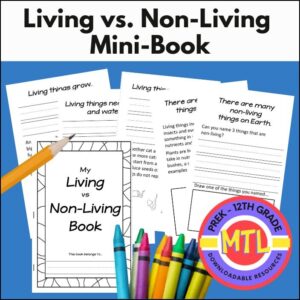
This living vs. nonliving booklet is perfect for kindergarten and 1st grade students just learning the science concept. It includes a cover page and 5 inside pages that will teach students that living things grow, need food and water as well as reproduce.
-
 $2.50Add to Cart
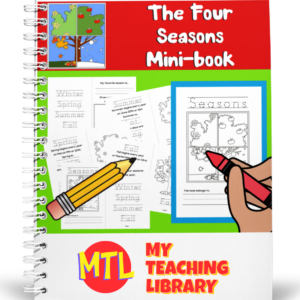
Students will learn about the four seasons, (winter, spring, summer and fall) while creating a cherished 12 page science mini-book! For each season, students will learn when that season begins and a fact about it.
Example: For spring, students will learn that spring begins every year on March 19th or 20th and that spring is warm and flowers begin to grow. Whey will be coloring, as well as tracing words and pictures! (Some seasons have more than one date when it may begin, as you see in the spring example. This allows this resource to be used every year and can be a springboard to a discussion as to why this is true if appropriate.)
-
 $3.00Add to Cart
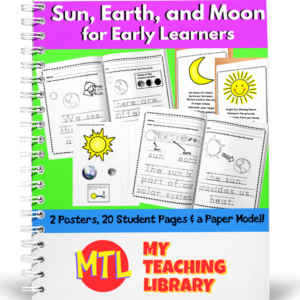
This unit is designed to help early learners learn about the sun, earth and moon through fun, engaging activities! Students will learn that the sun supplies heat and light to the earth, that the moon reflects light from the sun and rotates around the earth, that there are different phases of the moon (specifically in this unit: full, half and crescent), and more! Includes:
– 2 posters
– 20 student pages
– 1 interactive model craft -
 $5.25Add to Cart
Telling time is an important Math skill to learn in the 1st, 2nd and 3rd Grades. This math unit will give you everything you need to teach this skill! This resource includes:
– 5 Posters
– 84 Student Pages (See detailed description below)
– Answer Keys -
 $2.50Add to Cart
Hands-on activities and worksheets designed for 2nd grade students learning measurement skills such as using a variety of measurement tools (ruler, yardstick, meter stick and tape measure), finding two different measurements for objects (inches and centimeters), estimating measurements, and solving measurement word problems (with bonus if converting inches to feet and inches).
-
 $3.50Add to Cart
Hands-on activities and worksheets designed for students learning measurement skills such as:
- – Reading a ruler and using to measure objects (inches and centimeters)
- – Determining the best measurements (inches, feet, yards, miles / ounce, pounds / centimeter, meter, kilometer)
- – Tools of measurement
- – Reading a measuring cup
- – Comparing objects that have been measured


