
Category: Science
Showing 101–105 of 105 resultsSorted by latest
-
 $2.50Add to Cart
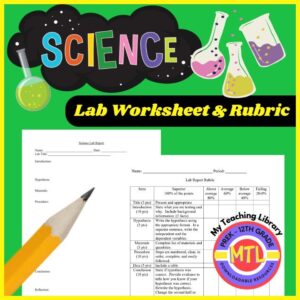
This Science lab worksheet and rubric will give your middle school and high school students an organized way to report the entire process of a science lab. Plus, the rubric can be given to students in advance so that they will know all of the criteria you are expecting! Use again and again, throughout the year for all your labs
There are sections for students to record…
- – Lab title
- – Introduction (Students are to state what they are testing and why plus give background information)
- -Hypothesis (Students are to write their hypothesis plus give the independent and dependent variables)
- -Materials (A complete list of materials)
- – Procedure (Students are to give detailed numbered steps that were followed)
- – Data (Should include a table)
- – Conclusion (Students will state if their hypothesis was correct, providing evidence. Change the hypothesis is necessary.)
- – Reflection (Students should list at least two sources of possible error)
The grading rubric makes it easy for YOU to grade!
-
$4.50Add to Cart
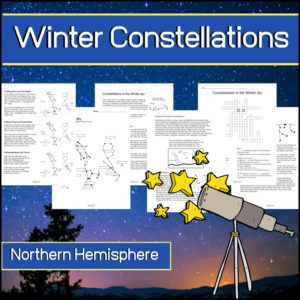
Explore the Northern Hemisphere’s Winter constellations with this resource! Students will learn…
- What are the major constellations?
- What is the Greek Mythology behind them?
- What major stars will help guide them through the night sky?
- How is Orion the ‘key’ to locating the main constellations?
- What is the name of the North Star, and which constellation is it in?
- What is the brightest star in the sky?
Students will learn about the following constellations:
- Orion
- Canis Major
- Canis Minor
- Gemini
- Auriga
- Pleiades
- Taurus
- Draco
- Ursa
- Major
- Ursa Minor
- Cepheus
- Cassiopeia
They will learn the location of the following stars:
- Pollux
- Castor
- Capella
- Procyon
- Sirius
- Betelgeuse
- Rigel
- Aldebaran
- Capella
- Polaris
They will also learn which constellations are called the Northern Circumpolar constellations PLUS the Greek Mythology behind these major constellations!
Student activity sheets include:
- Fill in the blank (constellation and star names for the ‘Winter Sky’)
- Draw and name (the five circumpolar constellations and the North Star)
- Crossword Puzzle (in which they will use the information within the resource to gather answers)
Suggested follow up activities:
- Assign students to go outside after dark, find and draw the constellations they see and can identify.
- Visit a local planetarium
-
$1.50Add to Cart
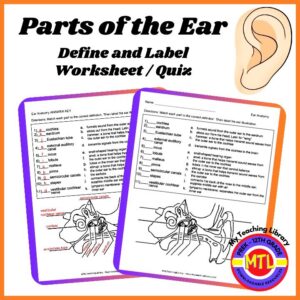
A ready-to-print and use worksheet that will have students define and label parts of the human ear. Answer key provided.
Great learning tool or quiz!
Parts: cochlea, eardrum, Eustachian tube, external auditory canal, incus, lobule, malleus, pinna, semicircular canals, stapes, vestibular cochlear nerve
-
$3.25Add to Cart
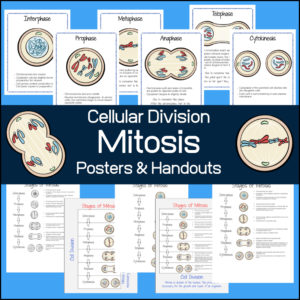
Let’s face it: Trying to explain the “dance of the chromosomes” without clear visuals is a recipe for confused faces. This resource simplifies the complex process of cellular division into digestible, visually engaging steps.
🔍 What’s Inside?
This resource covers the full cycle of mitosis, ensuring your students see the “big picture” of how cells replicate.
The Phases Outlined:
- Interphase: The prep work (DNA replication).
- Prophase: Chromosomes condense and the party starts.
- Metaphase: Everyone aligns in the middle.
- Anaphase: The great separation.
- Telophase: Two new nuclei form.
- Cytokinesis: The final split!
Included Versions:
- 🎨 Full Color: Perfect for high-impact classroom decor or digital presentations.
- 🗒️ Black & White: Ideal for student handouts, coloring activities, or saving on ink.
- ✍️ With Explanations: Includes detailed text describing the events of each phase.
💡 Why You’ll Love This
1. Visual Clarity for Abstract Concepts Mitosis is hard to visualize! These posters provide a clear “anchor” for students to refer back to when they get stuck on the difference between anaphase and telophase.
2. Differentiation Made Easy With both “labeled” and “blank” versions, you can easily scaffold your instruction. Use the labeled version for an introductory lecture and the blank version for a formative assessment.
3. Saves You Prep Time Stop scouring the internet for clear, high-quality diagrams. These are ready to print and use immediately. ☕🏫 Suggested Grade Levels & Subjects
- Grades: 6th – 10th Grade
- Subjects: Life Science, General Science, and Biology
-
$15.00Add to Cart
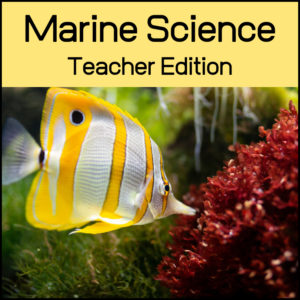
Marine Science Teacher Edition to use alongside the Marine Science Student Edition
Units include: The Hydrosphere, Measuring the Ocean, The Nature of Seawater, Waves, Tides, Ocean Currents, The Ocean Floor, Ocean Sediments, Food Chains & Webs, Ocean Zones, Near-shore Ecosystems, Plankton, Marine Plants, Classifying Marine Animals, Cold-blooded Swimmers, Marine Mammals, Marine Pollution, Marine Resources