
Category: Life Sciences
Showing 81–100 of 258 resultsSorted by latest
-
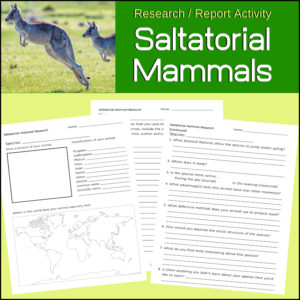
 $2.50Add to CartOne way of categorizing animals is how they move. Mammals that are designed to jump, hop, gallop, or leap are called Saltatorial mammals such as the kangaroo, leopard, rabbit, horse, antelope and many others! This product is perfect to use as a research and report assignment to have students study mammals that jump, hop, gallop and/or leap! It will guide students through their research and can be used as the end reporting tool!
 -
$2.50Add to Cart
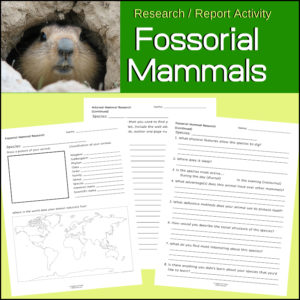
Burrowing, ground dwelling mammals are known as fossorial mammals. Fossorial comes from the Latin fossor, meaning “digger”, thus mammals such as groundhogs, gophers, moles, rabbits and others are in this group. This resource will help students research and report on fossorial mammals as it guides students through their research and can be used as the end reporting tool!
-
$2.50Add to Cart
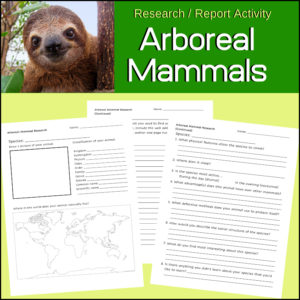
During a study of animals (specifically tree-dwelling, arboreal mammals), students can use this product to research and report on animals such as the koala, monkey, sloth or possum. Any tree dwelling mammal is considered arboreal. Students can use this product as both a guide to their research as well as the end reporting tool!
-
$2.50Add to Cart
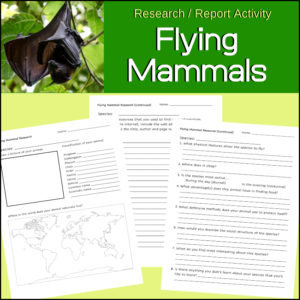
In the Science field of Zoology there is a group of mammals that are considered ‘flying’ mammals. This product makes it easy to assign students to research and report on one of these ‘flying’ mammals! Students will be able to use the product to both guide their research and use as their reporting tool.
-
$1.25Add to Cart
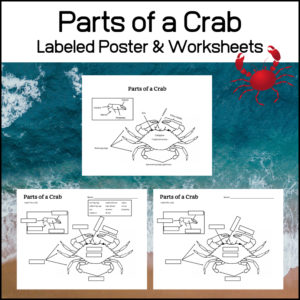
Is your Science class studying (or preparing to study) ocean life, crustaceans or the phylum Arthropoda? This resource, Parts of a Crab – Poster & Worksheets, includes a labeled poster of a crab and 2 worksheets (or quizzes).
-
$3.00Add to Cart
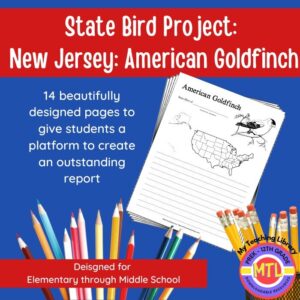
Studying the state of New Jersey and state symbols? What is the state bird of New Jersey? This project-based unit is designed to help students study and record information about New Jersey’s state bird: American Goldfinch
⭐Included:
– A map page (for the state)
– Scientific classification page
– A page for students to give details about the bird’s physical description, habitat, diet, life span and reproduction
– A page where students will do additional map work to show where in the U.S. the bird lives in addition to migration information
– Coloring page
– Several pages on which students can use for expository and/or creative writing as well as sections in which students may draw.⭐ 14 pages in all and is designed for different levels / abilities.
My Teaching Library has a notebooking set for each of all 50 states. In addition, you can get all of them bundled!
Here are other bird related products you’ll love…
-
$8.00Add to Cart
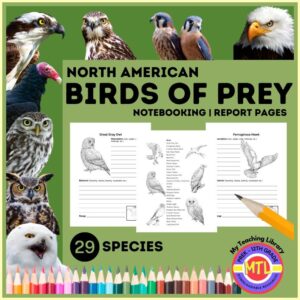
‘North American Birds of Prey’ is a 41-page resource designed to help students organize and present reports for each 29 different birds of prey species!
Each species-specific page includes the name of the bird, an illustration and the following sections: description (size, weight, color, markings, etc.), behavior (breeding, nesting, feeding, vocalization, etc.) and range plus a map of North America.
In addition to the species-specific pages, there are ten additional pages on which students can included additional information, draw their own illustrations, plus add additional species to their projects.
Use alone or add to your lessons: North American Birds of Prey Cards
This resource includes pages for the following birds:
• Great Gray Owl
• Ferruginous Hawk
• Common Black Hawk
• Red-Tailed Hawk
• Barred Owl
• Barn Owl
• Short-Eared Owl
• Prairie Falcon
• Swainson’s Hawk
• Snowy Owl
• Turkey Vulture
• Eastern Screech Owl
• Burrowing Owl
• American Swallow-Tailed Kite
• Elf Owl
• Osprey
• American Kestrel
• Peregrine Falcon
• Bald Eagle
• Northern Goshawk
• Merlin
• Golden Eagle
• Northern Harrier
• Northern Saw-Whet Owl
• Crested Caracara
• Great Horned Owl
• Sharp-Shinned Hawk
• Harris Hawk
• Long-Eared Owl -
$1.50Add to Cart
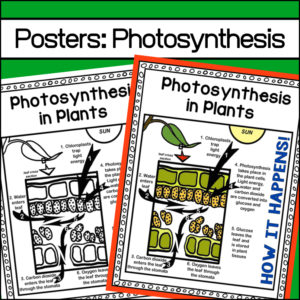
Here are 2 posters (b/w and color) of the process of photosynthesis.
-
$4.50Add to Cart
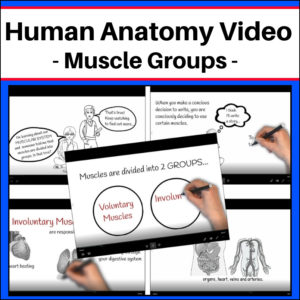
Human Anatomy – Muscle Groups Video has been created to introduce, explain and/or review voluntary and involuntary muscles in the human body. Each group is defined, explained and definitions given. This is great for visual learners!
To add student interest, one student is helping another student learn, interesting graphics have been added and upbeat music fills the background. (Music is easily muted if needed.)
-
$1.50Add to Cart
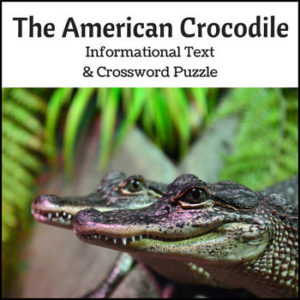
Designed for 5th-8th grade students, American Crocodile Informational Text and Crossword Puzzle will provide students with details about the only crocodile native to the Americas in the following categories:
* Appearance
* Differences from alligators
* Distribution and Habitat
* Food and Growth
* ReproductionAfter reading the text (3 pages), students are to complete the crossword puzzle. Answer Key provided.
-
$8.00Add to Cart
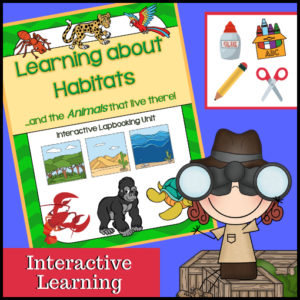
This unit on habitats and the animals that live in each is an interactive learning unit that allows students to be hands-on and create a beautiful project be the completion of the study! Use as a mini-course, in a Science center or in conjunction with another habitat study.
Use the complete unit (or) use only parts of it. Designed for 2nd-4th grades so it has been designed to work well with multiple ages/grades.
Includes:
– Instructions
– Informational text (Definition of habitat plus information on these 8 different habitats: desert, forest, ocean, arctic, wetlands, grasslands, rainforest and jungle)
– Suggested book recommendations for further study
– Project pieces (cover pages, vocabulary, definitions, habitat cards, mini-book, habitat flapbooks, habitat pockets to insert included animal cards, basic needs spinning template, favorite animal templates plus clip art)Comes in both black/white pages as well as color (so you decide if you want to print using color ink or not as well as if you want your students to color or not).
See included habitats and animals in description below.
-
$15.00Add to Cart
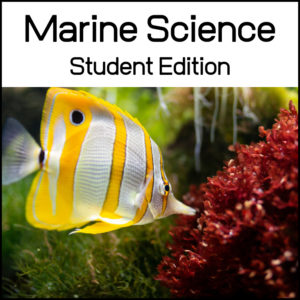
Complete Marine Science Student Curriculum
Units include: The Hydrosphere, Measuring the Ocean, The Nature of Seawater, Waves, Tides, Ocean Currents, The Ocean Floor, Ocean Sediments, Food Chains & Webs, Ocean Zones, Near-shore Ecosystems, Plankton, Marine Plants, Classifying Marine Animals, Cold-blooded Swimmers, Marine Mammals, Marine Pollution, Marine Resources
Get your Teacher’s Guide here!
-
$2.00Add to Cart
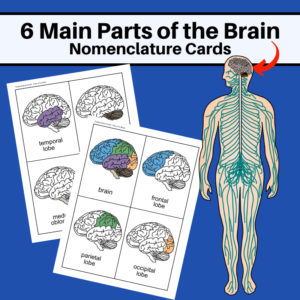
6 Main Parts of the Brain – Human Anatomy Nomenclature Cards – This resource will help students learn and study the following parts of the brain: frontal lobe, parietal lobe, occipital lobe, temporal lobe, cerebellum and the medulla oblongata.
-
$1.25Add to Cart
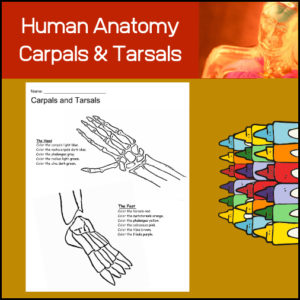
On this one page worksheet titled Carpals and Tarsals, students identify the bones of the hands (+ wrist and lower arm) and feet (+ lower leg): carpals, metacarpals, phalanges, radius, ulna, tarsals, metatarsals, phalanges, calcaneus, tibia and fibula.
Suggested uses: Use in a Science center when studying human anatomy, give as homework or use as a quick quiz. Answer key is provided.
-
$1.99Add to Cart
This cross-curricular resource will inform and assess students’ understanding of the basic process of photosynthesis. Includes both close reading and a cloze activity.
-
$2.00Add to Cart
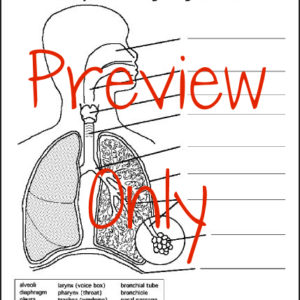
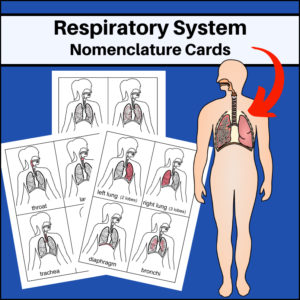
Respiratory System – Human Anatomy Nomenclature Cards – This resource will help students learn and study the location of the following parts of the respiratory system: left lung, right lung, diaphragm, bronchi, bronchioles, alveoli, sinus cavity, nose, throat, larynx, trachea, and pleura. There are also 4 extra diagrams with no labels for you to use as you wish…such as give to students to have them color in and label the cards for themselves!
-
$5.00Add to Cart
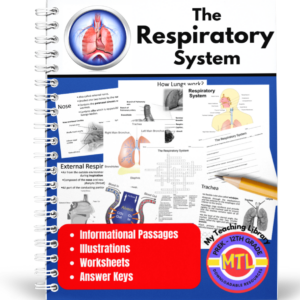
Students will learn all about the respiratory system with this resource designed for middle and high school biology / anatomy students. Students will learn about the nose, pharynx, larynx, trachea, lungs, pleura, diaphragm and more.
This resource includes:
- 22 informational pages with details and illustrations
- 8 posters
- 6 worksheet pages (a 3 page detailed short answer worksheet to use along side the informational pages, 2 labeling worksheets and a crossword puzzle)
- answer keys
-
$3.00Add to Cart
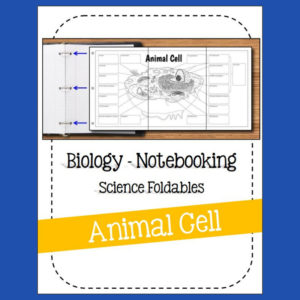
High School Biology Notebook resource!
Students will learn the following terms: peroxisome, cilium, centriole, lysosome, cell / plasma membrane, cytoplasm, mitochondrion, smooth endoplasmic reticulum, flagellum, cytoskeleton, nuclear pores, nuclear membrane / envelope, DNA, nucleolus, nucleus, rough endoplasmic reticulum, ribosomes, Golgi body, Golgi vesicles