
Tag: science
Showing 81–100 of 101 resultsSorted by latest
-
 $2.00Add to Cart
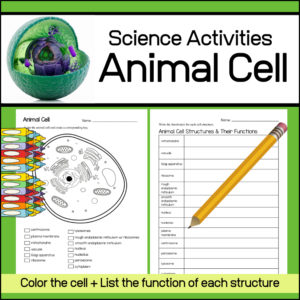
This Science / Biology resource includes 2 activity worksheets for students to help them review the structures / organelles of an animal cell and the main function(s) of each. Structures /organelles include: centrosome, plasma membrane, mitochondria, vacuole, Golgi apparatus, ribosome, lysosomes, rough endoplasmic reticulum, smooth endoplasmic reticulum, nucleus, nucleolus, peroxisome, cytoplasm
-
 $2.50Add to Cart
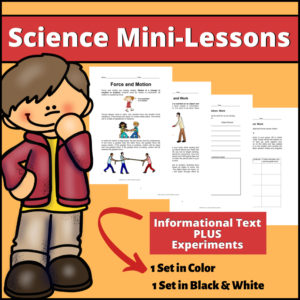
Studying ‘Force & Motion‘ in your classroom? This Mini-Lessons resource has been designed to help students gain a greater understanding as well as to help them retain the information they are learning!
Includes:
- 2 Instructional text pages ( 1 on Force and Motion and 1 one on Force, Motion and Work)
- 2 Experiments (1 Cooperative Group experiment focusing on how ‘unbalanced forces cause motion‘ and to show ‘how energy can be transferred’. )
- 1 Worksheet Activity (Students will find and list examples of ‘machines and work‘ as well as draw an illustration.
-
 $2.00Add to Cart
Studying ‘Forces & Magnets‘ in your classroom? This Mini-Lessons resource has been designed to help students gain a greater understanding as well as to help them retain the information they are learning!
-
$3.00Add to Cart
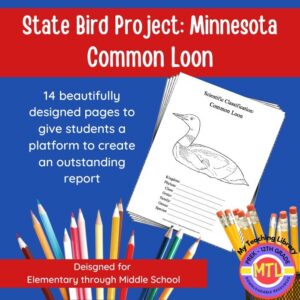
Studying the state of Minnesota and state symbols? What is the state bird of Minnesota?
This project-based unit is designed to help students study and record information about Minnesota’s state bird: Common Loon
What type of pages are contained in this set:
– A map page (for the state)
– Scientific classification page
– A page for students to give details about the bird’s physical description, habitat, diet, life span and reproduction
– A page where students will do additional map work to show where in the U.S. the bird lives in addition to migration information
– Coloring page
– Several pages on which students can use for expository and/or creative writing as well as sections in which students may draw.14 pages in all and is designed for different levels / abilities.
My Teaching Library has a notebooking set for each of all 50 states. In addition, you can get all of them bundled!
Here are other bird related products you’ll love…
-
$3.00Add to Cart
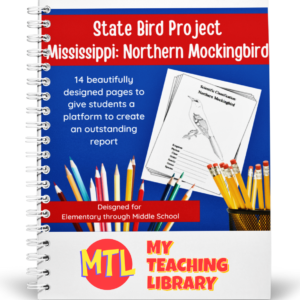
Studying the state of Mississippi and state symbols? What is the state bird of Mississippi?
This project-based unit is designed to help students study and record information about Mississippi’s state bird: Northern Mockingbird
⭐Included:
– A map page (for the state)
– Scientific classification page
– A page for students to give details about the bird’s physical description, habitat, diet, life span and reproduction
– A page where students will do additional map work to show where in the U.S. the bird lives in addition to migration information
– Coloring page
– Several pages on which students can use for expository and/or creative writing as well as sections in which students may draw.⭐ 14 pages in all and is designed for different levels / abilities.
My Teaching Library has a notebooking set for each of all 50 states. In addition, you can get all of them bundled!
Here are other bird related products you’ll love…
-
$3.00Add to Cart
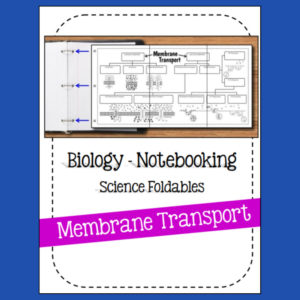
High School Biology Notebook resource!
Students will learn all about the cell membrane. Terms include: passive transport, active transport, diffusion, osmosis, facilitated diffusion, molecular active transport, bulk transport, primary active transport, secondary active transport, exocytosis, endocytosis, phagocytosis, pinocytosis, receptor mediated endocytosis
-
$3.00Add to Cart
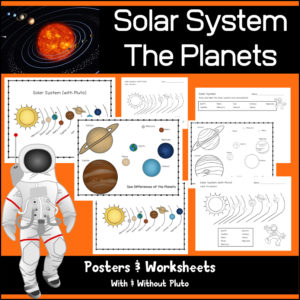
This Solar System product will help students learn and reinforce their knowledge of the order of the planets and to be able to visual size differences of the planets! Each color poster has a duplicate b/w poster that can be used as a student handout. There are also worksheets for students to complete (with and without word banks). This resource provides 2 sets of all resources – One which includes the dwarf planet of Pluto and one that does not.
-
$3.00Add to Cart
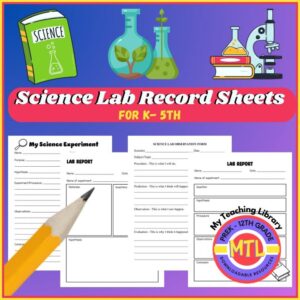
Science Experiment Lab Record Worksheets will give your students the ability to organize their activities, observations and conclusions for any experiment!
There are 3 different worksheets from which to choose:
#1: “Science Labe Observation Form” – 1 page
– Students will name themselves as the ‘scientist’ and will be given sections to name the subject/topic, give details for the procedure (what they will do), their prediction (what they think will happen, their observations (what they saw) and an evaluation (why they think the result happened and what was learned).#2: “Lab Report” – 2 pages
– First page (completed prior to the experiment): Students will name the experiment, list materials, questions they have and their hypothesis.
– Second page (completed after the experiment): Students will name the specific question they are testing, restate their hypothesis, detail the procedure and observations and then write their conclusions.#3: “My Science Experiment” – 1 page
– Students will state the purpose of the experiment, their hypothesis, detail the procedure, give their observations and write their conclusions. -
$1.00Add to Cart
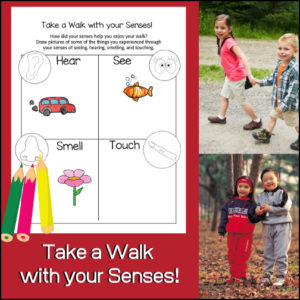
This worksheet has been designed for students to complete after taking a walk! While they walk, remind them of their senses (specifically hearing, seeing, smelling and touching). Once the walk is over, students will complete this worksheet by drawing pictures of what they experienced through those four senses.
-
$4.00Add to Cart
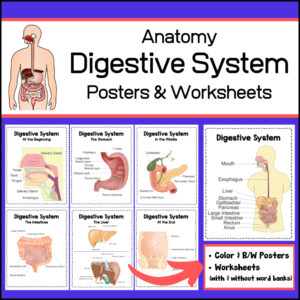
This ANATOMY / BIOLOGY / HEALTH resource includes 7 sets of posters and worksheets for your classroom, all involving human digestion. Each poster comes in color (great for bulletin boards) and b/w (great for student handouts) and each worksheet comes with and without a word bank.
-
$3.00Add to Cart
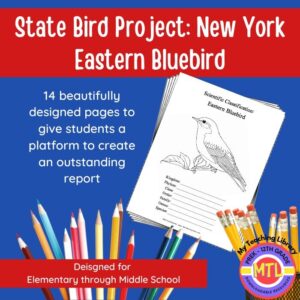
Studying the state of New York and state symbols? What is the state bird of New York?
This project-based unit is designed to help students study and record information about New York’s state bird: Eastern Bluebird
What type of pages are contained in this set:
– A map page (for the state)
– Scientific classification page
– A page for students to give details about the bird’s physical description, habitat, diet, life span and reproduction
– A page where students will do additional map work to show where in the U.S. the bird lives in addition to migration information
– Coloring page
– Several pages on which students can use for expository and/or creative writing as well as sections in which students may draw.14 pages in all and is designed for different levels / abilities.
-
$3.00Add to Cart
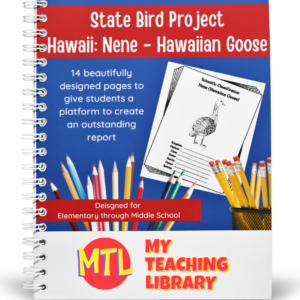
Studying the state of Hawaii and state symbols? What is the state bird of Hawaii?
This project-based unit is designed to help students study and record information about Hawaii’s state bird: Nene – Hawaiian Goose
What type of pages are contained in this set:
– A map page (for the state)
– Scientific classification page
– A page for students to give details about the bird’s physical description, habitat, diet, life span and reproduction
– A page where students will do additional map work to show where in the U.S. the bird lives in addition to migration information
– Coloring page
– Several pages on which students can use for expository and/or creative writing as well as sections in which students may draw.14 pages in all and is designed for different levels / abilities.
My Teaching Library has a notebooking set for each of all 50 states. In addition, you can get all of them bundled!
Here are other bird related products you’ll love…
-
$2.50Add to Cart
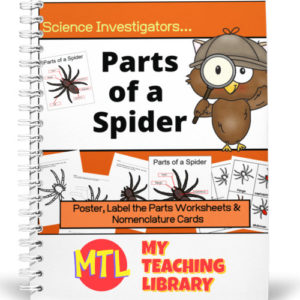
Help students learn the parts of a spider with this fun arachnid resource! Students will learn the following parts: eyes, fangs, cephalothorax, abdomen, spinnerets, legs.
Includes:
- – Color poster
- – 2 Worksheets – One for students to write and label, the other to cut and paste.
- – 1 Science Center activity
- – Nomenclature flashcards – Labeled
- – Blank Cards for students to complete
-
$3.00Add to Cart
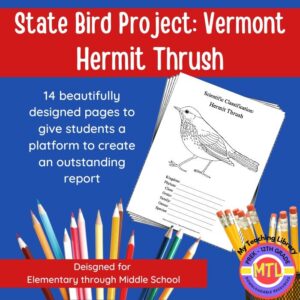
Studying the state of Vermont and state symbols? What is the state bird of Vermont?
This project-based unit is designed to help students study and record information about Vermont’s state bird: Hermit Thrush
What type of pages are contained in this set:
– A map page (for the state)
– Scientific classification page
– A page for students to give details about the bird’s physical description, habitat, diet, life span and reproduction
– A page where students will do additional map work to show where in the U.S. the bird lives in addition to migration information
– Coloring page
– Several pages on which students can use for expository and/or creative writing as well as sections in which students may draw.14 pages in all and is designed for different levels / abilities.
My Teaching Library has a notebooking set for each of all 50 states. In addition, you can get all of them bundled!
Here are other bird related products you’ll love…
-
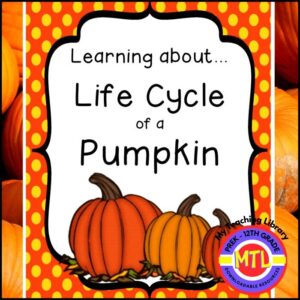
$3.00Add to CartThis unit covers the life cycle of a pumpkin!Includes:
-
B/W Life Cycle poster
-
Color Life Cycle poster
-
Word Wall Vocabulary
-
Sequencing cards
-
Life Cycle Worksheet (Cut-n-paste)
-
Life Cycle Vocabulary matching
-
Life Cycle Drawing
-
Life Cycle Shape Book activity
-
(Bonus Coloring page AND Pumpkin Seeds for counting)
-
-
$4.50Add to Cart
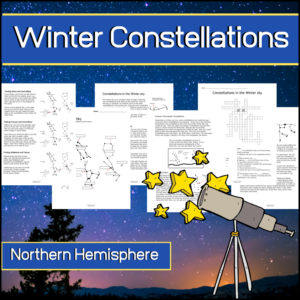
Explore the Northern Hemisphere’s Winter constellations with this resource! Students will learn…
- What are the major constellations?
- What is the Greek Mythology behind them?
- What major stars will help guide them through the night sky?
- How is Orion the ‘key’ to locating the main constellations?
- What is the name of the North Star, and which constellation is it in?
- What is the brightest star in the sky?
Students will learn about the following constellations:
- Orion
- Canis Major
- Canis Minor
- Gemini
- Auriga
- Pleiades
- Taurus
- Draco
- Ursa
- Major
- Ursa Minor
- Cepheus
- Cassiopeia
They will learn the location of the following stars:
- Pollux
- Castor
- Capella
- Procyon
- Sirius
- Betelgeuse
- Rigel
- Aldebaran
- Capella
- Polaris
They will also learn which constellations are called the Northern Circumpolar constellations PLUS the Greek Mythology behind these major constellations!
Student activity sheets include:
- Fill in the blank (constellation and star names for the ‘Winter Sky’)
- Draw and name (the five circumpolar constellations and the North Star)
- Crossword Puzzle (in which they will use the information within the resource to gather answers)
Suggested follow up activities:
- Assign students to go outside after dark, find and draw the constellations they see and can identify.
- Visit a local planetarium
-
$2.50Add to Cart
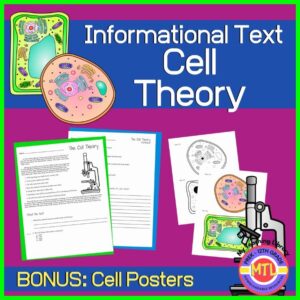
A great introductory lesson on Cell Theory for your Science students. The text will teach students about the contributions of scientists Robert Hooke, Matthias Schleiden, Theodor Schwann and Rudolf Virchow. It lists the 3 basics of Cell Theory as well as the 3 ‘modern’ ideas that have been added to Cell Theory.
This resource includes:
- Informational Text
- Assessment of student understanding (multiple choice and short essay)
- Answer Key
- BONUS: B/W and Color posters of animal and plant cells.
-
$3.25Add to Cart
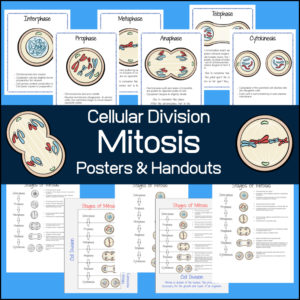
Let’s face it: Trying to explain the “dance of the chromosomes” without clear visuals is a recipe for confused faces. This resource simplifies the complex process of cellular division into digestible, visually engaging steps.
🔍 What’s Inside?
This resource covers the full cycle of mitosis, ensuring your students see the “big picture” of how cells replicate.
The Phases Outlined:
- Interphase: The prep work (DNA replication).
- Prophase: Chromosomes condense and the party starts.
- Metaphase: Everyone aligns in the middle.
- Anaphase: The great separation.
- Telophase: Two new nuclei form.
- Cytokinesis: The final split!
Included Versions:
- 🎨 Full Color: Perfect for high-impact classroom decor or digital presentations.
- 🗒️ Black & White: Ideal for student handouts, coloring activities, or saving on ink.
- ✍️ With Explanations: Includes detailed text describing the events of each phase.
💡 Why You’ll Love This
1. Visual Clarity for Abstract Concepts Mitosis is hard to visualize! These posters provide a clear “anchor” for students to refer back to when they get stuck on the difference between anaphase and telophase.
2. Differentiation Made Easy With both “labeled” and “blank” versions, you can easily scaffold your instruction. Use the labeled version for an introductory lecture and the blank version for a formative assessment.
3. Saves You Prep Time Stop scouring the internet for clear, high-quality diagrams. These are ready to print and use immediately. ☕🏫 Suggested Grade Levels & Subjects
- Grades: 6th – 10th Grade
- Subjects: Life Science, General Science, and Biology
-
$3.00Add to Cart
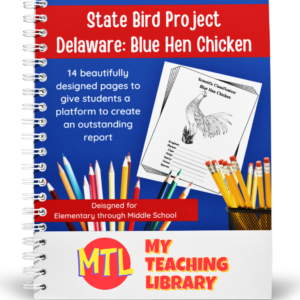
Studying the state of Delaware and state symbols? What is the state bird of Delaware?
This project-based unit is designed to help students study and record information about Delaware’s state bird: Delaware Blue Hen Chicken
What type of pages are contained in this set:
– A map page (for the state)
– Scientific classification page
– A page for students to give details about the bird’s physical description, habitat, diet, life span and reproduction
– A page where students will do additional map work to show where in the U.S. the bird lives in addition to migration information
– Coloring page
– Several pages on which students can use for expository and/or creative writing as well as sections in which students may draw.14 pages in all and is designed for different levels / abilities.
My Teaching Library has a notebooking set for each of all 50 states. In addition, you can get all of them bundled!
Here are other bird related products you’ll love…
-
$15.00Add to Cart
Marine Science Teacher Edition to use alongside the Marine Science Student Edition
Units include: The Hydrosphere, Measuring the Ocean, The Nature of Seawater, Waves, Tides, Ocean Currents, The Ocean Floor, Ocean Sediments, Food Chains & Webs, Ocean Zones, Near-shore Ecosystems, Plankton, Marine Plants, Classifying Marine Animals, Cold-blooded Swimmers, Marine Mammals, Marine Pollution, Marine Resources