
Category: Science
Showing 141–160 of 167 resultsSorted by latest
-
 $1.50Add to Cart
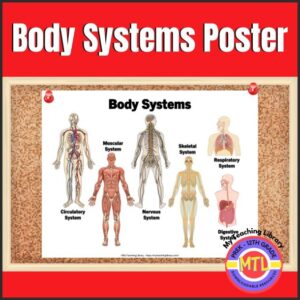
Studying anatomy? Body systems? Here is “Body Systems” poster that that illustrates these systems: circulatory, muscular, digestive, nervous, skeletal and respiratory.
-
$3.00Add to Cart
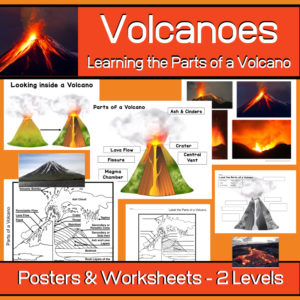
Help students master their knowledge of the parts of a volcano with these posters, handouts and worksheets! This resource provides 2 levels of learning plus worksheets come with and without terms. (Landforms, Earth Science, Geology)
-
$8.50Add to Cart
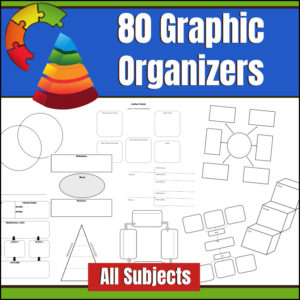
A graphic organizer, also known as knowledge map, concept map, story map, cognitive organizer, advance organizer, or concept diagram, is a communication tool that uses visual symbols to express knowledge, concepts, thoughts, or ideas, and the relationships between them. This resource gives you 80 different graphic organizers and can be used across the curriculum!
Here is a comment from a customer…
Karen E. said: “OK, at first I thought “Really? I’m going to pay for graphic organizers that I can probably find for free with some searching, etc?” Well, now I am so glad that I did. So good to have organizers available quickly BUT also several of them have variations which is helpful for “seeing” how to use them in my content area. Good value.“ -
$2.00Add to Cart
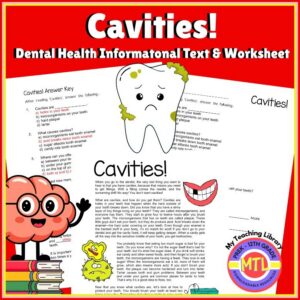
This informational text is a perfect short lesson to use anytime for a Health class or perhaps a Reading or Science class during the month of February which in Dental Health Month! Students will learn what cavities are, that microorganisms (called plaque) produce acid and the acid breaks down the enamel! They will also learn about tarter, what not to eat and how to care for their teeth.
Includes:
- 1 page of informational text
- 1 page assessment (multiple choice and fill-in-the-blanks)
- Answer Key
-
$7.00Add to Cart
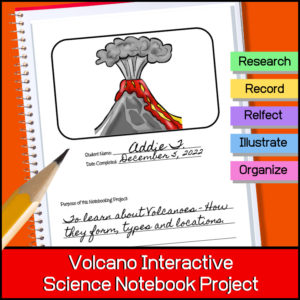
Help your students become self-learners as the plan, research, organize and most of all…LEARN as they create their own Volcano notebook project. This cross-curricular resource has been designed to inspire and guide students through the learning and reporting process as they learn how volcanoes are formed, prediction of eruptions, types of volcanoes, where they are located and more.
-
$2.50Add to Cart
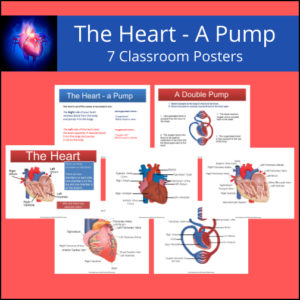
These 7 posters can be displayed or used to create media or transparencies to teach about the heart. Students will learn…
- – Functions of the right and left sides of the heart
- – Oxygenated and Deoxygenated blood
- – The pathway (flow) of blood
- – Parts of the heart
-
$4.00Add to Cart
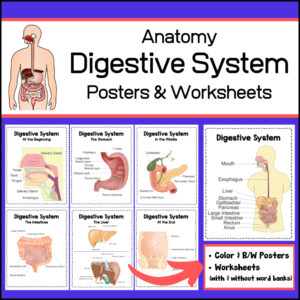
This ANATOMY / BIOLOGY / HEALTH resource includes 7 sets of posters and worksheets for your classroom, all involving human digestion. Each poster comes in color (great for bulletin boards) and b/w (great for student handouts) and each worksheet comes with and without a word bank.
-
$2.00Add to Cart
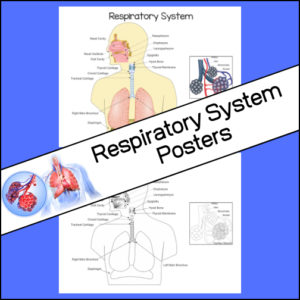
This set of 2 posters is perfect for any classroom studying the human respiratory system. Display the colored poster in the classroom and give students their own b/w copy to use as a study reference.
(See description below for more details)
-
$2.00Add to Cart
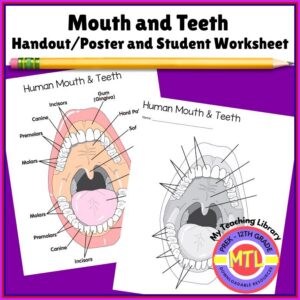
Help students learn the parts of the mouth and the types of teeth with this labeled poster and worksheet!
Looking for additional resources to use with the resource?
Tooth Anatomy Diagram and Worksheet
Dental Care Word Search | Dental Health -
Natural Science: Physics & Earth Science – Grade 7 (Teacher’s Edition) to Pinterest (opens in a new window)$15.00Add to Cart
This is the teacher’s edition for Natural Science: Physics & Earth Science – Grade 7 (Student Edition)
Preview the student edition here.
Bundle and Save: 7th Grade Science Curriculum Bundle
-
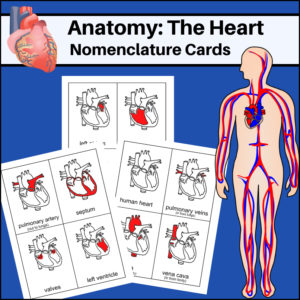
$2.00Add to CartThis resource,The Heart – Human Anatomy Nomenclature Cards, help students learn and study the location of the parts of the heart: pulmonary veins, aorta, vena cava, pulmonary artery, septum, valves, left ventricle, left atrium, right ventricle and right atrium.
-
$1.00Add to Cart
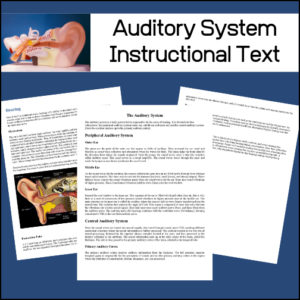
This resource contains instructional text to teach students about the human auditory system. There are no assessments or worksheets included.
-
$2.50Add to Cart
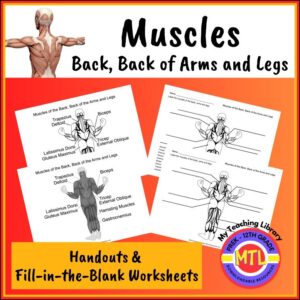
Muscles of the Back, Back of the Arms and Legs will be exactly what you need if you are looking for a easy to read handouts and fill-in-the-blank, labeling worksheets for students.
Muscles include:
- Hamstring
- Triceps
- External Oblique
- Gluteus Maximus
- Gastrocnemius
- Biceps
- Deltoid
- Trapezius
- Latissimus Dorsi
This resource includes two handouts and two worksheets, one with and one without terms. (You choose if you want your students to completely remember the names or if they need the terms to help them.)
-
Natural Science: Physics & Earth Science – Grade 8 (Student Edition) to Pinterest (opens in a new window)$15.00Add to Cart
This Physics and Earth Science student textbook is designed to use with middle school students (specifically those learning at or ready for 8th grade work). View the table of contents in the description below.
Preview video of the companion 8th Grade Science: Biology & Chemistry textbook here.
Get the TEACHER’S EDITION here!
Bundle and Save: 8th Grade Science Curriculum Bundle
-
$1.50Add to Cart
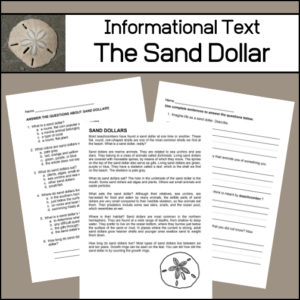
This informational article will teach students about the sand dollar. They will learn that the little round, coin-shaped shell found on the beach is actually part of a marine animal, related to sea urchins and sea stars. They will also learn how living sand dollars move, that they aren’t ‘white’, how and what they eat and much more. After reading, students will complete two worksheets (multiple choice and short answer) to assess their comprehension / understanding of the material. Answer Key is provided.
Automated Readability Index: 4.8
Grade level: 8-9 yrs. old (Fourth and Fifth graders)
Linsear Write Formula : 5.6
Grade level: Sixth Grade. -
$8.00Add to Cart
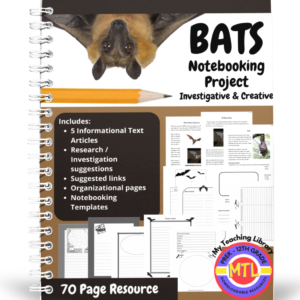
Studying bats? Here is a resource that will allow students to create a beautiful project that will show off what they’ve learned. This 70 page project unit can be used as a fully contained project resource (with no needed outside information required) or can be a launch for a full-blown research project using additional resources and includes:
- – Explanation page about creating a notebooking project
- – Suggested supply list
- – Evaluation rubric
- – Assignment page
- – Table of contents pages
- – Vocabulary & Reference pages
- – List of bat related vocabulary
- – Suggested links (optional)
- – Research / Notebooking questions/investigation suggestion handouts
- – 5 Informational text articles
- – Project KWL
- – Notebooking template pages
- – Bat pictures
-
Natural Science: Biology & Chemistry – Grade 7 (Teacher’s Edition) to Pinterest (opens in a new window)$15.00Add to Cart
This is the Teacher’s edition for Natural Science: Biology & Chemistry – Grade 7 (Student Edition)
Bundle and Save: 7th Grade Science Curriculum Bundle
-
$2.50Add to Cart
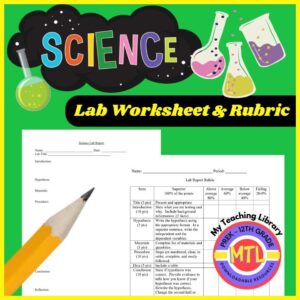
This Science lab worksheet and rubric will give your middle school and high school students an organized way to report the entire process of a science lab. Plus, the rubric can be given to students in advance so that they will know all of the criteria you are expecting! Use again and again, throughout the year for all your labs
There are sections for students to record…
- – Lab title
- – Introduction (Students are to state what they are testing and why plus give background information)
- -Hypothesis (Students are to write their hypothesis plus give the independent and dependent variables)
- -Materials (A complete list of materials)
- – Procedure (Students are to give detailed numbered steps that were followed)
- – Data (Should include a table)
- – Conclusion (Students will state if their hypothesis was correct, providing evidence. Change the hypothesis is necessary.)
- – Reflection (Students should list at least two sources of possible error)
The grading rubric makes it easy for YOU to grade!
-
$4.50Add to Cart
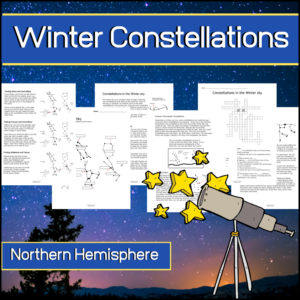
Explore the Northern Hemisphere’s Winter constellations with this resource! Students will learn…
- What are the major constellations?
- What is the Greek Mythology behind them?
- What major stars will help guide them through the night sky?
- How is Orion the ‘key’ to locating the main constellations?
- What is the name of the North Star, and which constellation is it in?
- What is the brightest star in the sky?
Students will learn about the following constellations:
- Orion
- Canis Major
- Canis Minor
- Gemini
- Auriga
- Pleiades
- Taurus
- Draco
- Ursa
- Major
- Ursa Minor
- Cepheus
- Cassiopeia
They will learn the location of the following stars:
- Pollux
- Castor
- Capella
- Procyon
- Sirius
- Betelgeuse
- Rigel
- Aldebaran
- Capella
- Polaris
They will also learn which constellations are called the Northern Circumpolar constellations PLUS the Greek Mythology behind these major constellations!
Student activity sheets include:
- Fill in the blank (constellation and star names for the ‘Winter Sky’)
- Draw and name (the five circumpolar constellations and the North Star)
- Crossword Puzzle (in which they will use the information within the resource to gather answers)
Suggested follow up activities:
- Assign students to go outside after dark, find and draw the constellations they see and can identify.
- Visit a local planetarium
-
$2.00Add to Cart
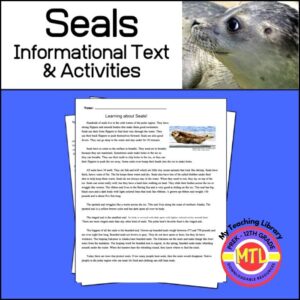
This informational text article is all about seals, where they live, their physical characteristics and about several different types of this cold-water mammal. After reading, students will complete a reading comprehension worksheet and (optional) write a story! Answer key provided.