
Category: 9th-12th
Showing 321–340 of 421 resultsSorted by latest
-
 $6.00Add to Cart
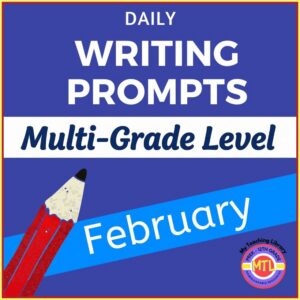
Stop the “I don’t know what to write about!” struggle before it starts. This daily writing prompts resource provides a seamless solution for developing consistent writing habits, critical thinking skills, and creative expression for students in 4th – 12th Grade. Whether it’s a deep dive into facts and history or a light-hearted reflection, this month’s prompts ensure your students have a meaningful reason to put pen to paper every single day.
What’s Included?
This isn’t just a list of sentences; it is a complete journaling system. Each month is packed with:
- Individual Journal Pages: A unique, dedicated page for every day of the month.
- Diverse Prompt Styles: A balanced mix of “light and fun” topics and “deep-dive” prompts that challenge students to think critically about values, history, and social issues.
Here are two examples:
February 22nd – (Be Humble Day)
Have you ever given up an argument, even when you thought you were right, for the sake of not fighting? Have you ever helped someone and not taken credit for it? Do you show respect to people simply because they are older (even if you believe they aren’t necessarily wiser)? These are acts of humility. How hard is it to be humble? Why is it important to be humble? Write about a time that you were humble.February 26th – (“Oh for Pete’s Sake” Day)
Oh, for Pete’s Sake Day celebrates one example of a ‘minced oath’, where an offensive word or phrase is substituted by something more acceptable in society. Other examples include, “For crying out loud!” and “Sugar!”. Such euphemisms have been used for centuries whenever people hit thumbs with hammers, burn hands on hot plates or sit on sharp things while in polite company. Why has Pete been singled out for special attention? Create a story to explain why Pet was singled out!How to implement it:
- Daily Starts: Start your morning or English period with a 10-minute quiet writing session.
- Fast-Finisher Activity: Keep your “early birds” engaged with a meaningful task that doesn’t feel like “busy work.”
- Homeschool Portfolios: Use these daily entries to track progress in handwriting, grammar, and expressive thought throughout the year.
- Digital or Print: These pages are designed to be “print-and-go” ready, but they also work beautifully as digital assignments. Simply give them to your student(s) and allow them to create a word document for each. First, have them copy (type) the prompt. Then answer it! Print and place in a growing 3 ring-binder of work.
The Benefits of Daily Prompting
Daily writing is like a workout for the brain. By using these journals, students will:
- Build Writing Stamina
- Strengthen Critical Thinking
- Encourage Research
- Encourages Deep Thinking About Different Topics
My Teaching Library has writing prompts for the entire year – BUNDLE & SAVE: Daily Writing Prompt Journal – ONE YEAR BUNDLE
-
 $5.00Add to Cart
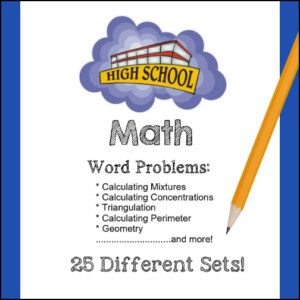
Here are 250 word problems with answer keys. There are 25 sets, each with 10 problems each.
-
$6.00Add to Cart
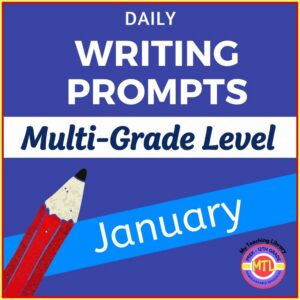
Stop the “I don’t know what to write about!” struggle before it starts. This daily writing prompts resource provides a seamless solution for developing consistent writing habits, critical thinking skills, and creative expression for students in 4th – 12th Grade. Whether it’s a deep dive into facts and history or a light-hearted reflection, this month’s prompts ensures your students have a meaningful reason to put pen to paper every single day.
What’s Included?
This isn’t just a list of sentences; it is a complete journaling system. Each month is packed with:
- Individual Journal Pages: A unique, dedicated page for every day of the month.
- Diverse Prompt Styles: A balanced mix of “light and fun” topics and “deep-dive” prompts that challenge students to think critically about values, history, and social issues.
Here are two examples:
January 16th – (America put the “Prohibition Amendment” into effect in 1919)
To prohibit something is to forbid it, or to make it illegal. In 1917, in Amendment 18, the United States decided that the negative effects of alcohol were so dangerous that is should be illegal. The Amendment when into effect in 1919. The intention of the amendment was to protect people from the dangers of alcohol. Unfortunately, it had the effect of making organized crime very wealthy through the illegal sale of alcohol. In 1933, Prohibition was repealed with the 21st Amendment. If you could make something that is legal become illegal, what would it be? How would you enforce the law?January 22nd – (National Mentoring Month is January)
To be a mentor, you don’t need special skills, just an ability to listen and to offer friendship, guidance and encourage to a young person. Have you ever been a mentor to someone? If so, describe your experience. If not, is there someone you might mentor? Do you know him/her already? If not, how would you meet? Describe how you’d be a good mentor.Whether you are an educator or a homeschooling parent, you probably know that the hardest part of writing is often just getting started. This bundle removes that barrier.
How to implement it:
- Daily Starts: Start your morning or English period with a 10-minute quiet writing session.
- Fast-Finisher Activity: Keep your “early birds” engaged with a meaningful task that doesn’t feel like “busy work.”
- Homeschool Portfolios: Use these daily entries to track progress in handwriting, grammar, and expressive thought throughout the year.
- Digital or Print: These pages are designed to be “print-and-go” ready, but they also work beautifully as digital assignments. Simply give them to your student(s) and allow them to create a word document for each. First, have them copy (type) the prompt. Then answer it! Print and place in a growing 3 ring-binder of work.
The Benefits of Daily Prompting
Daily writing is like a workout for the brain. By using these journals, students will:
- Build Writing Stamina
- Strengthen Critical Thinking
- Encourage Research
- Encourages Deep Thinking About Different Topics
My Teaching Library has writing prompts for the entire year – BUNDLE & SAVE: Daily Writing Prompt Journal – ONE YEAR BUNDLE
-
$2.50Add to Cart
This is a downloadable copy of the book.
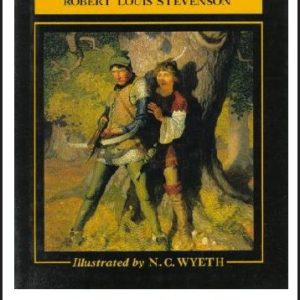
About the book: The Black Arrow: A Tale of the Two Roses is an 1888 novel and is both an historical adventure novel and a romance novel. The Black Arrow tells the story of Richard (Dick) Shelton during the Wars of the Roses: how he becomes a knight, rescues his lady Joanna Sedley, and obtains justice for the murder of his father, Sir Harry Shelton. Outlaws in Tunstall Forest organised by Ellis Duckworth, whose weapon and calling card is a black arrow, cause Dick to suspect that his guardian Sir Daniel Brackley and his retainers are responsible for his father’s murder. Dick’s suspicions are enough to turn Sir Daniel against him, so he has no recourse but to escape from Sir Daniel and join the outlaws of the Black Arrow against him. This struggle sweeps him up into the greater conflict surrounding them all.About the Author: Robert Louis Stevenson (13 November 1850 – 3 December 1894) was a Scottish novelist and travel writer, most noted for Treasure Island, Kidnapped, Strange Case of Dr Jekyll and Mr Hyde, and A Child’s Garden of Verses. A celebrity in his lifetime, Stevenson’s critical reputation has fluctuated since his death, though today his works are held in general acclaim. He is currently ranked as the 26th most translated author in the world.
-
 $2.50Add to Cart
This is a downloadable copy of the book.
About the book: It was her book, The Mayflower which first brought Stowe attention internationally. The Mayflower was so popular in England that it was immediately republished and it essentially made Stowe’s reputation abroad. This work has been selected by scholars as being culturally important.About the Author: Harriet Elisabeth Beecher Stowe (June 14, 1811 – July 1, 1896) was an American abolitionist and author. She came from the Beecher family, a famous religious family, and is best known for her novel Uncle Tom’s Cabin (1852), which depicts the harsh conditions for enslaved African Americans. Stowe wrote 30 books, including novels, three travel memoirs, and collections of articles and letters. She was influential for both her writings and her public stances and debates on social issues of the day.
-
$1.00Add to Cart
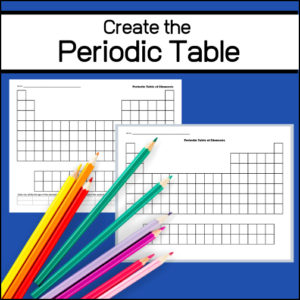
Here are two worksheets for students to use to create the periodic table of elements.
– One for elements only
– One to create a color key showing the type of elementsThese are great for students to use when they are just learning the elements and can be used as a student-created study guide as well.
-
$15.00Add to Cart
This student textbook covers World History 1 and is a large download (617 pages). It includes 21 units from Ancient Egypt to the rise of nationalism in the 1800’s. (see description below for details).
-
$1.75Add to Cart
This informational article will help students understand one of ‘taxes’ imposed upon the colonies by King George prior to the American Revolution. After reading, students will be questions to assess their comprehension of the material (1 multiple-choice question, 7 short answer questions and 2 short essay questions).
-
$3.00Add to Cart
This is a downloadable copy of the book. (386 pages)
About the book: A literary classic that wasn’t recognized for its merits until decades after its publication, Herman Melville’s Moby-Dick tells the tale of a whaling ship and its crew, who are carried progressively further out to sea by the fiery Captain Ahab. Obsessed with killing the massive whale, which had previously bitten off Ahab’s leg, the seasoned seafarer steers his ship to confront the creature, while the rest of the shipmates, including the young narrator, Ishmael, and the harpoon expert, Queequeg, must contend with their increasingly dire journey. The book invariably lands on any short list of the greatest American novels.Interest Level Reading Level Grades 9 – 12 Grades 9 – 11 -
$4.00Add to Cart
This 123 page math resource will help students who are learning (or struggling to understand) algebra better by giving detailed explanations of related terminology and concepts. This book as been categorized as curriculum because of the detailed explanations of the topics. It however, is for instructional use only and does not include student problems.
(See description below for covered topics)
-
$2.00Add to Cart
This is a downloadable copy of the book. (400 pages)
About the book: -
$1.00Add to Cart
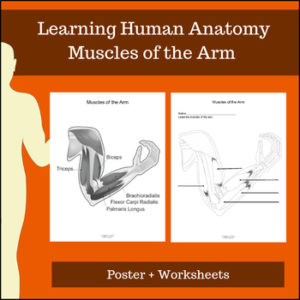
Muscles of the Arm – Learning Human Anatomy will be exactly what you need if you are looking for a easy to read poster as well as a labeling worksheet for students.
This resource actually comes with two worksheets, one with and one without terms. (You choose if you want your students to completely remember the names or if they need the terms to help them. )
-
$15.00Add to Cart
Units:
- America from Exploration through Colonization
- Road to Revolution
- The Constitution and Early National Period
- The Civil War and the Reconstruction Era
- Westward Expansion (1840-1890)
- Industrial America (1865-1925)
- Problems in Industrial America
- Becoming a World Power
- U.S. Foreign Policy (1898-1933)
- The Progressive Era (1890-1917)
- World War 1 in Europe
- The U.S. enters WW1
- Peace after WW1
- Prosperity after WW1
- The Great Depression (1929-1932)
- The New Deal (1933-1940)
-
$6.00Add to Cart
Stop the “I don’t know what to write about!” struggle before it starts. This daily writing prompts resource provides a seamless solution for developing consistent writing habits, critical thinking skills, and creative expression for students in 4th – 12th Grade. Whether it’s a deep dive into facts and history or a light-hearted reflection, this month’s prompts ensure your students have a meaningful reason to put pen to paper every single day.
What’s Included?
This isn’t just a list of sentences; it is a complete journaling system. Each month is packed with:
- Individual Journal Pages: A unique, dedicated page for every day of the month.
- Diverse Prompt Styles: A balanced mix of “light and fun” topics and “deep-dive” prompts that challenge students to think critically about values, history, and social issues.
Here are two examples:
October 10th – (World Mental Health Day)
What is mental health? Why is mental health important? Do you know anyone that has a mental health issue? How does it affect his/her life and the lives of those around him/her? What are things we can do to help our mental health? What type of careers are considered mental health careers? Would you be be interested in any of these careers? Why or why not?October 13th – (October is Vegetarian Month)
What does it mean to be vegetarian? Do you know someone who is a vegetarian? If you decided to become a vegetarian (or are a vegetarian) what food(s) would (do) you miss the most and why? How would you incorporate protein into your diet? What is the difference between being a vegetarians and a vegan?How to implement it:
- Daily Starts: Start your morning or English period with a 10-minute quiet writing session.
- Fast-Finisher Activity: Keep your “early birds” engaged with a meaningful task that doesn’t feel like “busy work.”
- Homeschool Portfolios: Use these daily entries to track progress in handwriting, grammar, and expressive thought throughout the year.
- Digital or Print: These pages are designed to be “print-and-go” ready, but they also work beautifully as digital assignments. Simply give them to your student(s) and allow them to create a word document for each. First, have them copy (type) the prompt. Then answer it! Print and place in a growing 3 ring-binder of work.
The Benefits of Daily Prompting
Daily writing is like a workout for the brain. By using these journals, students will:
- Build Writing Stamina
- Strengthen Critical Thinking
- Encourage Research
- Encourages Deep Thinking About Different Topics
My Teaching Library has writing prompts for the entire year – BUNDLE & SAVE: Daily Writing Prompt Journal – ONE YEAR BUNDLE
-
$1.00Add to Cart
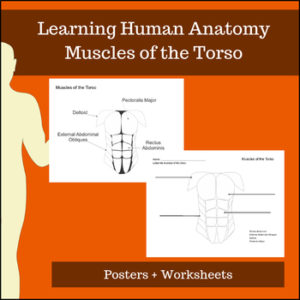
Muscles of the Torso – Learning Human Anatomy will be exactly what you need if you are looking for a easy to read posters as well as a labeling worksheet for students.
This resource actually comes with two worksheets, one with and one without terms. (You choose if you want your students to completely remember the names or if they need the terms to help them. )
-
$10.00Add to Cart
(Part 2) English 2 Curriculum – Student Edition for High School
Need the Teacher’s guide? Here it is: English 2 Teacher’s Guide
English II (2) is typically studied in 10th grade. This curriculum is large and has been broken up into to two separate parts. This is part 2 (412 pages) and covers the last two units of this curriculum:
- Listening, Viewing, Speaking / Communicating Face to Face
- Literature / Discovering the World, Analyzing Ourselves (Themes, Plot, Conflict, Character and more)
Click here to view part 1 (355 pages) which covers the first four units of English 2:
- Integrating Technology / Using the Internet
- Reading / Understanding What you Read
- Writing / Building upon Your Writing Skills
- Writing / Taking a Second Look
-
$10.00Add to Cart
(Part 1) English 2 Curriculum – Student Edition for High School
Need the Teacher’s guide? Here it is: English 2 Teacher’s Guide
English II (2) is typically studied in 10th grade. This curriculum is large and has been broken up into to two separate parts. This is part 1 (355 pages) and covers the first four units of English 2:
- Integrating Technology / Using the Internet
- Reading / Understanding What you Read
- Writing / Building upon Your Writing Skills
- Writing / Taking a Second Look
Click here to see Part 2 of English 2. English 2 covers:
- Listening, Viewing, Speaking / Communicating Face to Face
- Literature / Discovering the World, Analyzing Ourselves (Themes, Plot, Conflict, Character and more)
-
$2.00Add to Cart
Kinetic energy is energy possessed by an object due to its motion or movement. Potential energy is the stored energy of position possessed by an object. Here are eight experiments for students to perform which display chemical energy! Experiments include:
1. Rube Goldberg Machines
2. Homemade Marble Run
3. Bucket Spin
4. Salad Spinner Art
5. Rubber Band Vehicles
6. Rubber Band Car
7. Flywheel Battery
8. Pendulum of Peril -
$6.00Add to Cart
Stop the “I don’t know what to write about!” struggle before it starts. This daily writing prompts resource provides a seamless solution for developing consistent writing habits, critical thinking skills, and creative expression for students in 4th – 12th Grade. Whether it’s a deep dive into facts and history or a light-hearted reflection, this month’s prompts ensure your students have a meaningful reason to put pen to paper every single day.
What’s Included?
This isn’t just a list of sentences; it is a complete journaling system. Each month is packed with:
- Individual Journal Pages: A unique, dedicated page for every day of the month.
- Diverse Prompt Styles: A balanced mix of “light and fun” topics and “deep-dive” prompts that challenge students to think critically about values, history, and social issues.
Here are two examples:
November 11th – (Veterans Day)
Veterans Day (celebrated somewhat differently as Remembrance Day in Canada, Australia and Great Britain) originally commemorated the end of World War I. In the United States, it is now a day to honor all those who serve in the military, living and dead, from all wars and during peacetime. Do you know any veterans? Write a letter to a veteran you know or, if you don’t know one, to any veteran.November 13th – (World Kindness Day)
“No act of kindness, however small, is ever wasted.” ~ Aesop
Tell about a time when someone was kind to you.How to implement it:
- Daily Starts: Start your morning or English period with a 10-minute quiet writing session.
- Fast-Finisher Activity: Keep your “early birds” engaged with a meaningful task that doesn’t feel like “busy work.”
- Homeschool Portfolios: Use these daily entries to track progress in handwriting, grammar, and expressive thought throughout the year.
- Digital or Print: These pages are designed to be “print-and-go” ready, but they also work beautifully as digital assignments. Simply give them to your student(s) and allow them to create a word document for each. First, have them copy (type) the prompt. Then answer it! Print and place in a growing 3 ring-binder of work.
The Benefits of Daily Prompting
Daily writing is like a workout for the brain. By using these journals, students will:
- Build Writing Stamina
- Strengthen Critical Thinking
- Encourage Research
- Encourages Deep Thinking About Different Topics
My Teaching Library has writing prompts for the entire year – BUNDLE & SAVE: Daily Writing Prompt Journal – ONE YEAR BUNDLE



&url=https://myteachinglibrary.com/product/the-black-arrow-robert-louis-stevenson/&media=https://myteachinglibrary.com/wp-content/uploads/2019/08/wy-302-c.jpg)
&url=https://myteachinglibrary.com/product/the-may-flower-and-miscellaneous-writings-stowe/&media=https://myteachinglibrary.com/wp-content/uploads/2019/08/wy-301-b.jpg)


