
Category: By Grade
Showing 1101–1120 of 1688 resultsSorted by latest
-
 $1.50Add to Cart
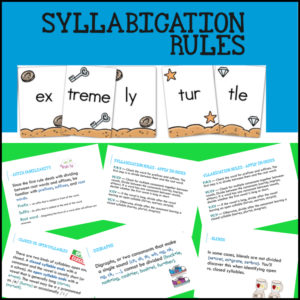
7 Posters that will guide students through the rules of dividing words into syllables!
Example: The first poster tells students to first check for prefixes and suffixes and to divide these from the root word. Next, the students are told to check for multiple consonants together between vowels and then how to proceed.
-
$3.00Add to Cart
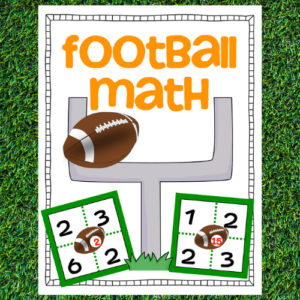
* Critical thinking required! * Help students practice math skills with this fun and engaging Math game! Students will be given 4 numbers and a solution. They will need to find a way to use all four numbers to find the solution which may require a a combination of adding, subtracting, multiplying and dividing! Includes: 30 game cards.
Example of one solution:
[(6 – 2) x 3]+6 = 18 -
$3.00Add to Cart
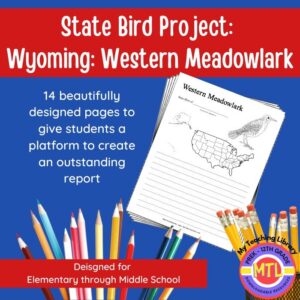
Studying the state of Wyoming and state symbols? What is the state bird of Wyoming?
This project-based unit is designed to help students study and record information about Wyoming’s state bird: Western Meadowlark
⭐Included:
– A map page (for the state)
– Scientific classification page
– A page for students to give details about the bird’s physical description, habitat, diet, life span and reproduction
– A page where students will do additional map work to show where in the U.S. the bird lives in addition to migration information
– Coloring page
– Several pages on which students can use for expository and/or creative writing as well as sections in which students may draw.⭐ 14 pages in all and is designed for different levels / abilities.
My Teaching Library has a notebooking set for each of all 50 states. In addition, you can get all of them bundled!
Here are other bird related products you’ll love…
-
 $2.50Add to Cart
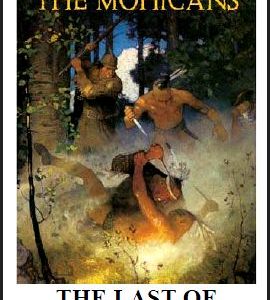
This is a downloadable copy of the book.
About the book:About the Author: James Fenimore Cooper was an American writer of the first half of the 19th century. His historical romances draw a picture of frontier and American Indian life in the early American days which created a unique form of American literature.
-
$1.00Add to Cart
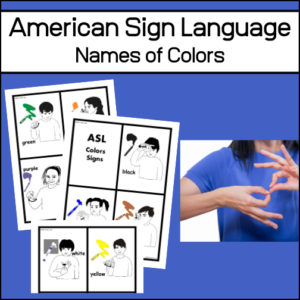
9 flash cards – ASL signs for colors
Includes signs for: yellow, white, red, purple, orange, green, brown, blue and black
-
$2.75Add to Cart
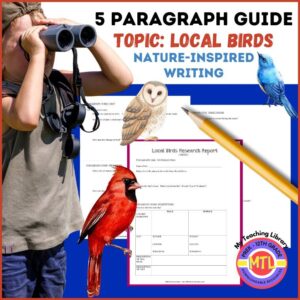
Easy-to-use, step-by-step, print-and-go guide for students to use as they learn to write a 5-paragraph essay! This nature-themed resource has a local bird focus and guides students as they research, observe and write about one bird species that lives in their local area.
This 3-page resource outlines paragraph by paragraph what to include and gives space for students to write detailed notes.
What will students learn and observe about a bird species before they begin writing?
– where the bird geographically lives
– habitat(s) where they are most likely found
– physical characteristics (coloring, markings, size, bill, feet)
– diet (herbivore, carnivore, omnivore) and where/how they find/gather their food
– predators and self-protection
– interesting factsPlus, this guide will encourage students to reflect on what they have learned.
Once completed, students will be able to take the guide and their notes and write amazing 5-paragraph essays!
Use once as one assignment for one bird of their choice or use again and again to create an entire collection of essays on local birds. Regardless of where you live, these pages will have students observing and learning about local birds.
-
FREEAdd to Cart
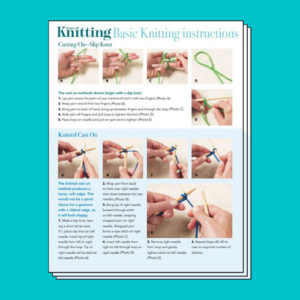
This free resource gives easy to follow pictures / instructions on basic knitting
-
$2.50Add to Cart
This is a downloadable copy of the book. (138 pages)
About the book: A Guide for the Study of Animals is a classic zoology guide (1911) which is intended for pupils in 9th-12th grades. It was prepared by the authors at the request of the Biology Round Table, an association composed of the teachers of Biology in the Chicago High Schools. The book is basically a Biology / Zoology Lab activity guide. Please note that this is not a ‘textbook’ but a lab activity book. (See description for further details.) -
$2.00Add to Cart
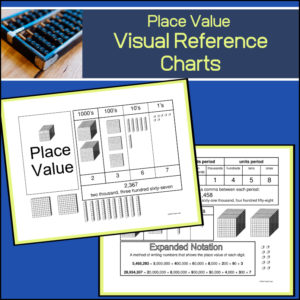
This b/w resource includes two reference posters that will allow your students to visually see (and learn) about place value!
The first poster clearly displays place value (using base ten blocks) for ones, tens, hundreds and thousands.
The second poster displays a table showing place value up through a hundred million as well as explains how to write expanded notation.
-
$3.00Add to Cart
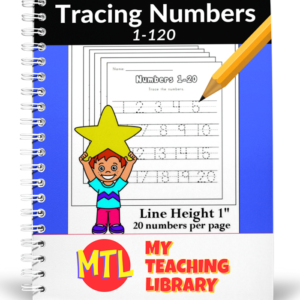
By the end of 1st grade, students should be able to write numbers through 120. These practice worksheets can be used for K-1st to practice writing their numbers.
– Page 1: 1-20
– Page 2: 21-40
– Page 3: 41-60
– Page 4: 61-80
– Page 5: 81-100
– Page 6: 101-115
– Page 7: 116-120 -
FLASH CARDS -100 Vocabulary Words Every High School Student Should Know to Pinterest (opens in a new window)$2.00Add to Cart
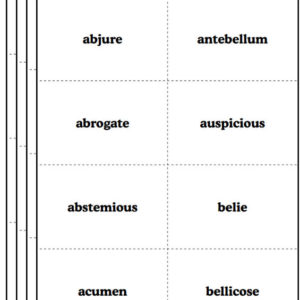
This resource are word cards (flash cards) of the 100 vocabulary words every High School student should know. Students can use to write definitions and study each word.
-
$6.50Add to Cart
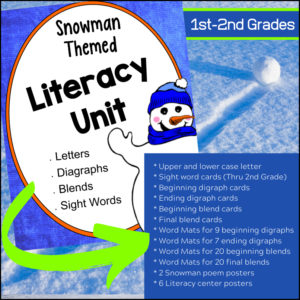
This Snowman Literacy resource focuses on letters, digraphs, blends and sight words and can be used in a variety of ways in your classroom and your LITERACY centers!
This product includes:
- * Upper and lower case letter cards
- * Sight word cards (Dolch Pre-Primer, Primer, 1st Grade and 2nd Grade)
- * Beginning digraph cards
- * Ending digraph cards
- * Beginning blend cards
- * Final blend cards
- * Word Mats for 9 beginning digraphs
- * Word Mats for 7 ending digraphs
- * Word Mats for 20 beginning blends
- * Word Mats for 20 final blends
- * Word Mat to match upper and lower case letters
- * 2 Snowman poem posters
- * 6 Literacy center posters
-
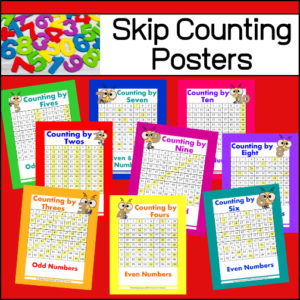
Skip Counting Posters | 2s – 3s – 4s – 5s – 6s – 7s – 8s – 9s – 10s to Pinterest (opens in a new window)$3.00Add to Cart
Here are 9 colorful Math posters to help students learn to skip count! As a bonus, each poster will tell students if the numbers are even, odd or both.
-
$2.00Add to Cart
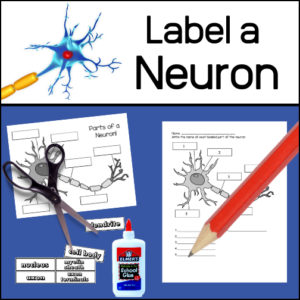
This resource is meant to help students learn and remember the basic parts of a neuron (dendrite, nucleus, cell body, myelin sheath, axon and axon terminals).
Includes:- – Poster
- – Center activity
- – 2 Student worksheets
- – Answer Key
-
$1.00Add to Cart
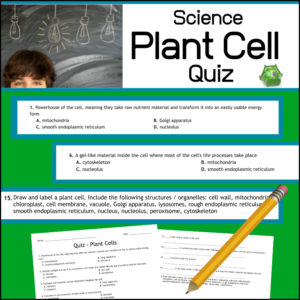
The resource is a 15 question quiz that will assess student understanding of the following structures / organelles of a plant cell: cell wall, mitochondria, chloroplast, cell membrane, vacuole, Golgi apparatus, lysosomes, rough endoplasmic reticulum w/ ribosomes, smooth endoplasmic reticulum, nucleus, nucleolus, peroxisome, cytoskeleton
-
$3.00Add to Cart
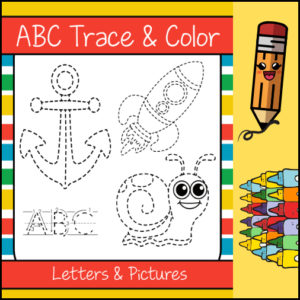
Give your students a way to practice fine motor skills through tracing and coloring while learning and reinforcing the letters of the alphabet! There are 26 pages – One for every letter of the alphabet and on each they will trace both upper and lower case of the letter and a word that begins with that letter PLUS trace and color a picture to represent the word!
-
$3.00Add to Cart
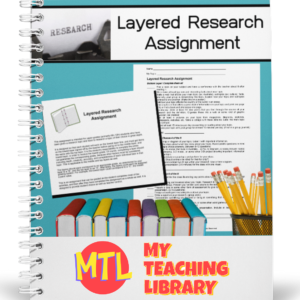
This layered research assignment gives students the opportunity to delve deeply into a topic and give students a variety of tasks from which to choose, all designed to guide and build a meaningful learning experience. Also, when using this layered approach, students will move through Bloom’s Taxonomy of knowledge, comprehension, application, analysis, synthesis and evaluation. (See below description for more details.)
Closely related resources:
-
Molly Pitcher Project-Based Unit | Research – Writing – Presentation to Pinterest (opens in a new window)$3.00Add to Cart
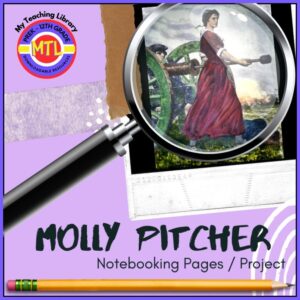
✏️A student-centered resource to help students learn and practice research skills, report writing, project and presentation skills.
Students will use this project-based unit to learn about and report on Molly Pitcher. Molly Pitcher is a nickname given to a woman said to have fought in the American Battle of Monmouth, generally believed to have been Mary Ludwig Hays McCauley. However, various Molly Pitcher tales grew in the telling, and many historians regard Molly Pitcher as folklore rather than history or suggest that Molly Pitcher may be a composite image inspired by the actions of a number of real women. The name itself may have originated as a nickname given to women who carried water to men on the battlefield during War.
✏️This notebooking project unit can be assigned individually or within cooperative groups. Use it within a Language Arts classroom or a Social Studies / U.S. History classroom. Very flexible and cross-curricular! After completing the written portion of this resource, you can grade it (or) assign students to do an oral and/or audio-visual presentation based on their findings/work.
✏️What is in this resource?
- Student instructions for using biographical notebooking, project pages
- Suggested research questions
- Student notebooking, project pages (includes covers, KWL, reference recording, report writing, and more)
- Teacher pages (instructions, assignment, evaluation)
-
Lady Deborah Moody Project-Based Unit | Research – Writing – Presentation to Pinterest (opens in a new window)$3.00Add to Cart
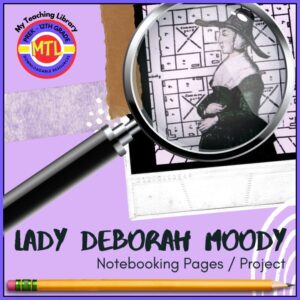
✏️A student-centered resource to help students learn and practice research skills, report writing, project and presentation skills.
Students will use this project-based unit to learn about and report on Lady Deborah Moody. Lady Deborah Moody is notable as the founder of Gravesend, Brooklyn, and is the only woman known to have started a village in colonial America. She was the first known female landowner in the New World.
✏️This notebooking project unit can be assigned individually or within cooperative groups. Use it within a Language Arts classroom or a Social Studies / U.S. History classroom. Very flexible and cross-curricular! After completing the written portion of this resource, you can grade it (or) assign students to do an oral and/or audio-visual presentation based on their findings/work.
✏️What is in this resource?
- Student instructions for using biographical notebooking, project pages
- Suggested research questions
- Student notebooking, project pages (includes covers, KWL, reference recording, report writing, and more)
- Teacher pages (instructions, assignment, evaluation)
-
$4.99Add to Cart
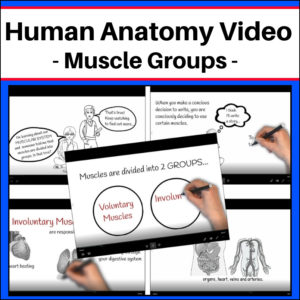
Human Anatomy – Muscle Groups Video has been created to introduce, explain and/or review voluntary and involuntary muscles in the human body. Each group is defined, explained and definitions given. This is great for visual learners!
To add student interest, one student is helping another student learn, interesting graphics have been added and upbeat music fills the background. (Music is easily muted if needed.)
Supporting Document: A worksheet (with answer key) that students can complete as they watch!



&url=https://myteachinglibrary.com/product/the-last-of-the-mohicans/&media=https://myteachinglibrary.com/wp-content/uploads/2019/08/wy-306-d.jpg)


