
Category: Zoology
Showing 41–60 of 156 resultsSorted by latest
-
 $2.00Add to Cart
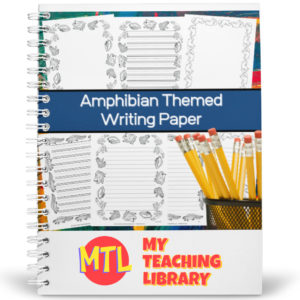
This fun amphibian themed paper can be used by all ages for a variety of uses such as writing essays, poetry, creating reports, science and nature journaling and even art projects!
Includes 9 pages:
– 3 Salamander (single lined, dashed line, blank center)
– 3 Newt (single lined, dashed line, blank center)
– 3 Frog & Toad ( (single lined, dashed line, blank center) -
$3.50Add to Cart
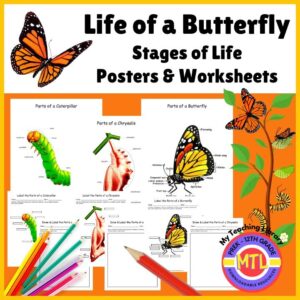
This Science / Biology resource provides colorful posters and worksheets for 3 stages of a butterfly’s life cycle: caterpillar, chrysalis, adult butterfly.
Each stage of life comes with a poster (labels showing the parts) and the following 3 worksheets:
#1: Students will label a picture of the specific stage and are given the names of the parts they are to label
#2: Students will label a picture of the specific stage but are not given the names of the parts (as they should have those memorized)
#3: Students are to both draw and label the specific stage. Parts they are to label of given.What parts are labeled for each stage?
- caterpillar: head, thorax, simple eye, mandible, walking leg, abdominal segment, proleg, anal proleg
- chrysalis: cremaster, abdomen, spiracle, wing, metathorax, mesothorax, antenna, prothorax
- adult butterfly: back leg, middle leg, front leg, spiracles, forewing, antenna, hind wing, veins, compound eye, ocellus, anus, proboscis, labial palpus
BONUS: All pages are also included in B/W format!
-
$1.75Add to Cart
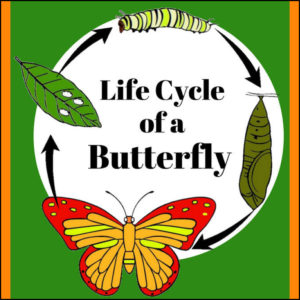
This Science resource will teach students the Life Cycle of a Butterfly and includes:
- * 2 color posters of the life cycle (1 with added details)
- * 1 b/w poster (for students to color),
- * 4 picture/information cards for each stage of the life cycle
- * 3 life cycle worksheets
-
$2.00Add to Cart
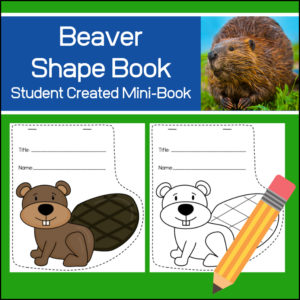
Studying Beavers? Students will love to self-publish their own work in this cute Beaver shape book! Not only can they write creative stories or poems, but you can also have them use these templates to convey what they’ve learned (comprehension) from a book or from their own research! Template size: 7.5″ tall x 7″ wide.
Includes:
- 6 possible covers
- 13 different inside pages
I’ve created pages with both dotted-dashed lines as well as single lines so that you can use what best fits the level of your students.
-
$2.50Add to Cart
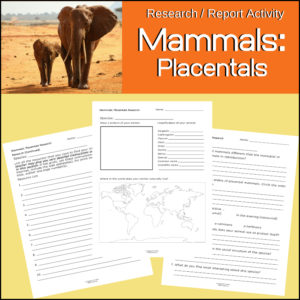
Placental mammals are the most diverse group of mammals with about 4000 discovered species and include dogs, cats, rodents, elephants, whales, cattle, pigs, humans and many more! If you are planning a study on these mammals, this product will guide students through their research and can be used as the end reporting tool!
-
$2.50Add to Cart
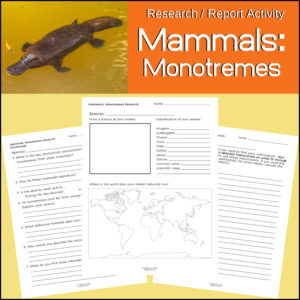
This science, animal study activity is designed to guide your students through the researching and reporting of any egg laying mammal (also known as Monotremes). These unusual mammals only reside in Australia and New Guinea. There are only five known species of monotremes: the platypus and four species of echidna.
This product will guide students through their research and can be used as the end reporting tool!
-
Mammals Research and Report Activity | Marsupials | Pouch Carriers to Pinterest (opens in a new window)$2.50Add to Cart
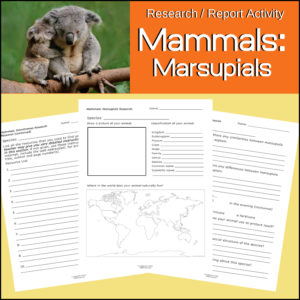
Students love kangaroos, wallabies, koalas and other pouch carrying animals also known as marsupials! This resource will guide students through their research on these amazing pouch carrying animals and can be used as the end reporting tool!
-
Natatorial Mammals | Swimming Animals | Science Research and Report Activity to Pinterest (opens in a new window)$2.50Add to Cart
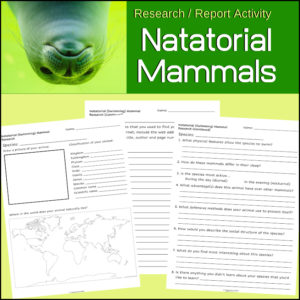
Any mammal designed to swim such as a whale, sea lion, seal or walrus is considered a natatorial mammal. The term natatorial comes from the Latin natātor, natātōrem meaning “swimmer”. This product is perfect for your students if you want to assign a research & report project on water dwelling mammals. It will guide students through their research and can be used as the end reporting tool!
-
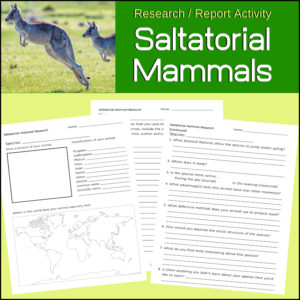
Saltatorial Mammals | Jumping or Leaping | Science Research and Report Activity to Pinterest (opens in a new window)$2.50Add to CartOne way of categorizing animals is how they move. Mammals that are designed to jump, hop, gallop, or leap are called Saltatorial mammals such as the kangaroo, leopard, rabbit, horse, antelope and many others! This product is perfect to use as a research and report assignment to have students study mammals that jump, hop, gallop and/or leap! It will guide students through their research and can be used as the end reporting tool!
-
Fossorial Mammals | Ground Dwelling | Science Research and Report Activity to Pinterest (opens in a new window)$2.50Add to Cart
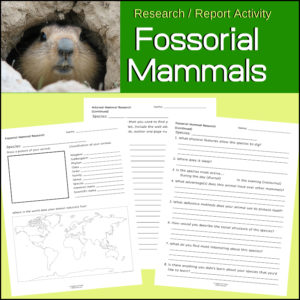
Burrowing, ground dwelling mammals are known as fossorial mammals. Fossorial comes from the Latin fossor, meaning “digger”, thus mammals such as groundhogs, gophers, moles, rabbits and others are in this group. This resource will help students research and report on fossorial mammals as it guides students through their research and can be used as the end reporting tool!
-
Arboreal Mammals | Tree Dwelling Animals | Science Research and Report Activity to Pinterest (opens in a new window)$2.50Add to Cart
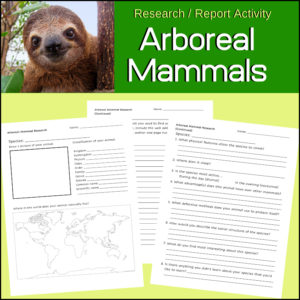
During a study of animals (specifically tree-dwelling, arboreal mammals), students can use this product to research and report on animals such as the koala, monkey, sloth or possum. Any tree dwelling mammal is considered arboreal. Students can use this product as both a guide to their research as well as the end reporting tool!
-
$2.50Add to Cart
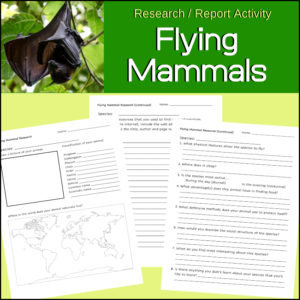
In the Science field of Zoology there is a group of mammals that are considered ‘flying’ mammals. This product makes it easy to assign students to research and report on one of these ‘flying’ mammals! Students will be able to use the product to both guide their research and use as their reporting tool.
-
$1.25Add to Cart
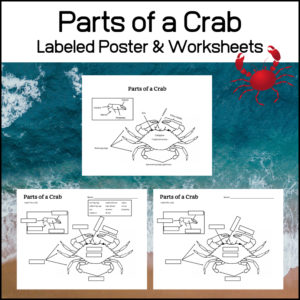
Is your Science class studying (or preparing to study) ocean life, crustaceans or the phylum Arthropoda? This resource, Parts of a Crab – Poster & Worksheets, includes a labeled poster of a crab and 2 worksheets (or quizzes).
-
$3.00Add to Cart
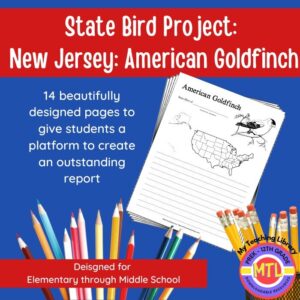
Studying the state of New Jersey and state symbols? What is the state bird of New Jersey? This project-based unit is designed to help students study and record information about New Jersey’s state bird: American Goldfinch
⭐Included:
– A map page (for the state)
– Scientific classification page
– A page for students to give details about the bird’s physical description, habitat, diet, life span and reproduction
– A page where students will do additional map work to show where in the U.S. the bird lives in addition to migration information
– Coloring page
– Several pages on which students can use for expository and/or creative writing as well as sections in which students may draw.⭐ 14 pages in all and is designed for different levels / abilities.
My Teaching Library has a notebooking set for each of all 50 states. In addition, you can get all of them bundled!
Here are other bird related products you’ll love…
-
$8.00Add to Cart
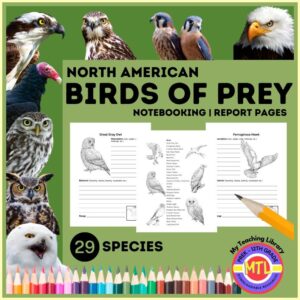
‘North American Birds of Prey’ is a 41-page resource designed to help students organize and present reports for each 29 different birds of prey species!
Each species-specific page includes the name of the bird, an illustration and the following sections: description (size, weight, color, markings, etc.), behavior (breeding, nesting, feeding, vocalization, etc.) and range plus a map of North America.
In addition to the species-specific pages, there are ten additional pages on which students can included additional information, draw their own illustrations, plus add additional species to their projects.
Use alone or add to your lessons: North American Birds of Prey Cards
This resource includes pages for the following birds:
• Great Gray Owl
• Ferruginous Hawk
• Common Black Hawk
• Red-Tailed Hawk
• Barred Owl
• Barn Owl
• Short-Eared Owl
• Prairie Falcon
• Swainson’s Hawk
• Snowy Owl
• Turkey Vulture
• Eastern Screech Owl
• Burrowing Owl
• American Swallow-Tailed Kite
• Elf Owl
• Osprey
• American Kestrel
• Peregrine Falcon
• Bald Eagle
• Northern Goshawk
• Merlin
• Golden Eagle
• Northern Harrier
• Northern Saw-Whet Owl
• Crested Caracara
• Great Horned Owl
• Sharp-Shinned Hawk
• Harris Hawk
• Long-Eared Owl -
$1.50Add to Cart
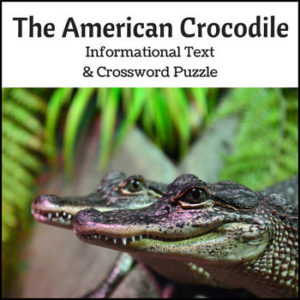
Designed for 5th-8th grade students, American Crocodile Informational Text and Crossword Puzzle will provide students with details about the only crocodile native to the Americas in the following categories:
* Appearance
* Differences from alligators
* Distribution and Habitat
* Food and Growth
* ReproductionAfter reading the text (3 pages), students are to complete the crossword puzzle. Answer Key provided.
-
$15.00Add to Cart
Complete Marine Science Student Curriculum
Units include: The Hydrosphere, Measuring the Ocean, The Nature of Seawater, Waves, Tides, Ocean Currents, The Ocean Floor, Ocean Sediments, Food Chains & Webs, Ocean Zones, Near-shore Ecosystems, Plankton, Marine Plants, Classifying Marine Animals, Cold-blooded Swimmers, Marine Mammals, Marine Pollution, Marine Resources
Get your Teacher’s Guide here!
-
$3.00Add to Cart
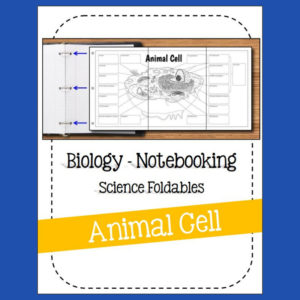
High School Biology Notebook resource!
Students will learn the following terms: peroxisome, cilium, centriole, lysosome, cell / plasma membrane, cytoplasm, mitochondrion, smooth endoplasmic reticulum, flagellum, cytoskeleton, nuclear pores, nuclear membrane / envelope, DNA, nucleolus, nucleus, rough endoplasmic reticulum, ribosomes, Golgi body, Golgi vesicles
-
$3.00Add to Cart
Studying the state of Alabama? Perhaps doing a unit on Ornithology? This project based unit is designed to help students study and record information about Alabama’s state bird – the Northern Flicker!
What type of pages are contained in this set:
– A map page (for the state)
– Scientific classification page
– A page for students to give details about the bird’s physical description, habitat, diet, life span and reproduction
– A page where students will do additional map work to show where in the U.S. the bird lives in addition to migration information
– Coloring page
– Several pages on which students can use for expository and/or creative writing as well as sections in which students may draw.14 pages in all and is designed for different levels / abilities.
My Teaching Library has a notebooking set for each of all 50 states. In addition, you can get all of them bundled!
If you only want a specific state, type in the search bar the state you want + ‘notebooking set’ (Example: West Virginia Notebooking Set)
Here are other bird related products you’ll love…
-
$1.75Add to Cart
This cross-curricular (Language Arts – Science) informational article has been designed to help students gain a better understanding of why some animals in our world are endangered. The article will list causes such the need for more land and food for humans as well as pollution and hunting. Students will also be given several examples of animals from around the world that are in danger and what we need to learn in order to make plans to help them survive.