
Shop
Showing 1881–1900 of 1926 resultsSorted by latest
-
 $1.50Add to Cart
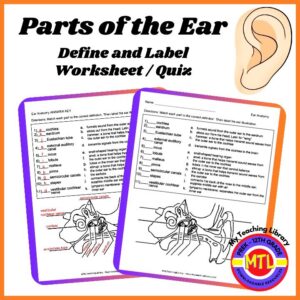
A ready-to-print and use worksheet that will have students define and label parts of the human ear. Answer key provided.
Great learning tool or quiz!
Parts: cochlea, eardrum, Eustachian tube, external auditory canal, incus, lobule, malleus, pinna, semicircular canals, stapes, vestibular cochlear nerve
-
$3.00Add to Cart
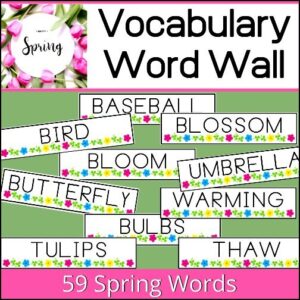
Here are 59 Spring vocabulary word cards to use on a word (vocabulary) wall, place in a writing center or use as flash cards. These words can be a springboard to numerous learning activities!
Ideas on how to use words in this resource:
– Write definitions and sentences using each word.
– Create a short story using as many words as they can.
– Choose 3-5 words and create a fun Haiku poem using the words.
– Create a Spring shape poem using as many words as they can.
– Create their own word search puzzle or crossword puzzle using 10 or more of the words.
– Create a Science based report on Spring using as many words as they can.
– Create a ‘newspaper’ report about Spring using as many words as they can.
…and don’t let the creativity stop there! -
$1.50Add to Cart
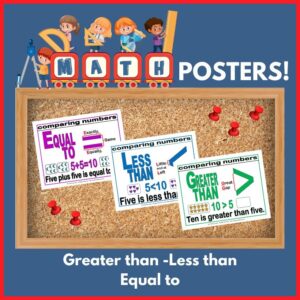
Three classroom posters to display to help students learning to recognize / identify three Math signs:
- – Greater than
- – Less than
- – Equal to
-
$2.50Add to Cart
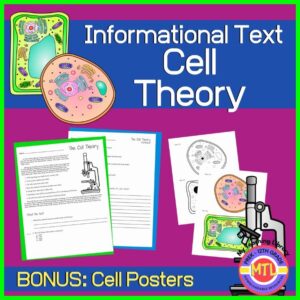
A great introductory lesson on Cell Theory for your Science students. The text will teach students about the contributions of scientists Robert Hooke, Matthias Schleiden, Theodor Schwann and Rudolf Virchow. It lists the 3 basics of Cell Theory as well as the 3 ‘modern’ ideas that have been added to Cell Theory.
This resource includes:
- Informational Text
- Assessment of student understanding (multiple choice and short essay)
- Answer Key
- BONUS: B/W and Color posters of animal and plant cells.
-
$3.00Add to Cart
This is a downloadable copy of the book. (358 pages)
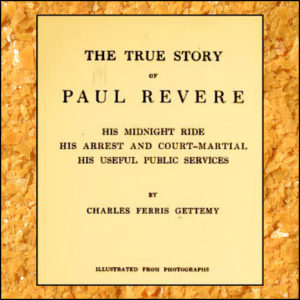
About the book: Published in 1905, Gettemy writes of Paul Revere’s midnight ride, his arrest, court-martial plus his ‘useful public services’. Paul Revere ( December 21, 1734 – May 10, 1818) was an American silversmith, engraver, early industrialist, and a patriot in the American Revolution. He is most famous for alerting the Colonial militia to the approach of British forces before the battles of Lexington and Concord, as dramatized in Henry Wadsworth Longfellow’s poem, “Paul Revere’s Ride”. Revere was a prosperous and prominent Boston silversmith, who helped organize an intelligence and alarm system to keep watch on the British military. Revere later served as a Massachusetts militia officer, though his service culminated after the Penobscot Expedition, one of the most disastrous campaigns of the American Revolutionary War, for which he was absolved of blame. Following the war, Revere returned to his silversmith trade and used the profits from his expanding business to finance his work in iron casting, bronze bell and cannon casting, and the forging of copper bolts and spikes. Finally in 1800 he became the first American to successfully roll copper into sheets for use as sheathing on naval vessels.
-
$3.75Add to Cart
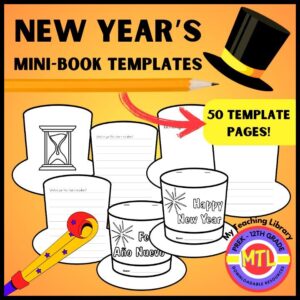
Have students start the New Year off writing! Here are fun top hat shaped pages for students to use as the self-publish their writing about the New Year, define related (given) vocabulary and answer (given) writing prompts about the holiday.
Includes:
– 3 different covers so students can choose which best ‘fits’ their project
– Differentiated lined pages (both single lined and primary dashed)
– Lined and Unlined pages to define and use 13 related vocabulary words
– 4 different question pages relating to the holiday (how they celebrated, resolutions, what they hope for the new year and how they celebrated)
– 5 picture pagesThis resource has 50 template pages!
-
Sight Words – 3rd Grade Flash Cards and Classification | Christmas Themed to Pinterest (opens in a new window)$4.00Add to Cart
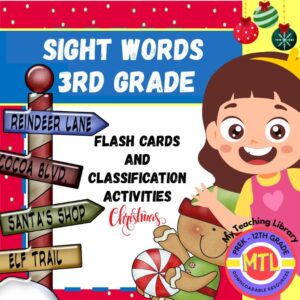
3rd grade flashcards and classification/sorting activities – Designed for students needing to learn and/or practice reading 3rd grade sight words. In addition to learning to read these words, students will be actively engaged in a variety of classification activities as they sort the words based on syllabication, vowel sounds and parts of speech.
Included:
– 2 sets of flash cards:
— Set 1: Students will trace each word to create their set to of cards that they can use to practice reading the words.
— Set 2: A ready-to-use set to use in whatever way(s) you decide! Use for practice, assessment or within a classification / sorting activity!– Classification posters: (1 syllable, 2 syllables, 3 syllables, long vowel, short vowel, noun, verb, adjective, adverb, preposition)
— Create an interactive bulletin board – Display posters (based on the classification you wish students to complete: syllabication, vowel sound or parts of speech) and give students the flash cards. Include on the bulletin board a pocket under each poster that you display. This can be a baggie or a folder pocket that you create. Students will place each card in the ‘correct’ pocket.
— Create a center – Affix the posters (based on the classification you wish students to complete: syllabication, vowel sound or parts of speech) on the front of folders or create ‘boxes’ with a poster on each box. Give students the flash cards and have them sort them into the folder or box! -
$4.00Add to Cart
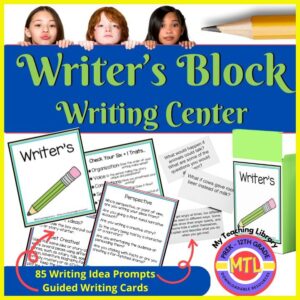
An engaging writing center resource that students will love to use! Materials include:
- Center Title & Instruction ideas
– Check your 6 + 1 traits
– Instructions
– Perspective questions - 86 writing prompt cards (best suited for 3rd-6th grades)
- Center Title & Instruction ideas
-
$2.75Add to Cart
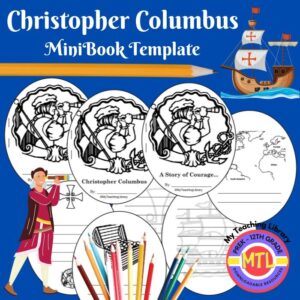
Students will enjoy creating their own Christopher Columbus mini-book with this resource! After learning about Columbus (through their own curriculum, reading, watching a video or research), they can use these pages to create a story, report or poem about Columbus.
Includes:
- – 3 cover templates (blank, Christopher Columbus, A Story of Courage)
- – 12 inside page templates
-
$2.50Add to Cart
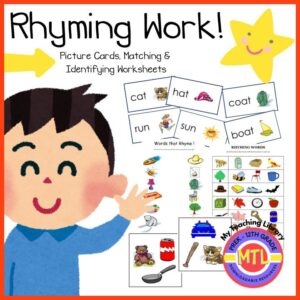
This resource teaches 30 rhyming words through picture flashcards and 8 easy matching worksheets.
Teaching rhyming words aids in teaching early literacy skills like phonemic awareness and fluency development. When children learn to rhyme, it helps them develop the ability to break words down into smaller parts like puzzle pieces.
-
$2.00Add to Cart
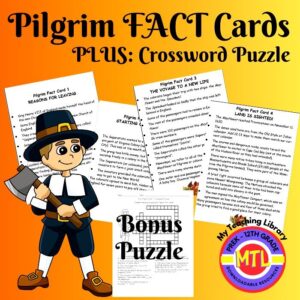
This resource gives you four Pilgrim Fact Cards:
– Reasons for Leaving
– Starting Over, Again
– The Voyage to a New Life
– Land is Sighted!Students will learn the answers to questions such as…Why did the Pilgrims leave England? Where did they move before crossing the Atlantic? What did they bring with them when coming to the New World? What is the name of the ship (not the Mayflower) that also brought pilgrims to Virginia? Why did the Wampanoag attach the colonists?
Included Bonus: A fun crossword puzzle!
-
$2.00Add to Cart
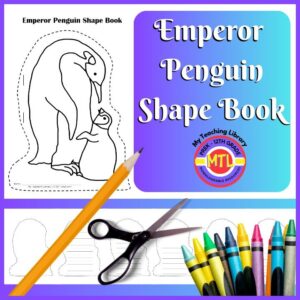
Studying penguins or perhaps animals of the arctic? Here is a ready-to-use resource for students to publish stories, reports or poems about penguins.
You’ll find pages with both dotted-dashed lines as well as single lines so that you can use what best fits the level of your students.
-
$3.00Add to Cart
This is a downloadable copy of the book.
About the book: The Odyssey focuses on the ten-year journey home of Odysseus, king of Ithaca, after the fall of Troy. Many accounts of Homer’s life circulated in classical antiquity, the most widespread being that he was a blind bard from Ionia, a region of central coastal Anatolia in present-day Turkey. Modern scholars consider these accounts legendary.
About the Author: Homer is the legendary author of the Iliad and the Odyssey, two epic poems that are the central works of ancient Greek literature.
-
$15.00Add to Cart
An American Government Curriculum – Student Text edition
Units include:
- Structure and Function
- Foundations of American Government
- The Federal System
- The Three Branches
- Influencing Government
- Civil Rights
- Government Transformation (20s-30s)
- Domestic Policy and Foreign Affairs
- The Politics of Democracy
- Personal Involvement
-
$3.25Add to Cart
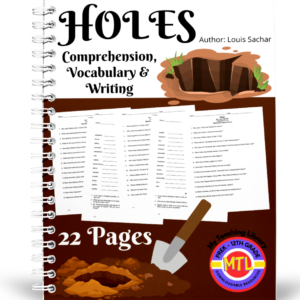
This book unit (Holes by Lousi Sachar) provides reading comprehension questions, vocabulary work and discussion questions in which students will be tasked with writing their answers.
There are 22 pages and split into groups of chapters for ease of assignment/use:
- Chapters 1-5
- Chapters 6-10
- Chapters 11-16
- Chapters 17-22
- Chapters 23-28
- Chapters 29-33
- Chapters 34-39
- Chapters 40-45
- Chapters 46-50
Also included: Extended activity ideas and answer keys
About the book:
Holes is a 1998 novel written by Louis Sachar. It won the 1998 U.S. National Book Award for Young People’s Literature and the 1999 Newbery Medal for the year’s “most distinguished contribution to American literature for children”. The story centers on an unlucky teenage boy named Stanley Yelnats, who is sent to Camp Green Lake, a juvenile corrections facility in a desert in Texas, after being falsely accused of theft. The plot explores the history of the area and how the actions of several characters in the past have affected Stanley’s life in the present. These interconnecting stories touch on themes such as racism, homelessness, illiteracy, and arranged marriage.Interest level:
Grades 4 – 8Reading level:
Grades 3 – 8 -
$3.25Add to Cart
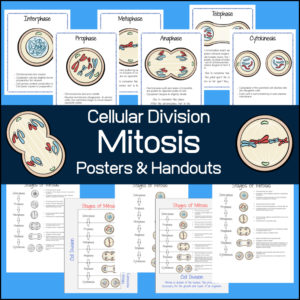
Let’s face it: Trying to explain the “dance of the chromosomes” without clear visuals is a recipe for confused faces. This resource simplifies the complex process of cellular division into digestible, visually engaging steps.
🔍 What’s Inside?
This resource covers the full cycle of mitosis, ensuring your students see the “big picture” of how cells replicate.
The Phases Outlined:
- Interphase: The prep work (DNA replication).
- Prophase: Chromosomes condense and the party starts.
- Metaphase: Everyone aligns in the middle.
- Anaphase: The great separation.
- Telophase: Two new nuclei form.
- Cytokinesis: The final split!
Included Versions:
- 🎨 Full Color: Perfect for high-impact classroom decor or digital presentations.
- 🗒️ Black & White: Ideal for student handouts, coloring activities, or saving on ink.
- ✍️ With Explanations: Includes detailed text describing the events of each phase.
💡 Why You’ll Love This
1. Visual Clarity for Abstract Concepts Mitosis is hard to visualize! These posters provide a clear “anchor” for students to refer back to when they get stuck on the difference between anaphase and telophase.
2. Differentiation Made Easy With both “labeled” and “blank” versions, you can easily scaffold your instruction. Use the labeled version for an introductory lecture and the blank version for a formative assessment.
3. Saves You Prep Time Stop scouring the internet for clear, high-quality diagrams. These are ready to print and use immediately. ☕🏫 Suggested Grade Levels & Subjects
- Grades: 6th – 10th Grade
- Subjects: Life Science, General Science, and Biology
-
$2.25Add to Cart
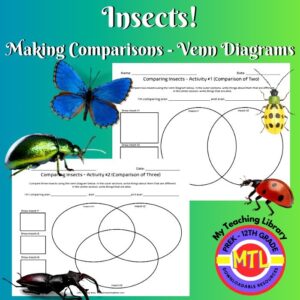
TWO ready to use Venn Diagram Science activities for students to use to compare 2 or 3 insects. On each, students will list the insects they will compare and contrast, draw a picture of each and then complete the Venn Diagram.
Extend the activity by asking students to write a paragraph or short report about their discoveries!
-
$3.00Add to Cart
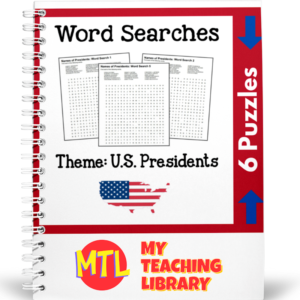
Do your students love word searches? This product includes 6 Word Search puzzles for students to find the names of U.S. Presidents! Names are hidden horizontally, diagonally, vertically, forwards and backwards. The first 5 word search puzzles have from 17-20 different presidents to find within each puzzle. The 6th puzzle contains presidents (Washington to Biden).
Fun puzzles for any classroom, especially a U.S. History or Government class. Use anytime of the year, or for Presidents’ Day. Great time filler too!
-
$1.25Add to Cart
These three fun ‘trace and color’ worksheets displaying a fish will give little hands a fun picture color and words to trace! The first two worksheets have words to trace. The third worksheet has a line on which students can write a word or short sentence (without tracing). Great worksheets for developing fine motor skills.
-
$6.00Add to Cart
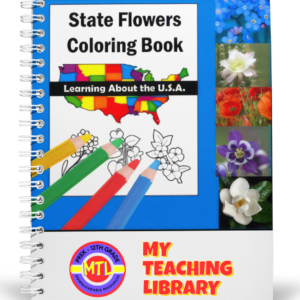
A U.S.A. state flowers coloring book that students will truly enjoy. Students will color each state flower and have the opportunity to write about each.
Each page has a large state flower to color + the state name. Also included: 2 notebooking / report pages for students to use (optional) so they can write a little about each flower. Whether you are studying each state or simply want to provide some coloring fun with an educational twist to your day, students will enjoy this resource!