
Category: 6th-8th
Showing 361–380 of 601 resultsSorted by latest
-
 $3.00Add to Cart
✏️A student-centered resource to help students learn and practice research skills, report writing, project and presentation skills.
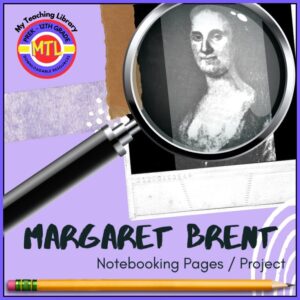
Students will use this project-based unit to learn about and report on Margaret Brent.Margaret Brent was the first woman in the American colonies to appear before a court of the Common Law to claim land in her own right or to pursue her own interests in court. She was also a significant founding settler in the early histories of the colonies of Maryland and Virginia.
✏️This notebooking project unit can be assigned individually or within cooperative groups. Use it within a Language Arts classroom or a Social Studies / U.S. History classroom. Very flexible and cross-curricular! After completing the written portion of this resource, you can grade it (or) assign students to do an oral and/or audio-visual presentation based on their findings/work.
✏️What is in this resource?
- Student instructions for using biographical notebooking, project pages
- Suggested research questions
- Student notebooking, project pages (includes covers, KWL, reference recording, report writing, and more)
- Teacher pages (instructions, assignment, evaluation)
-
$3.00Add to Cart
✏️A student-centered resource to help students learn and practice research skills, report writing, project and presentation skills.
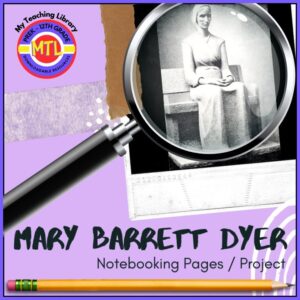
Students will use this project-based unit to learn about and report on Mary Barrett Dyer. Mary Barrett Dyer was a British-born religious figure whose martyrdom to her Quaker faith helped relieve the persecution of that group in the Massachusetts Bay Colony.
✏️This notebooking project unit can be assigned individually or within cooperative groups. Use it within a Language Arts classroom or a Social Studies / U.S. History classroom. Very flexible and cross-curricular! After completing the written portion of this resource, you can grade it (or) assign students to do an oral and/or audio-visual presentation based on their findings/work.
✏️What is in this resource?
- Student instructions for using biographical notebooking, project pages
- Suggested research questions
- Student notebooking, project pages (includes covers, KWL, reference recording, report writing, and more)
- Teacher pages (instructions, assignment, evaluation)
-
 $2.50Add to Cart
This is a downloadable copy of the book.
About the book: This is the second of eleven Alcott stories for girls published during the years 1899-1904, more than a decade after her death. This tale originally appeared in MY GIRLS (1878).About the Author: Louisa May Alcott was an American novelist, short story writer and poet best known as the author of the novel Little Women and its sequels Little Men and Jo’s Boys.
-
$5.00Add to Cart
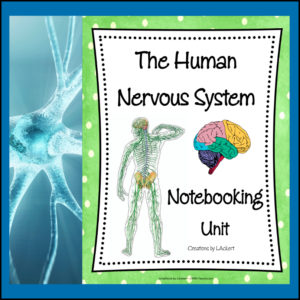
This BIOLOGY / HEALTH / ANATOMY / BODY SYSTEMS resource centers around the human nervous system and is a notebooking project unit. This interactive 56 page resource will require students to perform research and can be used independently or along side your curriculum.
-
$2.50Add to Cart
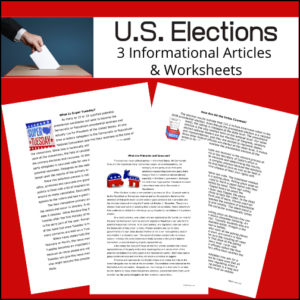
Here are three informational articles that will help students learn about the U.S. Election process, specifically how votes are counted, primaries and caucuses as well as what is Super Tuesday. After reading each, students understanding / comprehension will be assess through two worksheets (for each article). The worksheets are multiple choice and short answer. Answer keys provided.
-
$1.00Add to Cart
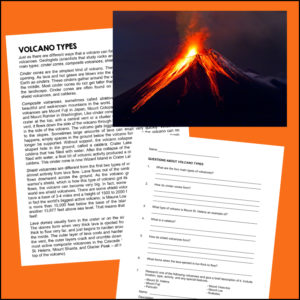
Here is a one page informational article to help students (6th-9th grades) learn about the various types of volcanoes and characteristics of each. After reading the text, student will answer questions to assess their comprehension.
-
$2.00Add to Cart
Help students learn the history behind St. Patrick’s Day and sharpen their reading comprehension skills with this informational text resource. Every year, on March 17th, Irish people throughout the world wear green, pin a shamrock to their clothing and celebrate. But what’s behind (or who is behind) this holiday? Where and why did it begin? What is the story behind the shamrock? Students will learn answers to these questions and more!
Flesch-Kincaid Grade Level: 5.1
Grade level: Fifth Grade
The SMOG Index: 5.8
Grade level: Sixth Grade -
$1.25Add to Cart
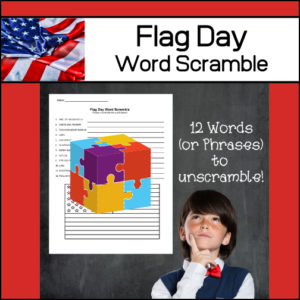
Students will need to unscramble 12 words (or phrases) associated with Flag Day to complete the puzzle! Answer Key provided
-
$3.00Add to Cart
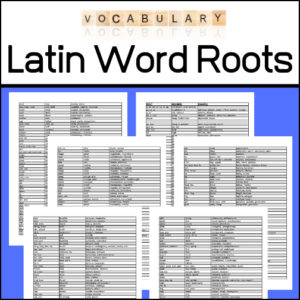
Here is a 6 page reference guide to Latin word roots! For each root, a meaning is given as well as word examples.
Samples:
ab, a, abs | away | abduct, abnormal, abrasion
alter | other | alternative, altercation
ject | throw | inject, projection
vad, vas | go | evade, evasive -
$5.00Add to Cart
Biography & Literary Analysis of the works of Shakespeare
-
$15.00Add to Cart
Teacher’s Guide for Language Arts 2 (suggested 7th Grade use)
-
$1.50Add to Cart
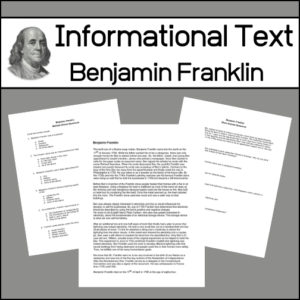
Students will learn about the writer, inventor and statesmen, Benjamin Franklin in this informational text article. After reading, students’ reading comprehension and understanding will be assessed with 2 worksheets (multiple choice and short answer).
-
$3.50Add to Cart
Observed every November, Veterans Day is a special day set aside to celebrate the bravery and sacrifice of all U.S. Veterans. This resource has been designed to give students the opportunity to research various aspects of the holiday, the men who have served, branches of the military, and anything related to the United States armed forces. After they have completed their research, students will have materials to…
- *Create a stand-alone notebook project
- *Use the pages within to creatively add to their existing History / Social Studies interactive notebooks.
-
$2.50Add to Cart
This is a downloadable copy of the book.
About the book: A collection of stories by the American author, historian and Methodist Minister whose tales (especially the Hoosier series) were very popular in their time. -
$3.00Add to Cart
Raised in a workhouse for orphans, Oliver Twist never knew his mother, who died just after he was born, and he has no idea who his father could be. He escapes the workhouse and runs away to London, where he discovers the city’s seedy underbelly that teems with pickpockets and beggars. While making friends and enemies in high and low places, Oliver tries to avoid a life of destitution and crime in the corrupt city. English author Charles Dickens’ rags-to-riches story champions the poor and examines social morals.
- Interest Level: Grade 7 – Grade 12 ·
- Reading Level: Grade 9
-
$2.50Add to Cart
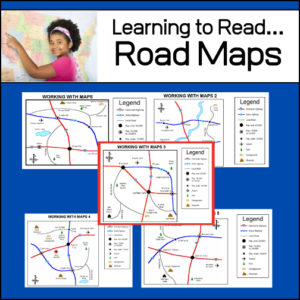
An important life skill is learning how to read maps! This resource provides 5 easy to read road maps. For each map, students will practice using the legend and answer 12-15 questions. Students will answer a total of 71 questions – Answer Keys provided.
-
 $2.50Add to Cart
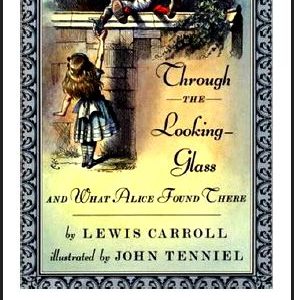
This is a downloadable copy of the book.
About the book: The sequel to Alice’s Adventures in Wonderland (1865). Alice again enters a fantastical world, this time by climbing through a mirror into the world that she can see beyond it. There she finds that, just like a reflection, everything is reversed, including logic (running helps you remain stationary, walking away from something brings you towards it, chessmen are alive, nursery rhyme characters exist, etc).About the Author: Lewis Carroll, was an English writer of world-famous children’s fiction, notably Alice’s Adventures in Wonderland and its sequel Through the Looking-Glass. He was noted for his facility at word play, logic, and fantasy. The poems Jabberwocky and The Hunting of the Snark are classified in the genre of literary nonsense. He was also a mathematician, photographer, and Anglican deacon. (Lewis Carroll is a pen name – Given name was Charles Lutwidge Dodgson)
-
$1.75Add to Cart
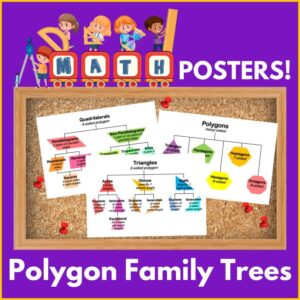
Here are three Math Geometry posters (polygon family trees) to display in your classroom! These will be a great visual addition to help introduce the relationships between shapes and shape vocabulary.
Included:
- Poster #1 Polygons will show: triangle pentagon, heptagon, quadrilateral, hexagon, octagon,
- Poster #2 Triangles will show: acute (scalene, isosceles, equilateral), obtuse (scalene, isosceles), right (scalene, isosceles)
- Poster #3 Quadrilaterals will show parallelograms (rhombuses, rectangles, squares), non-parallelograms (trapezoids, trapeziums, kites)