
Category: 6th-8th
Showing 341–360 of 604 resultsSorted by latest
-
 $15.00Add to Cart
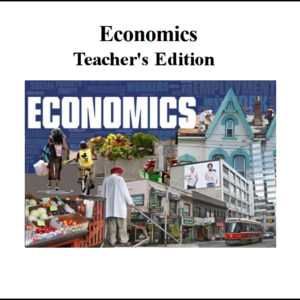
Teachers edition to be used with:
Economics Curriculum – Student Edition (separate resource) -
$2.50Add to Cart
Moby-Dick, written in 1851, recounts the adventures of the narrator Ishmael as he sails on the whaling ship, Pequod, under the command of the monomaniacal Captain Ahab. Melville dedicated the book to fellow Dark Romantic, Nathaniel Hawthorne: “In token of my admiration for his genius, this book is inscribed to Nathaniel Hawthorne.”
-
$3.00Add to Cart
Biography and Literary Analysis – George Orwell
454 pages -
$5.00Add to Cart
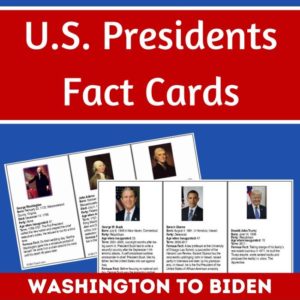
Studying the U.S. Presidents, U.S. History, or U.S. Government? These U.S. Presidents Fact Cards are perfect for students wanting to learn more about each president, from Washington to Biden. Also includes 2 blank templates to use for future presidents.
Three info cards per page, each approximately 5″ x 3″. To use year after year, laminate the cards after you print and cut out.
Each card includes:
- Photo and Name
- Date of Birth (some include date of death)
- Party affiliation
- Age when inaugurated
- Term (years of service)
- A famous fact(s)
-
$3.25Add to Cart
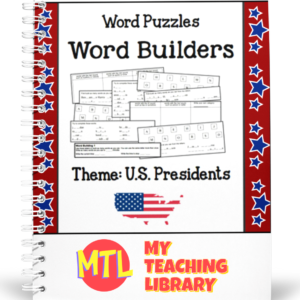
Challenge students’ critical thinking skills and knowledge of the U.S. Presidents with these 5 Word Builder puzzles with a U.S. Presidents theme!
See description below for details about these puzzles.
-
$4.50Add to Cart
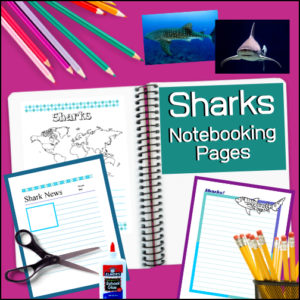
There are over 500 known species of sharks in the world! Most students love studying sharks and this unit has been created to help students record the knowledge they learn during a study on sharks as well as personal reflections of what has been learned.
This resource includes:
- – Creating a Notebooking Project…What is Notebookiing?
- – Supply list
- – Teacher pages
- – Student organizational pages
- -‘Jump off’ Questions designed to get students thinking about the different shark related questions they can research
- – 32 Notebooking pages
Notebooking is a coined term for what can also be referred to as educational journaling or scrapbooking.
-
$1.00Add to Cart
This resource, Types of Angles – Classroom Poster Set, includes 4 posters for your Math classroom…
- Obtuse Angle
- Acute Angle
- Straight Angle
- Right Angle
Print and for years of use, laminate!
-
Botany & Plant Science Unit Study: Interactive Project-Based Learning for Grades 2-6 to Pinterest (opens in a new window)$10.00Add to Cart
🌿 Botany – Plants | Interactive Learning Unit 🪴
Transform your science lessons into a hands-on adventure!
Ready to turn your science lesson plans into a thriving garden of knowledge? This Interactive, Project-Based Botany Unit is the ultimate resource for parents and educators looking to make science come alive. Designed with flexibility in mind, this resource grows with your students, making it perfect for multi-age learning environments (Grades 2nd–6th).
🍃 What’s Inside?
Give your students an engaging, deep dive into the world of plants. This resource covers everything from the microscopic details of a cell to the fascinating world of carnivorous plants:
-
Classification 🗂️: Learn how scientists group the green world.
-
Photosynthesis ☀️: Discover the magic of how plants turn sunlight into food.
-
The Plant Cell 🔬: A closer look at the building blocks of life.
-
Parts of the Plant 🌱: From roots to petals, understand how every part has a job.
-
Needs for Growth 💧: Exploration of the essential elements: water, light, soil, and air.
-
The Life Cycle 🔄: Follow the journey from a tiny seed to a mature plant.
-
Leaf Study 🍃: Diving into the shapes, functions, and beauty of foliage.
-
Specialty Species 🌵: Explore the “wild side” with non-flowering, carnivorous, and poisonous plants!
✨ Why You’ll Love It:
From a homeschooling parent: “Finally, a resource that works for my whole family! I can teach my 2nd grader and 5th grader at the same time with activities that challenge them both.”
From a classroom teacher: “Perfect for differentiated learning!“-
Project-Based Learning: Move beyond the worksheet! Students engage in hands-on projects that solidify their understanding.
-
Differentiated for Grades 2–6: The content is adaptable, allowing you to scale the complexity up or down depending on your students’ needs.
-
Interactive & Engaging: Keeps “boredom” at bay with activities that encourage curiosity and scientific inquiry.
-
No-Prep & Easy to Use: Whether you are in a traditional classroom or at the kitchen table, this unit is organized and ready to go.
Get ready to watch your students’ curiosity bloom! 🌸
-
-
$1.25Add to Cart
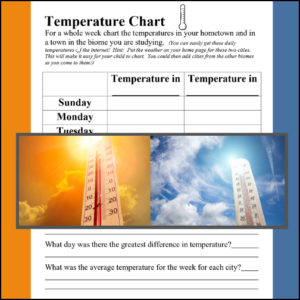
A biome is a large geographical area that contains distinct plant and animal groups which are adapted to live in that environment. There can be many different habitats in a biome. Some major biomes are tundra, taiga, grasslands, deciduous forest, fresh water, desert, alpine, rainforest and ocean. When studying a specific biome, use this temperature comparison chart to record the temperature in the student’s hometown and the biome of study for a week! (Use again and again with each biome studied)
Science meets Geography
-
$3.00Add to Cart
This resource offers vocabulary work, reading comprehension and discussion questions about the story and characters..
About the book (Not included):
The Giver is a 1993 novel by Lois Lowry. It is set in a society which at first appears to be utopian but is revealed to be dystopian as the story progresses. The novel follows a 12-year-old boy named Jonas. The society has taken away pain and strife by converting to “Sameness”, a plan that has also eradicated emotional depth from their lives. Jonas is selected to inherit the position of Receiver of Memory, the person who stores all the past memories of the time before Sameness, as there may be times where one must draw upon the wisdom gained from history to aid the community’s decision making. Jonas struggles with concepts of all the new emotions and things introduced to him: whether they are inherently good, evil, or in between, and whether it is even possible to have one without the other. The Community lacks any color, memory, climate, or terrain, all in an effort to preserve structure, order, and a true sense of equality beyond personal individuality.Interest level:
Grades 4 – 8Reading level:
Grades 3 – 8 -
$2.50Add to Cart
Before students begin a science project, it’s important to know important vocabulary and understand the process scientists use to design and perform experiments. This resource includes:
- Handout with a scientific method checklist (step-by-step process to follow)
- Seven vocabulary words with definitions
– Variables
– Independent variables
– Dependent variables
– Hypothesis
– Constants
– Control
– Trials - Vocabulary crossword puzzle (with key)
- Vocabulary quiz (with key)
To use again and again, laminate or place inside a sheet / page protector!
-
$5.00Add to Cart
This Vikings resource will have students interactively learning (and creating) as they learn about the lives these Norsemen explorers. Students will learn about their exploration, trade, ships, clothing, every day life and more.
This resource includes:
- – Informational text and worksheets
- – Notebooking / Report pages
- – Lapbooking Section
- – Visual Aids
- – Map Work
- – Crafts
- – Recipes
- – Puzzles
- – …and more
-
$1.50Add to Cart
This is a downloadable copy of the book. (64 pages)
About the book: Written in 1846. -
$9.75Add to Cart
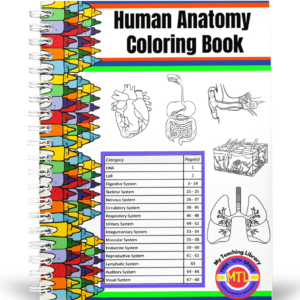
This 68-page anatomy coloring book has been designed for 5th-12th grade classrooms (Health, Science, Anatomy, Biology, Physiology).
Categories:
- DNA
- Cell
- Digestive System
- Skeletal System
- Nervous System
- Circulatory System
- Respiratory System
- Urinary System
- Integumentary System
- Muscular System
- Endocrine System
- Reproductive System
- Lymphatic System
- Auditory System
- Visual System
-
$5.50Add to Cart
With this comprehensive, cross-curricular unit study on the Mayflower, your students are going to read informational text to learn about the ship, its voyages, and its passengers (the Pilgrims). Students will also work with vocabulary related to ship navigational instruments, sections of the ship as well as words used in a farewell letter written to the passengers of the Mayflower. Perfect to use when studying the founding of the New World or during November (prior to Thanksgiving).
Students will be asked to…
- – Answer comprehension questions and questions to challenge their thoughts
- – Research and define unknown terms and vocabulary
- – Write a first person narrative
- – Complete hands-on projects
Some of the included items…
- – K-W-L
- – Informational Text: Mayflower before the Pilgrims
- – The Mayflowers Crew (Job titles and duties)
- – Sections of the Mayflower (Rooms/Areas and uses)
- – Names of navigational instruments of the day
- – Farewell letter read to the passengers prior to departure from Pastor John Robinson
- – Mayflower Passenger List
- – Informational Text: Food and Life Aboard the Mayflower
- – Pilgrim Fact Cards
- – Class outdoor activity
- – Answer Keys
After completion, students will have gained invaluable knowledge about life onboard a ship such as the Mayflower as well many of the reasons such a voyage was taken and a bit about life after they arrived into the New World.
I have included a list of books and web links that can be used for additional learning.
-
$3.00Add to Cart
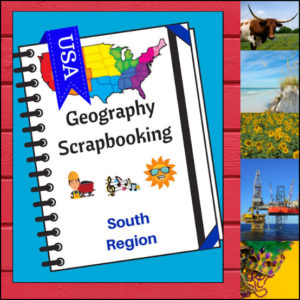
Turn your geography lessons into a creative travel adventure! As your students explore land of hospitality, diverse landscapes, and rich history of the South region, these scrapbooking pages offer a dynamic way for them to document their “journey.” Instead of just memorizing facts, students become curators of their own learning, capturing the essence of the states from West Virginia down to Florida and over to Texas.
This 5-page set is designed to be the perfect companion to your regional studies, allowing students to blend artistic expression with factual writing.
🧠 The “How” and “Why” (Educational Benefits)
Why swap traditional worksheets for scrapbooking? It’s all about active synthesis:
- Multisensory Engagement: By drawing or pasting pictures and writing short descriptions, students engage multiple areas of the brain, leading to significantly higher information retention. 🎨
- Critical Thinking & Opinion: The “Personal Opinion” section moves beyond rote memorization, asking students to evaluate information and decide what interests them most—a key skill in developing independent learners. 💭
- Comprehensive Coverage: These pages guide students through the “Big Six” of geography: Climate, Landforms, Water, Natural Resources, Landmarks, and Culture. 🏔️🌊
- Ownership of Learning: Creating a scrapbook gives students a sense of pride and ownership. It’s no longer just a school assignment; it’s an artifact of their hard work. 📖
🛠️ Creative Ways to Use These Pages
- The “Travel Journal” Project: Have students “visit” the South virtually. Use these pages as their daily log to record what they “saw” each day. ✈️
- State Fair Displays: If students are doing a deep dive into specific states, use these pages as the centerpiece for a poster board or display table.
- Geography Portfolios: Add these pages to a year-long geography binder. By the end of the year, students will have a complete “Travel Guide to the USA.” 📁
- Collaborative Posters: Print the pages at a larger scale and have small groups (or family) work together to illustrate and describe a specific aspect of the south (like “Culture and Food”). 🍕
📝 What’s Included:
- 5 Detailed Scrapbooking Pages: Focused on the Southern states.
- Guided Categories: Sections for Climate, Landforms, Water, Natural Resources, Landmarks, and Culture.
- Map Skills: Locating the states within the region.
- Personal Reflection: Space for students to share where they would most like to visit.
Pro Tip: This set is designed to pair perfectly with My Teaching Library’s Regions of the U.S. – South Region | Informational Text and Worksheets for a complete, no-prep curriculum solution!
🚀 Start Your South Adventure!
Transform your geography unit from dry facts into a vivid discovery! Download the South Scrapbooking Pages today and give your students the creative space to show off what they know!✨
Use as a stand-alone product or use with My Teaching Library’s Regions of the U.S. – South Region – Informational Text and Worksheets
⭐ This product is included in a $$$ SAVING BUNDLE: Regions of the U.S.A. | Geography Bundle
-
$2.00Add to Cart
This is a downloadable copy of the book. (74 pages)
About the book: Easy to follow traditional dishes that are relatively simple and unlike most regional cookery the ingredients are readily available!Includes recipes for dishes such as: dumplings (Spaetzle), corn chowder, hot dutch potato salad, cabbage rolls, wiener schnitzel, dutch meat loaf, apple ring fritters, old-fashion flannel cakes, peach fritters
-
$1.75Add to Cart
Pi Day is March 14th (3.14) and that’s why I’ve created two reading comprehension passages with questions (and answer keys) for your students. The first is ‘History of Pi’ and the second is ‘Celebrating Pi Day’!
-
$2.00Add to Cart
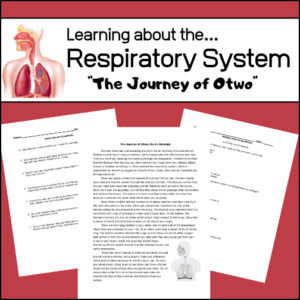
Students will learn about the respiratory system by following Otwo (the oxygen molecule) as he goes from bouncing around in the outside air into the human body! After reading the story, students will complete two worksheets (multiple choice and short answer) to access their understanding. Answer keys provided.
-
$6.00Add to Cart
Stop the “I don’t know what to write about!” struggle before it starts. This daily writing prompts resource provides a seamless solution for developing consistent writing habits, critical thinking skills, and creative expression for students in 4th – 12th Grade. Whether it’s a deep dive into facts and history or a light-hearted reflection, this month’s prompts ensure your students have a meaningful reason to put pen to paper every single day.
What’s Included?
This isn’t just a list of sentences; it is a complete journaling system. Each month is packed with:
- Individual Journal Pages: A unique, dedicated page for every day of the month.
- Diverse Prompt Styles: A balanced mix of “light and fun” topics and “deep-dive” prompts that challenge students to think critically about values, history, and social issues.
Here are two examples:
April 1st – (April Fool’s Day)
“The first of April is the day we remember what we are the other 364 days of the year.” ~ Mark Twain
Nobody is sure when April 1st became a day for practical jokes, but it is certain that April Fool’s Day is celebrated in many parts of the world. Do you have any special plans for this April Fool’s Day? Write about the best practical joke ever.April 2nd – (Reconciliation Day)
What does reconciliation mean? Is there someone with whom you need to reconcile? Who is it and what caused your fall out? If not, describe a reconciliation that has occurred sometime in your life.
How to implement it:
- Daily Starts: Start your morning or English period with a 10-minute quiet writing session.
- Fast-Finisher Activity: Keep your “early birds” engaged with a meaningful task that doesn’t feel like “busy work.”
- Homeschool Portfolios: Use these daily entries to track progress in handwriting, grammar, and expressive thought throughout the year.
- Digital or Print: These pages are designed to be “print-and-go” ready, but they also work beautifully as digital assignments. Simply give them to your student(s) and allow them to create a word document for each. First, have them copy (type) the prompt. Then answer it! Print and place in a growing 3 ring-binder of work.
The Benefits of Daily Prompting
Daily writing is like a workout for the brain. By using these journals, students will:
- Build Writing Stamina
- Strengthen Critical Thinking
- Encourage Research
- Encourages Deep Thinking About Different Topics
My Teaching Library has writing prompts for the entire year – BUNDLE & SAVE: Daily Writing Prompt Journal – ONE YEAR BUNDLE