
Category: 6th-8th
Showing 561–580 of 603 resultsSorted by latest
-
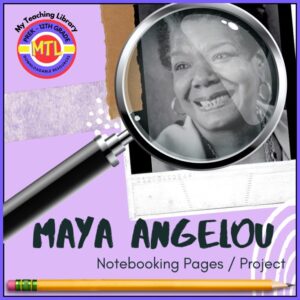
Maya Angelou Project-Based Unit | Research – Writing – Presentation to Pinterest (opens in a new window)
 $3.00Add to Cart
A student-centered resource to help students learn and practice research skills, report writing, project and presentation skills.
Students will use this project-based unit to learn about and report on Maya Angelou. Maya Angelou was an American poet, singer, memoirist, and civil rights activist. She published seven autobiographies, three books of essays, several books of poetry, and is credited with a list of plays, movies, and television shows spanning over 50 years. She received dozens of awards and more than 50 honorary degrees. Angelou is best known for her series of seven autobiographies, which focus on her childhood and early adult experiences. The first, I Know Why the Caged Bird Sings (1969), tells of her life up to the age of 17 and brought her international recognition and acclaim.
This notebooking, project unit can be assigned individually or within cooperative groups. After completing the written portion of this resource, you can grade it (or) assign students to do an oral and/or audio-visual presentation based on their findings/work.
What is in this resource?
- Student instructions for using biographical notebooking, project pages
- Suggested research questions
- Student notebooking, project pages (includes covers, KWL, reference recording, report writing, and more)
- Teacher pages (instructions, assignment, evaluation)
-
$2.50Add to Cart
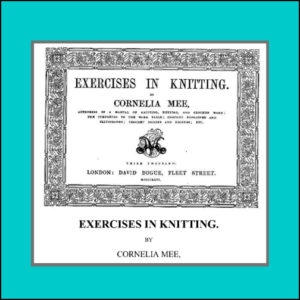
This is a downloadable copy of the book. (43 pages)
About the book: Published 1846 – Mrs. Mee, her husband, and her sister ran a yarn and needlework import/warehouse business in Bath, England. Her books primarily contain practical everyday items that knit up quickly with the busy homemaker in mind.
-
$20.00Add to Cart
This vocabulary curriculum will give middle school students the explanations and practice they need to master important word skills and helping them be successful! Includes a pretest, a post test and answer keys.
This workbook includes 4 Sections & Subsections:
- Tools for Building Vocabulary
– Why work on your vocabulary?
– Tools and techniques for learning new words
– Use a word’s context to figure out its meaning
– Create meaning from connotations
– Understanding word parts
– Take words down to their roots
– Mnemonics: Codes to help you spell words
– Synonyms and antonyms
– Which is the right word? - Use Different Parts of Speech to Increase Vocabulary
– Discover new nouns
– Pick the best adjectives
– Zip up your verbs
– Dress up verbs with adverbs - Build Vocabulary in All Subject Areas
– Words to describe personalities
– Words to describe feelings
– Words to describe extreme emotions
– Strange feelings and emotions
– Learn words for the Sciences
– You may see the doctor now
– Words about families
– Mind your manners
– Words from popular culture
– Words from the sports arena
– Words about politics
– Words about computers - Build Vocabulary in Special Ways
– Words we’ve adopted
– Words that really mean something else
– Confused and abused words
– Words about words
– Words with extra power
- Tools for Building Vocabulary
-
$2.00Add to Cart
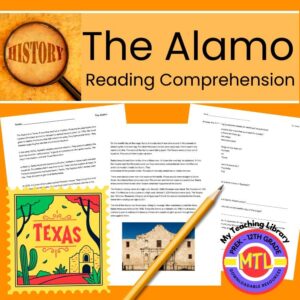
This Alamo Reading Comprehension will give students a good understanding of the historic battle and have students answer questions after reading the passage. Students will learn the following about the Alamo: What is it? Where is it? What happened there? What is it today?
Cross-curricular (Reading / History) – As students read for understanding they will be learning about an important landmark and event in U.S. History. After reading, students will answer multiple choice, short answer and short essay questions.
Flesch-Kincaid Grade Level: 4.9
Grade level: Fifth Grade -
$1.50Add to Cart
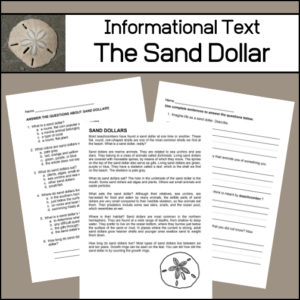
This informational article will teach students about the sand dollar. They will learn that the little round, coin-shaped shell found on the beach is actually part of a marine animal, related to sea urchins and sea stars. They will also learn how living sand dollars move, that they aren’t ‘white’, how and what they eat and much more. After reading, students will complete two worksheets (multiple choice and short answer) to assess their comprehension / understanding of the material. Answer Key is provided.
Automated Readability Index: 4.8
Grade level: 8-9 yrs. old (Fourth and Fifth graders)
Linsear Write Formula : 5.6
Grade level: Sixth Grade. -
$8.00Add to Cart
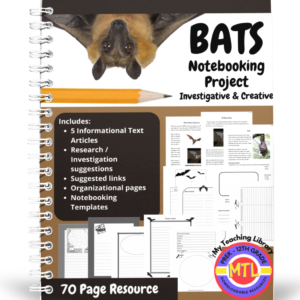
Studying bats? Here is a resource that will allow students to create a beautiful project that will show off what they’ve learned. This 70 page project unit can be used as a fully contained project resource (with no needed outside information required) or can be a launch for a full-blown research project using additional resources and includes:
- – Explanation page about creating a notebooking project
- – Suggested supply list
- – Evaluation rubric
- – Assignment page
- – Table of contents pages
- – Vocabulary & Reference pages
- – List of bat related vocabulary
- – Suggested links (optional)
- – Research / Notebooking questions/investigation suggestion handouts
- – 5 Informational text articles
- – Project KWL
- – Notebooking template pages
- – Bat pictures
-
$3.00Add to Cart
Since 1836, children have been delighted by these volumes filled with exotic adventures, exciting stories, beautiful poems, and funny fables. The Sixth Eclectic Reader includes selections from Patrick Henry, Sir Walter Scott, Elizabeth Barrett Browning, and William Shakespeare.
-
$3.00Add to Cart
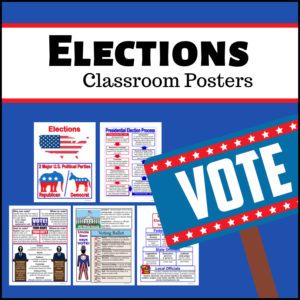
Teaching about U.S. elections? These colorful 5 election posters are packed with information about our government’s election process! Designed for 3rd, 4th, 5th and 6th grades.
Information you’ll find detailed on these posters include:
- What are our 2 major political parties
- The presidential election process (start to finish)
- Who can vote (plus when, how and where)
- Election terminology: debate, issues, platform, campaign, political party, nominate, candidate, incumbent, opponent, delegate, president, running mate, term, inauguration, oval office, ballot, citizen, democracy, election, electoral college, poll, vote
- Who are our elected officials in the U.S.? (examples of federal, state and local officials)
-
$10.00Add to Cart
One complete semester of work (90 days). Each day, students will be given 3 questions and designed to review a multitude of middle school math skills.
Click here for a flipbook preview (of Volume 1)Non-members: Bundle and save when you purchase Daily Math Skills Review | Middle School Full Year BUNDLE
(See description below for details)
-
$2.00Add to Cart
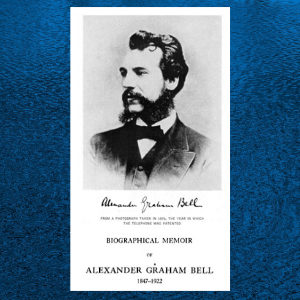
This is a downloadable copy of the book. (30 pages)
Excerpt from the book: Alexander Graham Bell – teacher, scientist, inventor, gentleman – was one whose life was devoted to the benefit of mankind with unusual success. Known throughout the world as the inventor of the telephone, he also made other inventions and scientific discovers of first importance, greatly advanced the methods and practices for teach the deaf and came to be admired and loved throughout the world for his accuracy of thought and expression.
-
$2.50Add to Cart
This is a downloadable copy of the book.
About the book: A poem typically categorized as a nonsense poem. Written from 1874 to 1876, the poem borrows the setting, some creatures, and eight portmanteau words from Carroll’s earlier poem “Jabberwocky” in his children’s novel Through the Looking-Glass (1871).About the Author: Lewis Carroll, was an English writer of world-famous children’s fiction, notably Alice’s Adventures in Wonderland and its sequel Through the Looking-Glass. He was noted for his facility at word play, logic, and fantasy. The poems Jabberwocky and The Hunting of the Snark are classified in the genre of literary nonsense. He was also a mathematician, photographer, and Anglican deacon. (Lewis Carroll is a pen name – Given name was Charles Lutwidge Dodgson)
-
 $2.50Add to Cart
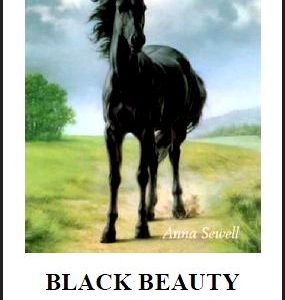
This is a downloadable. pdf copy of the book.
About the book: The story is narrated in the first person as an autobiographical memoir told by the titular horse named Black Beauty—beginning with his carefree days as a colt on an English farm with his mother, to his difficult life pulling cabs in London, to his happy retirement in the country. Along the way, he meets with many hardships and recounts many tales of cruelty and kindness. Each short chapter recounts an incident in Black Beauty’s life containing a lesson or moral typically related to the kindness, sympathy, and understanding treatment of horses, with Sewell’s detailed observations and extensive descriptions of horse behavior lending the novel a good deal of verisimilitude.
About the Author: Anna Sewell was an English novelist. She is well known as the author of the 1877 novel Black Beauty, which is now considered one of the top ten bestselling novels for children ever written, although it was intended at the time for an adult audience.
-
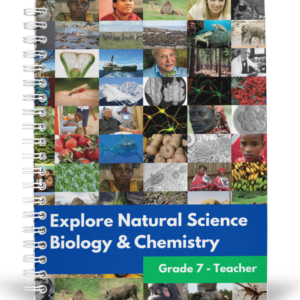
Natural Science: Biology & Chemistry – Grade 7 (Teacher’s Edition) to Pinterest (opens in a new window)$15.00Add to Cart
This is the Teacher’s edition for Natural Science: Biology & Chemistry – Grade 7 (Student Edition)
Bundle and Save: 7th Grade Science Curriculum Bundle
-
$2.50Add to Cart
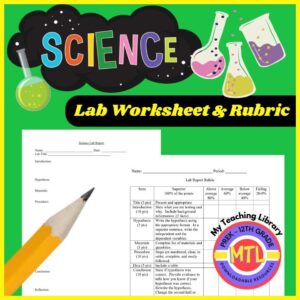
This Science lab worksheet and rubric will give your middle school and high school students an organized way to report the entire process of a science lab. Plus, the rubric can be given to students in advance so that they will know all of the criteria you are expecting! Use again and again, throughout the year for all your labs
There are sections for students to record…
- – Lab title
- – Introduction (Students are to state what they are testing and why plus give background information)
- -Hypothesis (Students are to write their hypothesis plus give the independent and dependent variables)
- -Materials (A complete list of materials)
- – Procedure (Students are to give detailed numbered steps that were followed)
- – Data (Should include a table)
- – Conclusion (Students will state if their hypothesis was correct, providing evidence. Change the hypothesis is necessary.)
- – Reflection (Students should list at least two sources of possible error)
The grading rubric makes it easy for YOU to grade!
-
$4.00Add to Cart
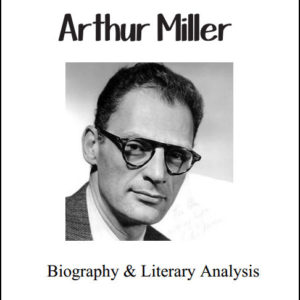
Biography & Literary Analysis – Arthur Miller
517 pages -
$4.50Add to Cart
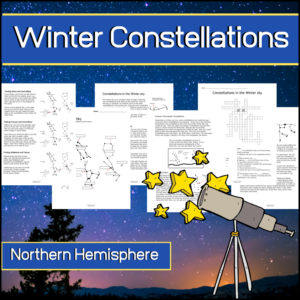
Explore the Northern Hemisphere’s Winter constellations with this resource! Students will learn…
- What are the major constellations?
- What is the Greek Mythology behind them?
- What major stars will help guide them through the night sky?
- How is Orion the ‘key’ to locating the main constellations?
- What is the name of the North Star, and which constellation is it in?
- What is the brightest star in the sky?
Students will learn about the following constellations:
- Orion
- Canis Major
- Canis Minor
- Gemini
- Auriga
- Pleiades
- Taurus
- Draco
- Ursa
- Major
- Ursa Minor
- Cepheus
- Cassiopeia
They will learn the location of the following stars:
- Pollux
- Castor
- Capella
- Procyon
- Sirius
- Betelgeuse
- Rigel
- Aldebaran
- Capella
- Polaris
They will also learn which constellations are called the Northern Circumpolar constellations PLUS the Greek Mythology behind these major constellations!
Student activity sheets include:
- Fill in the blank (constellation and star names for the ‘Winter Sky’)
- Draw and name (the five circumpolar constellations and the North Star)
- Crossword Puzzle (in which they will use the information within the resource to gather answers)
Suggested follow up activities:
- Assign students to go outside after dark, find and draw the constellations they see and can identify.
- Visit a local planetarium
-
$2.00Add to Cart
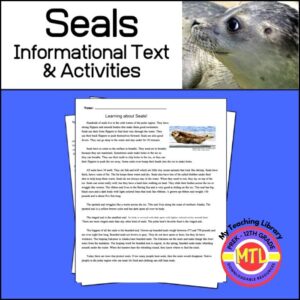
This informational text article is all about seals, where they live, their physical characteristics and about several different types of this cold-water mammal. After reading, students will complete a reading comprehension worksheet and (optional) write a story! Answer key provided.
-
$2.00Add to Cart
This is a downloadable copy of the book.
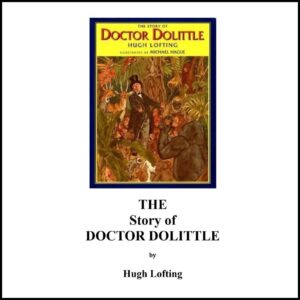
About the book: The Story of Doctor Dolittle, (Being the History of His Peculiar Life at Home and Astonishing Adventures in Foreign Parts) (1920), written and illustrated by the British author Hugh Lofting, is the first of his Doctor Dolittle books, a series of children’s novels about a man who learns to talk to animals and becomes their champion around the world. It was one of the novels in the series which was adapted into the film Doctor Dolittle.About the Author: Hugh John Lofting was an English author trained as a civil engineer, who created the classic children’s character of Doctor Dolittle. Dolittle first appeared in Lofting’s illustrated letters to his children, written from the British Army trenches in World War I. He travelled widely as a civil engineer, before enlisting in the Irish Guards regiment of the British Army to serve in the First World War. Not wishing to write to his children about the brutality of the war, he wrote imaginative letters which later became the foundation of the successful Doctor Dolittle novels for children.
-
$2.50Add to Cart
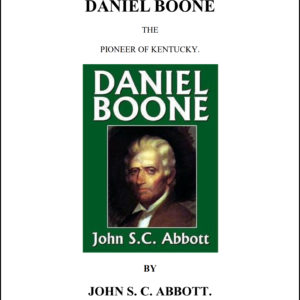
Daniel Boone is regarded as the first real American folk hero. Without his cunning bravery, settlement west of the Appalachians may not have been made possible for years. Boone’s Wilderness Road, which is still used today, helped bridge the Cumberland Gap, granting access to the state of Kentucky from Pennsylvania.
Thanks to the writing of John S. C. Abbot, the life and genius of Boone can truly be appreciated through Daniel Boone: The Pioneer of Kentucky. Find out just how Boone crafted his Wilderness Trail, what he did to make it happen, and how he overcame the struggles of life in late eighteenth century America.


&url=https://myteachinglibrary.com/product/the-hunting-of-the-snark-lewis-carroll/&media=https://myteachinglibrary.com/wp-content/uploads/2019/08/wy-306-b.jpg)
&url=https://myteachinglibrary.com/product/black-beauty-the-autobiography-of-a-horse/&media=https://myteachinglibrary.com/wp-content/uploads/2019/08/wy-303-d.jpg)
&url=https://myteachinglibrary.com/product/natural-science-biology-chemistry-7th-teacher/&media=https://myteachinglibrary.com/wp-content/uploads/2019/08/Z-258-Biology-Chemistry-Grade-7-teacher-1024x1024.png)


&url=https://myteachinglibrary.com/product/the-story-of-doctor-dolittle-by-hugh-lofting/&media=https://myteachinglibrary.com/wp-content/uploads/2019/08/Z-174-Doctor-Dolitle.jpg)

