
Category: By Grade
Showing 41–60 of 1679 resultsSorted by latest
-
 $1.50Buy Now
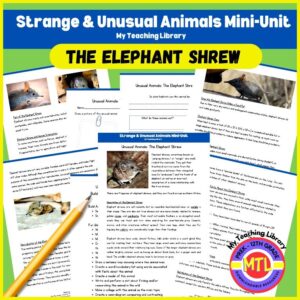
This engaging and cross-curricular mini-unit will teach students all about the elephant shrew! A strange and unusual animal, the elephant shrew is a small rodent-like mammal which gets its name from the resemblance between its elongated nose and the trunk of an elephant.
In this unit, students will read all about this little mammal…
– a description
– interesting facts
– where it lives
– what it eats
– interaction with humans
– if they make good pets
– behavior
– reproductionAfter reading all about the elephant shrew, students will complete a two-page activity in which they will draw the animal, do a little map work, answer questions and write about what they’ve learned.
Next, there are several hands-on ideas to continue building their knowledge and creating projects around this strange and unusual creature.
-
 $6.00Buy Now
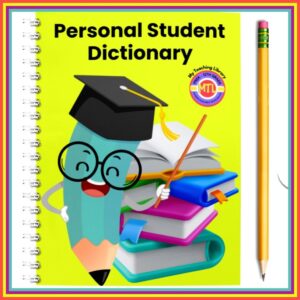
This personal Student Dictionary is a must-have spelling, writing, vocabulary dictionary tool for elementary students.
Students will use this dictionary all day long as they encounter new words in all subjects, Language Arts, Math, Science and Social Studies. Each time they meet a new word, they can write the word, a definition and (if level appropriate) an antonym and synonym for the word!
Put away other personal student dictionaries that do not give students space to record definitions as many do!!
What this resource includes:
- – Personal Dictionary cover page
- – Sight word list
- – Commonly misspelled words list in the categories named above)
- – A-Z letter sections
Each A-Z letter section includes 4 pages:
- – Page will give students another list (aside from the two previous lists mentioned above) of commonly misspelled words that begin with that letter. There will also be room to record three words (word, definition, antonym and synonym for each).
- – Pages 2-4 will provide room for students to record 5 additional words on each (word, definition, antonym and synonym for each). If more pages are needed, simply provide additional copies of these pages for students to add in their dictionaries!
This Student Dictionary is ideal for grades 1-4 but can be used in other grades for students needing extra support with spelling, or for kiddos with special needs.
-
 $42.00Buy Now
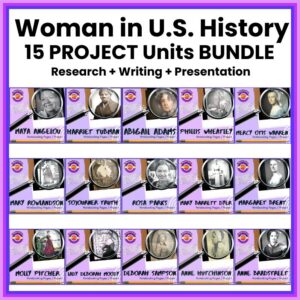
✏️Student-centered units that includes 15 projects surrounding important women in U.S. History. These units will help students learn and practice research skills, report writing, project and presentation skills.
✏️Students will use these 15 project-based units to learn about and create reports and presentations on the following people:
- Anne Hutchinson
- Anne Bradstreet
- Deborah Sampson
- Lady Deborah Moody
- Molly Pitcher
- Mary Barrett Dyer
- Margaret Brent
- Sojourner Truth
- Rosa Park
- Mary Rowlandson
- Mercy Otis Warren
- Phillis Wheatley
- Abigail Adams
- Harriet Tubman
- Maya Angelo
✏️These notebooking projects can be assigned individually or within cooperative groups. Use them within a Language Arts classroom or a Social Studies / U.S. History classroom. Very flexible and cross-curricular!
After completing the written portion of each resource, you can grade it (or) assign students to do an oral and/or audio-visual presentation based on their findings/work.
✏️What is in each unit?
- Student instructions for using biographical notebooking, project pages
- Suggested research questions
- Student notebooking, project pages (includes covers, KWL, reference recording, report writing, and more)
- Teacher pages (instructions, assignment, evaluation)
-
 $5.00Buy Now
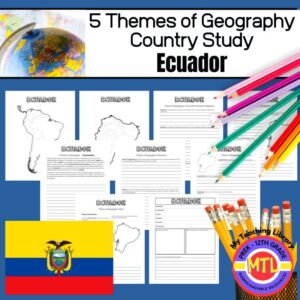
This is a project-based country study on the South American country of Ecuador focusing on the 5 Themes of Geography: location, place, regions, movement and human/environment integration! There are a lot of country studies but this one is different.
This study will ask students to ‘think like a geographer‘in their research and recording.
Using this resource, students will…
- Learn about the country of Ecuador
- Demonstrate knowledge of and ability to synthesize information and write about Ecuador through a 5 themes of geography lens.
- Create a wonderful project displaying their learning.
Sample questions include:
- – (Location) Describe the relative location of the country.
- – (Location) What is the latitude and longitude of the capital city?
- – (Place) What major landforms are found in the country?
- – (Place) What is/are the climate type(s) of the country?
- – (Regions) When considering this country, describe and give examples of at least one type of functional region within it.
- – (Movement) Describe any historically important migration patterns of information you have found about past or current migration for this country. You may include internal, external migration, emigration, immigration, return and/or seasonal migration.
- (Human/Environmental Integration) Give examples of how people who have lived in this country changed or modified the environment.
There are many more questions and this unit is designed to get your students thinking like a geographer!!
Students will need to have a good understanding of the 5 Themes of Geography to complete this project. Need teaching materials for the 5 Themes? Get My Teaching Library’s 5 Themes of Geography Bundle
-
 $5.00Buy Now
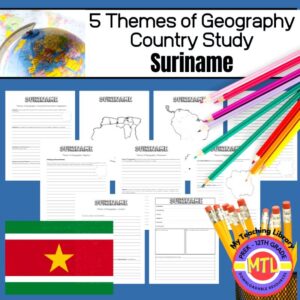
This is a project-based country study on the South American country of Suriname focusing on the 5 Themes of Geography: location, place, regions, movement and human/environment integration! There are a lot of country studies but this one is different.
This study will ask students to ‘think like a geographer‘in their research and recording.
Using this resource, students will…
- Learn about the country of Suriname
- Demonstrate knowledge of and ability to synthesize information and write about Suriname through a 5 themes of geography lens.
- Create a wonderful project displaying their learning.
Sample questions include:
- – (Location) Describe the relative location of the country.
- – (Location) What is the latitude and longitude of the capital city?
- – (Place) What major landforms are found in the country?
- – (Place) What is/are the climate type(s) of the country?
- – (Regions) When considering this country, describe and give examples of at least one type of functional region within it.
- – (Movement) Describe any historically important migration patterns of information you have found about past or current migration for this country. You may include internal, external migration, emigration, immigration, return and/or seasonal migration.
- (Human/Environmental Integration) Give examples of how people who have lived in this country changed or modified the environment.
There are many more questions and this unit is designed to get your students thinking like a geographer!!
Students will need to have a good understanding of the 5 Themes of Geography to complete this project. Need teaching materials for the 5 Themes? Get My Teaching Library’s 5 Themes of Geography Bundle
-
 $5.00Buy Now
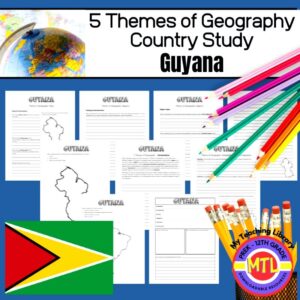
This is a project-based country study on the South American country of Guyana focusing on the 5 Themes of Geography: location, place, regions, movement and human/environment integration! There are a lot of country studies but this one is different.
This study will ask students to ‘think like a geographer‘in their research and recording.
Using this resource, students will…
- Learn about the country of Guyana
- Demonstrate knowledge of and ability to synthesize information and write about Guyana through a 5 themes of geography lens.
- Create a wonderful project displaying their learning.
Sample questions include:
- – (Location) Describe the relative location of the country.
- – (Location) What is the latitude and longitude of the capital city?
- – (Place) What major landforms are found in the country?
- – (Place) What is/are the climate type(s) of the country?
- – (Regions) When considering this country, describe and give examples of at least one type of functional region within it.
- – (Movement) Describe any historically important migration patterns of information you have found about past or current migration for this country. You may include internal, external migration, emigration, immigration, return and/or seasonal migration.
- (Human/Environmental Integration) Give examples of how people who have lived in this country changed or modified the environment.
There are many more questions and this unit is designed to get your students thinking like a geographer!!
Students will need to have a good understanding of the 5 Themes of Geography to complete this project. Need teaching materials for the 5 Themes? Get My Teaching Library’s 5 Themes of Geography Bundle
-
 $5.00Buy Now
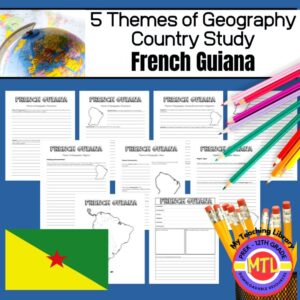
This is a project-based country study on the South American country of French Guiana focusing on the 5 Themes of Geography: location, place, regions, movement and human/environment integration! There are a lot of country studies but this one is different. This study will ask students to ‘think like a geographer‘ in their research and recording.
Using this resource, students will…
- Learn about the country of French Guiana
- Demonstrate knowledge of and ability to synthesize information and write about French Guiana through a 5 themes of geography lens.
- Create a wonderful project displaying their learning.
Sample questions include:
- – (Location) Describe the relative location of the country.
- – (Location) What is the latitude and longitude of the capital city?
- – (Place) What major landforms are found in the country?
- – (Place) What is/are the climate type(s) of the country?
- – (Regions) When considering this country, describe and give examples of at least one type of functional region within it.
- – (Movement) Describe any historically important migration patterns of information you have found about past or current migration for this country. You may include internal, external migration, emigration, immigration, return and/or seasonal migration.
- (Human/Environmental Integration) Give examples of how people who have lived in this country changed or modified the environment.
There are many more questions and this unit is designed to get your students thinking like a geographer!!
Students will need to have a good understanding of the 5 Themes of Geography to complete this project. Need teaching materials for the 5 Themes? Get My Teaching Library’s 5 Themes of Geography Bundle
-
Sale!
 Original price was: $16.00.$14.00Current price is: $14.00.Buy Now
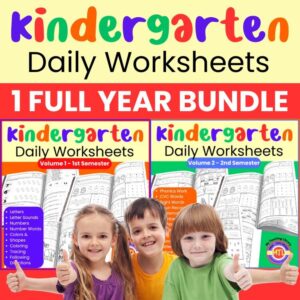
Looking for kindergarten worksheets that will teach vital literacy and math skills that students ask for? Here is a MONEY SAVING BUNDLE that provides an entire year of work!
This bundle includes 2 products:
Students LOVE these printables and will be excited to get started every morning. Using these pages will allow students to ease into their routine for the day as they work on developing important kindergarten skills.
⭐ What’s Included: 185 student pages
⭐ Skills covered:
- – Letter recognition and identification (upper and lower case)
- – Letter tracing
- – Letter sounds
- – Number recognition and identification (1-10)
- – Number tracing
- – Counting skills
- – Number word recognition
- – Number line work
- – Basic math (before and after)
- – Shapes
- – Colors
- – Fine motor skill practice (tracing, coloring, drawing)
- – Following directions
- – Phonics work
- – CVC words
- – Sight words
- – Noun recognition (identify if person, place or thing)
- – Tracing and copying sentences
- – Numbers and number words (11-20)
- – Tally marks
- – Money (counting pennies)
- – Patterns
- – Before and after
- – Single digit addition
- – Comparing
⭐ Print and Go!
-
 $2.50Buy Now
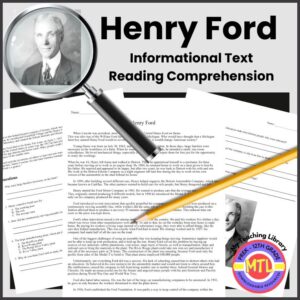
Henry Ford was an inventor, innovator, industrialist, and entrepreneur. In this resource, students will read about Ford’s life and business journey.
After reading, students will be asked a series of questions (multiple choice and short answer) to assess comprehension.
Students will learn:
- – About Henry’s family and early life
- – What he did at the age of 16
- – When he went to, left and then returned to Detroit
- – How he was first involved in car manufacturing and when he started Ford Motor Company
- – How is business practices made a huge stir in the country
- – One of his biggest challenges…and more!
Answer Key included!
-
 FREEBuy Now
Help students learn, reflect and build a positive, growth mindset while completing this FREE journaling page!
-
$2.00Buy Now
Give students a fun, engaging mini-book to create to help them learn about recycling! Recycle – Reuse – Reduce!
⭐Perfect to use during any student of our environment, our impact on the world, or for Earth Day!
⭐Students will have pages to color and put together creating a book that teaches and that they can keep! They’ll learn…
- The definition of recycle
- The definition of reuse
- The definition of reduce
- How to do all three (recycle, reuse, reduce)
- Examples of items to recycle
-
 $2.00Buy Now
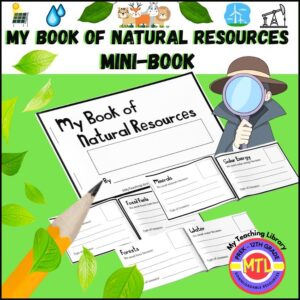
Give students a fun, engaging mini-book to create to help them demonstrate what they know (or are learning) about our natural resources!
⭐Perfect to use during any student of our environment, our impact on the world, or for Earth Day!
⭐Students will have pages for the following topics:
- Forests
- Soil
- Water
- Minerals
- Solar Energy
- Air
- Plants
- Animals
- Fossil Fuels
⭐On each page, students will be asked to answer the following:
- We need (topic) because?
- What type of resource? (renewable or non-renewable)
Related product: Earth Day Activities | Cross-Curricular | Multiple Learning Styles
-
 $3.00Buy Now
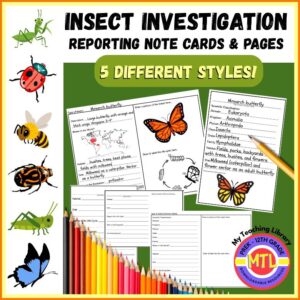
Studying insects? Doing a unit on entomology? Give students a resource to help guide an investigation as well as report what they find!
This product includes 5 different styles of insect investigation note cards and pages making it adaptable for multiple grades/levels. Depending on the information that you want students to gather and report, choose the appropriate style for the assignment. Once given the note card or page, the topics on each will help guide students as to the information they need to find and complete!
Details:
Style 1: (1/2 page note cards – 2 per page) Name of insect, habitat, diet, stages of the life cycle, role in the ecosystem and an interesting fact. Students will also draw a picture of the insect.
Style 2: (1 page) Name of insect, description, where in the world (map given to complete), habitat, diet, role in the ecosystem and an interesting fact. Students will draw a picture of the insect as well as draw and label the life cycle.
Style 3: (1/2 page note cards – 2 per page) Name of insect, scientific classification, habitat and diet. Students will draw a picture of the insect.
Style 4: (1 page) Name of insect, scientific classification, where in the world, habitat, diet, role in the ecosystem. Students will draw a picture of the insect as well as draw and label the life cycle.
Style 5: (1/4 page note cards – 4 per page) Name of insect, habitat, diet, stages of the life cycle, role in the ecosystem and an interesting fact. Students will also draw a picture of the insect. -
 $2.50Buy Now
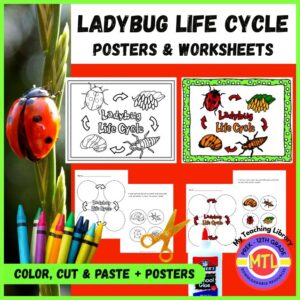
A great resource to display and to get students hands-on putting together their own life cycle of the ladybug!
⭐Benefits of this resource:
- -Low prep – print and use/
- -Children learn about the ladybug life cycle both visually (poster) and in a fun and hands-on way as they color, cut and glue (worksheets).
- -Can be used to introduce the life cycle, or as a review/assessment to check understanding.
- -Encourages fine motor/scissor skills and sequencing.
- -Differentiated can be achieved by deciding if students are allowed to have the poster as a reference when completing their own life cycle.
- -Finished worksheets can be inserted into an interactive notebook.
⭐What else is included?
- -2 Life cycle posters (Color and Black/White) You can always allow students to color the b/w poster and keep.
- -2 student pages (worksheets). Students will color and cut out the 4 stages of the ladybug life cycle from the first page and glue in the correct sequence on the second page.
-
FREEBuy Now
This FREE Kindergarten resource will have your students drawing, counting and writing the numbers 4, 5, 6 and 15.
- Get a FULL YEAR for Kindergarten Math here: Kindergarten Math Workbook BUNDLE
-
 $25.00Buy Now
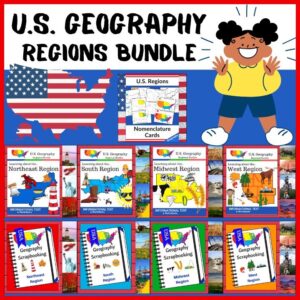
This United States Regions BUNDLE will immerse students in active, hands-on-learning geography learning about the four regions: Northeast, South, Midwest and West! Included are nomenclature cards, informational text, scrapbooking / notebooking project pages and worksheets that will give students the opportunity to not only learn about the Land and Water, Climate, Products and Natural Resources, Landmarks, Culture and Food of each region, AND create beautiful notebooking projects as well!
Included in this $$$ Bundle:
- – Geography: US Regions Nomenclature Cards
- – Regions of the U.S. – Northeast Region
- – US Geography – Northeast Scrapbooking Pages
- – Regions of the U.S. – South Region
- – US Geography – South Scrapbooking Pages
- – Regions of the U.S. – Midwest Region
- – US Geography – Midwest Scrapbooking Pages
- – Regions of the U.S. – West Region
- – US Geography – West Scrapbooking Pages
-
 $3.00Buy Now
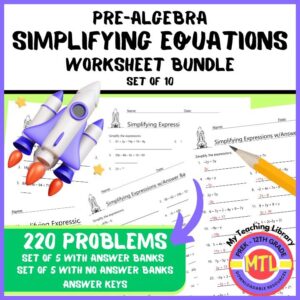
Easy-to-use, print-and-go, resource! When learning to simplify equations, this 10 worksheet bundle will give students the opportunity to practice and show what they know!
A 2-set bundle:
– Set 1: 5 worksheets with answer banks for students to use
– Set 2: 5 worksheets with no answer banksUse for practice and assessment. A total of 220 problems in all. Answer keys provided!
-
 $3.00Buy Now
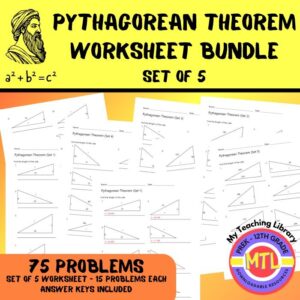
Ready-to-use, print-and-go, a set of 5 Pythagorean theorem worksheets. Each set includes 15 different problems.
Answer keys are included.
Perfect to use for practice, as a quiz or test.
-
 $2.75Buy Now
Looking for a fun way to teach students about the captivating phenomenon of a lunar eclipse? Add “Lunar Eclipse Mini Book: Earth Science – Learning about the Moon,” to your cart today, download and print! This resource will make complex space science accessible and exciting for young learners.
✨ What’s Included:
- – Five printable PDF pages that transform into a 10-page, student-created mini book.
- – Kid-friendly explanations of lunar eclipses, perfect for comprehension.
- – A dedicated page for students to illustrate their own lunar eclipse drawing.
📚 Learning Objectives
- – Students will be able to identify when a lunar eclipse can occur.
- – Students will understand the concepts of the umbra and penumbra shadows.
- – Students will be able to describe the conditions necessary for a total lunar eclipse.
- – Students will learn why total lunar eclipses can exhibit colorful hues.
- – Students will recognize and name the different phases of a lunar eclipse.
-
Sale!
 Original price was: $3.00.$2.25Current price is: $2.25.Buy Now
Hands on learning! This BUNDLE includes two products that will help students gain an understanding of what happens during a solar eclipse!
What’s included:
-
– A solar eclipse activity designed to help students visualize a solar eclipse through using common objects to actually demonstrate one.
-
– A solar eclipse activity designed to help students visualize a solar eclipse by creating a simple paper model of an eclipse.
-


