
Category: 4th-5th
Showing 121–140 of 716 resultsSorted by latest
-
 $5.00Add to Cart
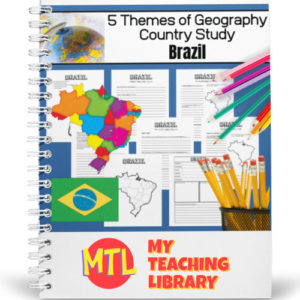
This is a country study resource on the South American country of Brazil focusing on the 5 Themes of Geography! There are a lot of country studies but this one is different.
This study will ask students to ‘think like a geographer‘ in their research and recording. Using this resource, students will…
- – Learn about the country of Brazil
- – Demonstrate knowledge of and ability to synthesize information and write about Brazil through a 5 themes of geography lens.
- – Create a wonderful project displaying their learning.
Sample questions include:
- – (Location) Describe the relative location of the country.
- – (Location) What is the latitude and longitude of the capital city?
- – (Place) What major landforms are found in the country?
- – (Place) What is/are the climate type(s) of the country?
- – (Regions) When considering this country, describe and give examples of at least one type of functional region within it.
- – (Movement) Describe any historically important migration patterns of information you have found about past or current migration for this country. You may include internal, external migration, emigration, immigration, return and/or seasonal migration.
- (Human/Environmental Integration) Give examples of how people who have lived in this country changed or modified the environment.
There are many more questions and this unit is designed to get your students thinking like a geographer!!
Students will need to have a good understanding of the 5 Themes of Geography to complete this project. Need teaching materials for the 5 Themes? Get My Teaching Library’s 5 Themes of Geography Bundle
-
$5.00Add to Cart
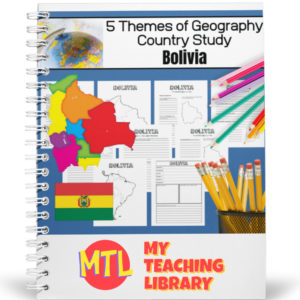
This is a country study resource on South American country of Bolivia focusing on the 5 Themes of Geography! There are a lot of country studies but this one is different.
This study will ask students to ‘think like a geographer‘ in their research and recording. Using this resource, students will…
- – Learn about the country of Bolivia
- – Demonstrate knowledge of and ability to synthesize information and write about Bolivia through a 5 themes of geography lens.
- – Create a wonderful project displaying their learning.
Sample questions include:
- – (Location) Describe the relative location of the country.
- – (Location) What is the latitude and longitude of the capital city?
- – (Place) What major landforms are found in the country?
- – (Place) What is/are the climate type(s) of the country?
- – (Regions) When considering this country, describe and give examples of at least one type of functional region within it.
- – (Movement) Describe any historically important migration patterns of information you have found about past or current migration for this country. You may include internal, external migration, emigration, immigration, return and/or seasonal migration.
- (Human/Environmental Integration) Give examples of how people who have lived in this country changed or modified the environment.
There are many more questions and this unit is designed to get your students thinking like a geographer!!
Students will need to have a good understanding of the 5 Themes of Geography to complete this project. Need teaching materials for the 5 Themes? Get My Teaching Library’s 5 Themes of Geography Bundle
-
$5.00Add to Cart
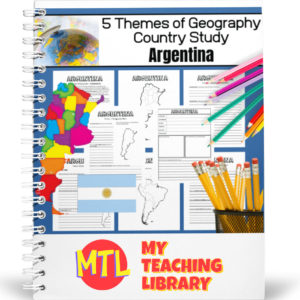
This is a project-based notebooking country study resource with a focus on the 5 Themes of Geography. There are a lot of country studies but this one is different!
This study will ask students to ‘think like a geographer‘ in their research and recording. By the end of the study, students will have learned about the country, their knowledge of the 5 themes will have been reinforced and they will have created a wonderful project displaying their learning.
Using this resource, students will…
- Learn about the country of Argentina
- Demonstrate knowledge of and ability to synthesize information and write about Argentina through a 5 themes of geography lens.
- Create a wonderful project displaying their learning.
Sample questions include:
- – (Location) Describe the relative location of the country.
- – (Location) What is the latitude and longitude of the capital city?
- – (Place) What major landforms are found in the country?
- – (Place) What is/are the climate type(s) of the country?
- – (Regions) When considering this country, describe and give examples of at least one type of functional region within it.
- – (Movement) Describe any historically important migration patterns of information you have found about past or current migration for this country. You may include internal, external migration, emigration, immigration, return and/or seasonal migration.
- (Human/Environmental Integration) Give examples of how people who have lived in this country changed or modified the environment.
There are many more questions and this unit is designed to get your students thinking like a geographer!!
Students will need to have a good understanding of the 5 Themes of Geography to complete this project. Need teaching materials for the 5 Themes? Get My Teaching Library’s 5 Themes of Geography Bundle
-
$5.00Add to Cart
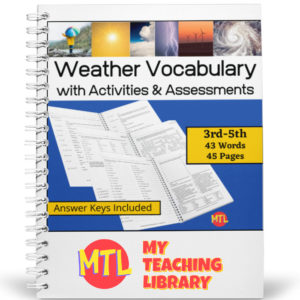
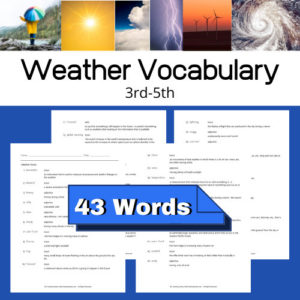
This weather vocabulary unit with activities is designed for 3rd-5th grade classrooms studying weather terms. It includes 43 weather terms with definitions (+ part of speech) plus the following types of activities to help students learn the words and their meanings:
* Vocabulary study sheet
* Spelling Challenge
* Word Jumble
* Alphabetical Order
* Alphabetical Order + Decoder Ring
* Word Search | Wacky Trails
* Word Frameup Puzzle
* Crossword Puzzle
* Weather Term Definitions | Optional assessment
* Weather Multiple Choice | Optional assessment
* 7 Additional “Suggested Ideas” for additional learning
See description below for details! -
$1.50Add to Cart
This weather resource includes 43 vocabulary words with definitions and an identified part of speech.
(See description below for included words)
-
$3.00Add to Cart
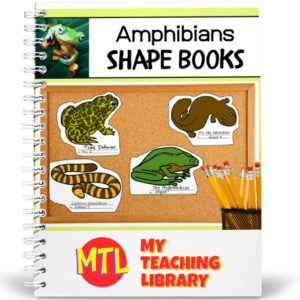
Here are four different amphibian shape books for student self-publishing! There are two for frogs/toads, one for salamanders and one for caecilians.
Students can use these shape book patterns to write stories, poems, and reports. Each book pattern has a cover page, a blank page and two pages with lines. Students can use as many pages as they need to complete their work and then fasten together with staples, ribbon or string.
-
$2.00Add to Cart
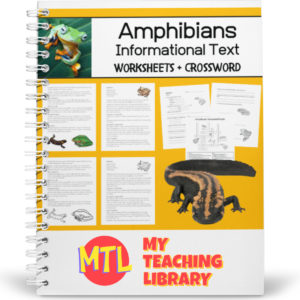
This resource has been designed to teach students about amphibians. They will learn the classification, the three types of amphibians, where they live (habitat), what the eat (diet), how they protect themselves (defense) and more.
Includes:
– Informational Text (b/w and color)
– 2 page worksheet
– Crossword puzzle
– Answer Keys
– BONUS: Large list of amphibian species -
$2.00Add to Cart
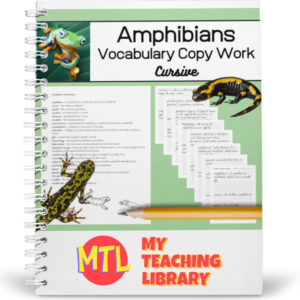
Studying amphibians? Help students learn important amphibian related vocabulary words and definitions while practicing copy work and handwriting (cursive). This resource include 22 vocabulary words and definitions. (See below description for included words)
-
$2.00Add to Cart
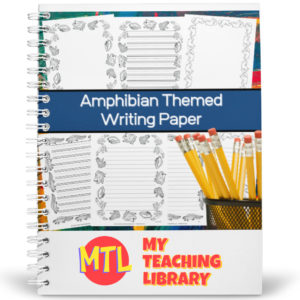
This fun amphibian themed paper can be used by all ages for a variety of uses such as writing essays, poetry, creating reports, science and nature journaling and even art projects!
Includes 9 pages:
– 3 Salamander (single lined, dashed line, blank center)
– 3 Newt (single lined, dashed line, blank center)
– 3 Frog & Toad ( (single lined, dashed line, blank center) -
$3.50Add to Cart
Give students the practice they need when learning to solve one-step, one-variable equations! This resource provides 7 different worksheets, each with 25 problems for a total of 175 problems. All equations in this set of worksheets use only the properties of addition and subtraction.
Answer Keys provided.
-
$1.00Add to Cart
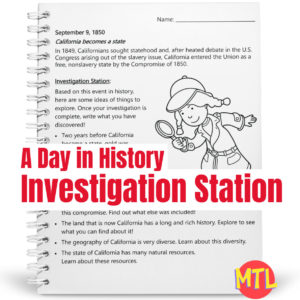
A Day in History – Investigation Station is a series of fun sleuthing research activities based on a single event on a specific day in history! This resource focus is on California. Investigation ideas include the ‘Gold Rush’, the Compromise of 1850, the state’s long and rich history, the geography and the natural resources.
Students will learn about an event and be given several topics from which to choose to ‘investigate’. After some exploration, students are asked to write what they have discovered and name used sources.
So…with each lesson, students will:
▪ (Read) Learn one ‘On this Day in History’ fact.
▪ (Investigate) Take a related topic and explore it through the use of different forms of media (i.e. books, internet).
▪ (Write) Summarize and write what they have discovered. This also should include the recording of sources. -
$1.00Add to Cart
A Day in History – Investigation Station is a series of fun sleuthing research activities based on a single event on a specific day in history! This resource centers around the convening of the First Continental Congress. Investigation ideas include the study of the Intolerable Acts, the delegates that attended and finding out why Georgia did not send a delegate.
Students will learn about an event and be given several topics from which to choose to ‘investigate’. After some exploration, students are asked to write what they have discovered and name used sources.
So…with each lesson, students will:
▪ (Read) Learn one ‘On this Day in History’ fact.
▪ (Investigate) Take a related topic and explore it through the use of different forms of media (i.e. books, internet).
▪ (Write) Summarize and write what they have discovered. This also should include the recording of sources. -
$1.00Add to Cart
A Day in History – Investigation Station is a series of fun sleuthing research activities based on a single event on a specific day in history! This investigation station begins with students learning about the surrender of Apache Indian Chief Geronimo in 1886. Exploration ideas include learning more about Geronimo, the Apache, Native Americans today and the American Indian Wars.
Students will learn about an event and be given several topics from which to choose to ‘investigate’. After some exploration, students are asked to write what they have discovered and name used sources.
So…with each lesson, students will:
▪ (Read) Learn one ‘On this Day in History’ fact.
▪ (Investigate) Take a related topic and explore it through the use of different forms of media (i.e. books, internet).
▪ (Write) Summarize and write what they have discovered. This also should include the recording of sources. -
$1.00Add to Cart
A Day in History – Investigation Station is a series of fun sleuthing research activities based on a single event on a specific day in history! This investigation centers around the establishment of the U.S. Treasury Department in 1789. Exploration ideas include investigating the first Secretary of Treasury, the history of the treasury building and the duties and functions of the department.
Students will learn about an event and be given several topics from which to choose to ‘investigate’. After some exploration, students are asked to write what they have discovered and name used sources.
So…with each lesson, students will:
▪ (Read) Learn one ‘On this Day in History’ fact.
▪ (Investigate) Take a related topic and explore it through the use of different forms of media (i.e. books, internet).
▪ (Write) Summarize and write what they have discovered. This also should include the recording of sources. -
$1.00Add to Cart
A Day in History – Investigation Station is a series of fun sleuthing research activities based on a single event on a specific day in history! This investigation centers around the Titanic. Exploration ideas include learning about Dr. Robert Ballad, the ship’s maiden voyage and survivor stories.
Students will learn about an event and be given several topics from which to choose to ‘investigate’. After some exploration, students are asked to write what they have discovered and name used sources.
So…with each lesson, students will:
▪ (Read) Learn one ‘On this Day in History’ fact.
▪ (Investigate) Take a related topic and explore it through the use of different forms of media (i.e. books, internet).
▪ (Write) Summarize and write what they have discovered. This also should include the recording of sources. -
$10.00Add to Cart
A student-friendly, math glossary designed for 3rd-5th grades and includes 129 math terms with definitions and 72 illustrations! Students love having this handy, easy-to-use reference when learning and practicing new math skills and concepts!
Terms include those surrounding basic operations, geometry and elementary statistics.
(See description below for a complete list of included terms)
-
$1.50Add to Cart
Help students learn and remember the difference between regular and irregular shapes by displaying this classroom poster!
-
$3.00Add to Cart
In geometry, students need to be able to identify a variety of irregular shapes! Here are 10 worksheets for students to practice identifying the following shapes:
- – quadrilateral
- – pentagon
- – hexagon
- – nonagon
- – heptagon
- – octagon
- – decagon
Answer Keys included.
-
$1.00Add to Cart
A Day in History – Investigation Station is a series of fun sleuthing research activities based on a single event on a specific day in history!
Students will learn about an event and be given several topics from which to choose to ‘investigate’. After some exploration, students are asked to write what they have discovered and name used sources.