
Category: 4th-5th
Showing 1–20 of 703 resultsSorted by latest
-
 $2.00Buy Now
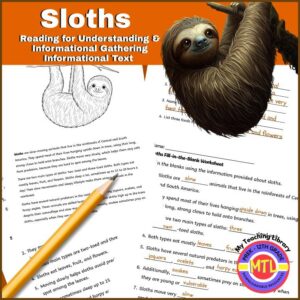
Students love to learn about animals and this resource will have students reading about the sloth, an elusive Amazon rainforest animal!
First, students will read information text that will tell students about sloths: habitat, diet, behavior and predators.
After reading, students may be assigned one or both included worksheets: (Fill-in the Blank | Short Answer)
There is also an image students may color.
Answer keys includedYou may also like:
- Sloth – Amazon Rainforest Animal Report – Writing – Project Paper
- Arboreal Mammals | Tree Dwelling Animals | Science Research and Report Activity
- Amazon Tropical Rainforest Animals – Realistic Images | Color and Write
- Rainforest Coloring Book
-
$2.00Buy Now
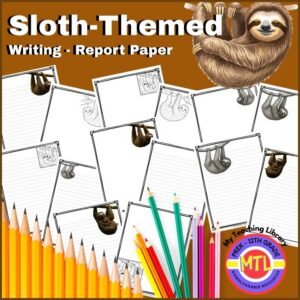
Sloth – Amazon Rainforest Animal Report – Writing – Project Paper
This product includes 21 pages for students to use when writing or creating a project on sloths.Details on the pages in the resource:
– 9 unlined pages with a black-and-white sloth image on each (2 include an image of a mom and her baby)
– 3 unlined pages with a color, photo realistic sloth image on each (2 include an image of a mom and her baby)
– 6 lined pages with a black-and-white sloth image on each (2 include an image of a mom and her baby)
– 3 lined pages with a color, photo realistic sloth image on each (2 include an image of a mom and her baby)You may also like: Amazon Tropical Rainforest Animals – Realistic Images | Color and Write
-
$2.75Buy Now
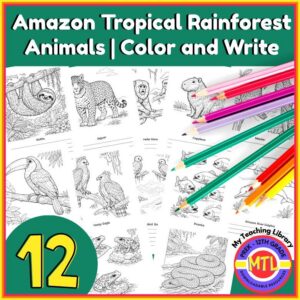
Students will love these Amazon Tropical Rainforest Animals Color and Write pages. It features twelve detailed, realistic black-and-white drawings of animals commonly found in the Amazon tropical rainforest. Can be used as a Language Arts, Geography and/or Science resource. Cross-curricular!
Each page includes a realistic, ready-to-color illustration of the animal and lines for students to write a paragraph about the animal.
Animals included:
– sloth
– jaguar
– capybara
– howler monkey
– macaw
– toucan
– harpy eagle
– resplendent quetzal
– green anaconda
– poison dart frog
– river dolphin
– piranhaSpace is provided for students to write a paragraph about each animal. You can assign what you’d like for them to include or you can allow them to choose what they include. Teachers often as students to describe the animal’s appearance, its habitat, unique behaviors, and any interesting facts they know or discover when reading about the animal(s) using outside materials.
Benefits of this resource:
- – Encourages children to learn about each animal.
- – Encourages children to express themselves through coloring and writing.
- – Reinforces writing, reading comprehension (through the gathering of information from outside resources to gather information to write) and science learning.
- – Improves attention span and concentration, as it requires careful attention to detail while coloring and while reading for detail (using outside resources).
- – Can reduce stress and anxiety when coloring.
- – Helps develop fine motor skills, hand-eye coordination, and dexterity through coloring.
- – Educational when using realistic images such as the ones in this resource
-
$4.00Buy Now
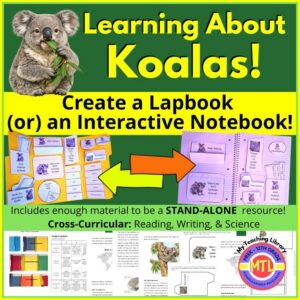
🐨 Planning to study Koalas? Marsupials? Animals of Australia/ If so, your students will love the student-centered, hands-on, cross-curricular project where they’ll learn all about Koalas while creating a lapbook or an interactive notebook!
🐨This can be used as a stand-alone unit that includes all of the informational materials, a map, and templates needed to create a beautiful project. Although this can be used completely as a stand-alone unit, a booklist is given if further research and reading is desired.
🐨Includes:
– Instructions and lapbook/notebooking examples
– Supply list
– Required elements checklist (optional for teacher assigned elements)
– Grading rubric and grading sheet
– Informational text covering:- Taxonomy
- Closest Relatives
- Anatomy
- Where they live (Habitat and Map)
- Diet
- Life Cycle
- Predators
- Fun Facts
- Vocabulary
– 11 pages of templates
– (Bonus) Nature’s Predators of the Koala Coloring Page -
$5.00Buy Now
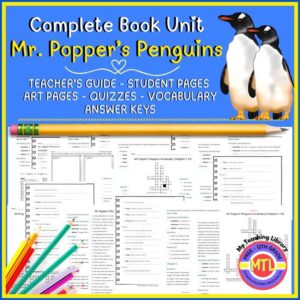
🐧A book unit for Mr. Popper’s Penguins which is easy-to-use, print-and-go unit and provides everything you need to teach and guide students through the book!
🐧Includes:
- -Teacher’s Guide – Brief and detailed chapter summaries, vocabulary with definitions, chapter questoins and answers.
- -Student Pages – Questions and vocabulary for each chapter
- -Student Art Pages – For students to draw a scene from an event that occurred in each chapter.
- -2 Quizzes – Short answer questions for Chapters 1-10 and 11-20
- -Vocabulary (extra) Work – Crossword puzzle and matching exercise. Can be used for review, reinforcement or testing.
- -Answer Keys
-
$5.00Buy Now
Here is a penguin unit study that is a student-centered, hands-on, cross-curricular project where they’ll learn all about 15 types of penguins while creating a lapbook or an interactive notebook!
🐧This can be used as a stand-alone unit that includes all of the informational materials, maps, illustrations and templates needed to create a beautiful project. However, a booklist is given if further research and reading is desired.
🐧Includes:
– Instructions and lapbook/notebooking examples
– Supply list
– Required elements checklist (optional for teacher assigned elements)
– Grading rubric and grading sheet
– Informational text covering: taxonomy, general information about penguins and unusual facts about penguins
– Detail fact sheets about the following species (includes image and location map for each): Adelie penguin, African penguin, Chinstrap penguin, Emperor penguin, Erect Crested penguin, Fiordland penguin, Galapagos penguin, Gentoo penguin, Humboldt penguin, King penguin, Little Blue penguin, Macaroni penguin, Magellanic penguin, Rockhopper penguin, Royal penguin
– Vocabulary
– Book suggestions for additional reading
– Illustration of a penguin’s basic anatomy– Illustration of the penguin life cycle
– 21 pages of templates that can be used to either create a lapbook or use in an interactive notebook -
$2.75Buy Now
Students will love to learn how to draw, step by step these woodland animals: 2 rabbits, cardinal, pileated woodpecker, fox, mouse, badger, hedgehog, wolf, raccoon and skunk.
Each page will illustrate how to draw one animal, starting with a single line and continue by adding additional lines and details as the drawing progresses. By the end, students will have drawn a woodland animal!
-
 $6.00Buy Now
Excite students as they learn all about whales and create an interactive project with this life science, hands-on, creative resource. This nonfiction science unit makes learning about baleen whales and toothed whales interesting and will help students develop reading, research, writing and organizational skills.
⭐Designed for 5th, 6th, 7th, and 8th grade students.
⭐Use as a fully stand-alone unit or students can research for additional information through books, videos and website.
⭐ Low-prep, comprehensive unit
⭐ Inspires reading, writing, organization, project research skills
⭐ Can be used to create a lapbook or interactive notebookWhat you get in this Whale unit:
- – How to use details
- – Images of how to create different style/size lapbooks and examples of interactive notebook pages
- – Supply list
- – Student forms: Required elements and grading rubric
- – Project grading form
- – Informational text covering topics such as classification, anatomy, behavior, communication, diet, life cycle, habitat and species-specific information for the following: Bottlenose whale, Cluver’s Beaked whale, Beluga whale, Killer whale, Narwhal, Sperm whale, Blue whale, Bowhead whale, fin whale, humpback whale and the Gray whale
- – Vocabulary
- – Whale surfacing behaviors – Images and descriptions
- – Suggested book titles for further research
- – Clipart
- – Project templates
-
 $1.00Buy Now
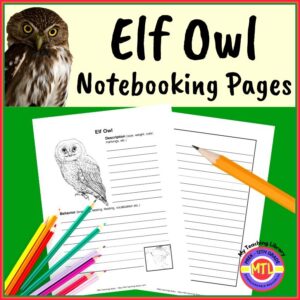
Elf Owl Notebooking pages provides students with two recording pages to report on this small owl that is the size of a sparrow! The first page includes an image to color and lines for students to describe the owl’s appearance and behavior. They will also be able to report on the range where it is found and complete map work. The second page can be duplicated as many times as necessary needed for students to write a report on the bird.
Suggested research link: Elf Owl Overview
Get My Teaching Library’s full Birds of Prey Notebooking Pages Resource!
-
 $2.00Buy Now
Studying Paul Revere, the American Revolution or famous people in American History? Here are three fun pages centered around Paul Revere’s famous midnight ride on which students can get creative!
Includes:
- – Coloring page
- – A page for students to draw their own interpretation of Paul’s ride
- – A page on which students will write what they believe each of the four people in the picture are either thinking or saying.
-
$3.50Buy Now
Art…Students love it but when it comes to drawing, most need a drawing guide to help. This resource will guide students in their drawing of many favorite parts about fall! Perfect for children and adults of all ages.
In this guide, you will find over 60 different fall images divided into categories:
– In the Kitchen
– Home Decor
– Autumn Foliage
– Layering Up for Cooler Weather
– October Themes
– On the FarmIn addition to the drawing guide, you will also find a template for students to draw their favorite part about autumn and also write about it. The perfect ELA cross curricular connection! (See description below for a detailed list images included in this drawing guide.)
-
Sale!Original price was: $33.50.$25.00Current price is: $25.00.Buy Now
400+ pages – Little House on the Prairie engaging literature units!
Included in this BUNDLE:
- Little House on the Prairie
- The Long Winter
- Farmer Boy
- These Happy Golden Years
- Little House in the Big Woods
- By the Shores of Silver Lake
- On the Banks of Plum Creek
Each unit includes:
- Vocabulary work – Students are asked to find and write a definition, an antonym and a synonym for each word given.
- Reading journal for every chapter in every book
- Reading comprehension quizzes (including keys)
- Essay questions – Many will ask students not only about events in each book but also ask students to relate events to their own lives in some way.
- Oral discussion questions – Perfect for large or small groups (literature circle) discussions.
Studying early American history? The American frontier? Pioneers? Wonderful cross-curricular work!
-
$1.50Buy Now
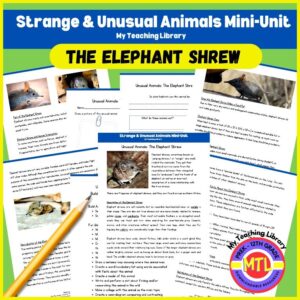
This engaging and cross-curricular mini-unit will teach students all about the elephant shrew! A strange and unusual animal, the elephant shrew is a small rodent-like mammal which gets its name from the resemblance between its elongated nose and the trunk of an elephant.
In this unit, students will read all about this little mammal…
– a description
– interesting facts
– where it lives
– what it eats
– interaction with humans
– if they make good pets
– behavior
– reproductionAfter reading all about the elephant shrew, students will complete a two-page activity in which they will draw the animal, do a little map work, answer questions and write about what they’ve learned.
Next, there are several hands-on ideas to continue building their knowledge and creating projects around this strange and unusual creature.
-
$6.00Buy Now
This personal Student Dictionary is a must-have spelling, writing, vocabulary dictionary tool for elementary students.
Students will use this dictionary all day long as they encounter new words in all subjects, Language Arts, Math, Science and Social Studies. Each time they meet a new word, they can write the word, a definition and (if level appropriate) an antonym and synonym for the word!
Put away other personal student dictionaries that do not give students space to record definitions as many do!!
What this resource includes:
- – Personal Dictionary cover page
- – Sight word list
- – Commonly misspelled words list in the categories named above)
- – A-Z letter sections
Each A-Z letter section includes 4 pages:
- – Page will give students another list (aside from the two previous lists mentioned above) of commonly misspelled words that begin with that letter. There will also be room to record three words (word, definition, antonym and synonym for each).
- – Pages 2-4 will provide room for students to record 5 additional words on each (word, definition, antonym and synonym for each). If more pages are needed, simply provide additional copies of these pages for students to add in their dictionaries!
This Student Dictionary is ideal for grades 1-4 but can be used in other grades for students needing extra support with spelling, or for kiddos with special needs.
-
$42.00Buy Now
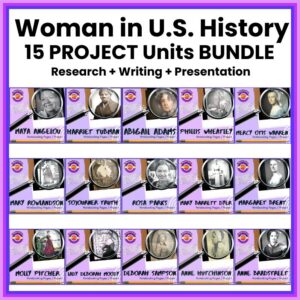
✏️Student-centered units that includes 15 projects surrounding important women in U.S. History. These units will help students learn and practice research skills, report writing, project and presentation skills.
✏️Students will use these 15 project-based units to learn about and create reports and presentations on the following people:
- Anne Hutchinson
- Anne Bradstreet
- Deborah Sampson
- Lady Deborah Moody
- Molly Pitcher
- Mary Barrett Dyer
- Margaret Brent
- Sojourner Truth
- Rosa Park
- Mary Rowlandson
- Mercy Otis Warren
- Phillis Wheatley
- Abigail Adams
- Harriet Tubman
- Maya Angelo
✏️These notebooking projects can be assigned individually or within cooperative groups. Use them within a Language Arts classroom or a Social Studies / U.S. History classroom. Very flexible and cross-curricular!
After completing the written portion of each resource, you can grade it (or) assign students to do an oral and/or audio-visual presentation based on their findings/work.
✏️What is in each unit?
- Student instructions for using biographical notebooking, project pages
- Suggested research questions
- Student notebooking, project pages (includes covers, KWL, reference recording, report writing, and more)
- Teacher pages (instructions, assignment, evaluation)
-
$5.00Buy Now
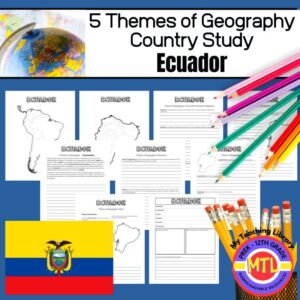
This is a project-based country study on the South American country of Ecuador focusing on the 5 Themes of Geography: location, place, regions, movement and human/environment integration! There are a lot of country studies but this one is different.
This study will ask students to ‘think like a geographer‘in their research and recording.
Using this resource, students will…
- Learn about the country of Ecuador
- Demonstrate knowledge of and ability to synthesize information and write about Ecuador through a 5 themes of geography lens.
- Create a wonderful project displaying their learning.
Sample questions include:
- – (Location) Describe the relative location of the country.
- – (Location) What is the latitude and longitude of the capital city?
- – (Place) What major landforms are found in the country?
- – (Place) What is/are the climate type(s) of the country?
- – (Regions) When considering this country, describe and give examples of at least one type of functional region within it.
- – (Movement) Describe any historically important migration patterns of information you have found about past or current migration for this country. You may include internal, external migration, emigration, immigration, return and/or seasonal migration.
- (Human/Environmental Integration) Give examples of how people who have lived in this country changed or modified the environment.
There are many more questions and this unit is designed to get your students thinking like a geographer!!
Students will need to have a good understanding of the 5 Themes of Geography to complete this project. Need teaching materials for the 5 Themes? Get My Teaching Library’s 5 Themes of Geography Bundle
-
$5.00Buy Now
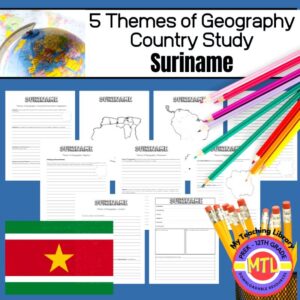
This is a project-based country study on the South American country of Suriname focusing on the 5 Themes of Geography: location, place, regions, movement and human/environment integration! There are a lot of country studies but this one is different.
This study will ask students to ‘think like a geographer‘in their research and recording.
Using this resource, students will…
- Learn about the country of Suriname
- Demonstrate knowledge of and ability to synthesize information and write about Suriname through a 5 themes of geography lens.
- Create a wonderful project displaying their learning.
Sample questions include:
- – (Location) Describe the relative location of the country.
- – (Location) What is the latitude and longitude of the capital city?
- – (Place) What major landforms are found in the country?
- – (Place) What is/are the climate type(s) of the country?
- – (Regions) When considering this country, describe and give examples of at least one type of functional region within it.
- – (Movement) Describe any historically important migration patterns of information you have found about past or current migration for this country. You may include internal, external migration, emigration, immigration, return and/or seasonal migration.
- (Human/Environmental Integration) Give examples of how people who have lived in this country changed or modified the environment.
There are many more questions and this unit is designed to get your students thinking like a geographer!!
Students will need to have a good understanding of the 5 Themes of Geography to complete this project. Need teaching materials for the 5 Themes? Get My Teaching Library’s 5 Themes of Geography Bundle
-
$5.00Buy Now
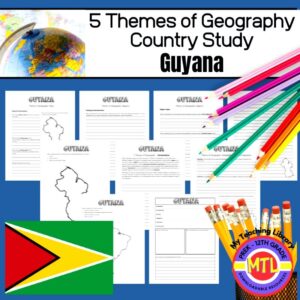
This is a project-based country study on the South American country of Guyana focusing on the 5 Themes of Geography: location, place, regions, movement and human/environment integration! There are a lot of country studies but this one is different.
This study will ask students to ‘think like a geographer‘in their research and recording.
Using this resource, students will…
- Learn about the country of Guyana
- Demonstrate knowledge of and ability to synthesize information and write about Guyana through a 5 themes of geography lens.
- Create a wonderful project displaying their learning.
Sample questions include:
- – (Location) Describe the relative location of the country.
- – (Location) What is the latitude and longitude of the capital city?
- – (Place) What major landforms are found in the country?
- – (Place) What is/are the climate type(s) of the country?
- – (Regions) When considering this country, describe and give examples of at least one type of functional region within it.
- – (Movement) Describe any historically important migration patterns of information you have found about past or current migration for this country. You may include internal, external migration, emigration, immigration, return and/or seasonal migration.
- (Human/Environmental Integration) Give examples of how people who have lived in this country changed or modified the environment.
There are many more questions and this unit is designed to get your students thinking like a geographer!!
Students will need to have a good understanding of the 5 Themes of Geography to complete this project. Need teaching materials for the 5 Themes? Get My Teaching Library’s 5 Themes of Geography Bundle
-
$5.00Buy Now
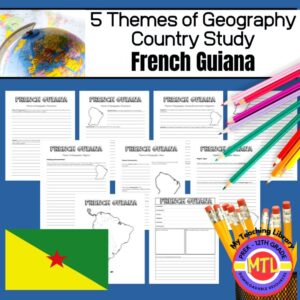
This is a project-based country study on the South American country of French Guiana focusing on the 5 Themes of Geography: location, place, regions, movement and human/environment integration! There are a lot of country studies but this one is different. This study will ask students to ‘think like a geographer‘ in their research and recording.
Using this resource, students will…
- Learn about the country of French Guiana
- Demonstrate knowledge of and ability to synthesize information and write about French Guiana through a 5 themes of geography lens.
- Create a wonderful project displaying their learning.
Sample questions include:
- – (Location) Describe the relative location of the country.
- – (Location) What is the latitude and longitude of the capital city?
- – (Place) What major landforms are found in the country?
- – (Place) What is/are the climate type(s) of the country?
- – (Regions) When considering this country, describe and give examples of at least one type of functional region within it.
- – (Movement) Describe any historically important migration patterns of information you have found about past or current migration for this country. You may include internal, external migration, emigration, immigration, return and/or seasonal migration.
- (Human/Environmental Integration) Give examples of how people who have lived in this country changed or modified the environment.
There are many more questions and this unit is designed to get your students thinking like a geographer!!
Students will need to have a good understanding of the 5 Themes of Geography to complete this project. Need teaching materials for the 5 Themes? Get My Teaching Library’s 5 Themes of Geography Bundle
-
$2.50Buy Now
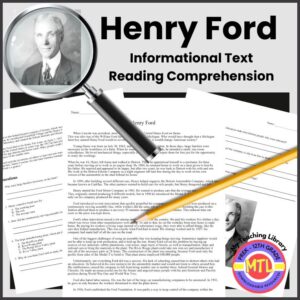
Henry Ford was an inventor, innovator, industrialist, and entrepreneur. In this resource, students will read about Ford’s life and business journey.
After reading, students will be asked a series of questions (multiple choice and short answer) to assess comprehension.
Students will learn:
- – About Henry’s family and early life
- – What he did at the age of 16
- – When he went to, left and then returned to Detroit
- – How he was first involved in car manufacturing and when he started Ford Motor Company
- – How is business practices made a huge stir in the country
- – One of his biggest challenges…and more!
Answer Key included!