
Category: 6th-8th
Showing 481–500 of 603 resultsSorted by latest
-
 $2.00Add to Cart
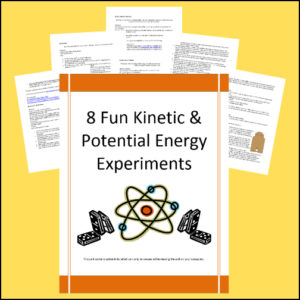
Kinetic energy is energy possessed by an object due to its motion or movement. Potential energy is the stored energy of position possessed by an object. Here are eight experiments for students to perform which display chemical energy! Experiments include:
1. Rube Goldberg Machines
2. Homemade Marble Run
3. Bucket Spin
4. Salad Spinner Art
5. Rubber Band Vehicles
6. Rubber Band Car
7. Flywheel Battery
8. Pendulum of Peril -
$6.00Add to Cart
Stop the “I don’t know what to write about!” struggle before it starts. This daily writing prompts resource provides a seamless solution for developing consistent writing habits, critical thinking skills, and creative expression for students in 4th – 12th Grade. Whether it’s a deep dive into facts and history or a light-hearted reflection, this month’s prompts ensure your students have a meaningful reason to put pen to paper every single day.
What’s Included?
This isn’t just a list of sentences; it is a complete journaling system. Each month is packed with:
- Individual Journal Pages: A unique, dedicated page for every day of the month.
- Diverse Prompt Styles: A balanced mix of “light and fun” topics and “deep-dive” prompts that challenge students to think critically about values, history, and social issues.
Here are two examples:
November 11th – (Veterans Day)
Veterans Day (celebrated somewhat differently as Remembrance Day in Canada, Australia and Great Britain) originally commemorated the end of World War I. In the United States, it is now a day to honor all those who serve in the military, living and dead, from all wars and during peacetime. Do you know any veterans? Write a letter to a veteran you know or, if you don’t know one, to any veteran.November 13th – (World Kindness Day)
“No act of kindness, however small, is ever wasted.” ~ Aesop
Tell about a time when someone was kind to you.How to implement it:
- Daily Starts: Start your morning or English period with a 10-minute quiet writing session.
- Fast-Finisher Activity: Keep your “early birds” engaged with a meaningful task that doesn’t feel like “busy work.”
- Homeschool Portfolios: Use these daily entries to track progress in handwriting, grammar, and expressive thought throughout the year.
- Digital or Print: These pages are designed to be “print-and-go” ready, but they also work beautifully as digital assignments. Simply give them to your student(s) and allow them to create a word document for each. First, have them copy (type) the prompt. Then answer it! Print and place in a growing 3 ring-binder of work.
The Benefits of Daily Prompting
Daily writing is like a workout for the brain. By using these journals, students will:
- Build Writing Stamina
- Strengthen Critical Thinking
- Encourage Research
- Encourages Deep Thinking About Different Topics
My Teaching Library has writing prompts for the entire year – BUNDLE & SAVE: Daily Writing Prompt Journal – ONE YEAR BUNDLE
-
$7.99Add to Cart
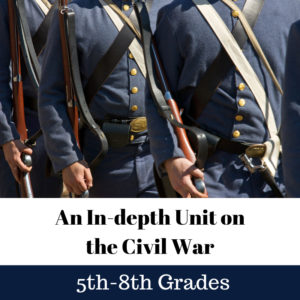
This 109 page Civil War teaching unit takes students through 9 different sections:
- Disunion
- Going to War
- Antietam & Emancipation
- Life at War
- The Home Front
- Shifting Tides of 1863
- Bringing the War to an End
- Post War Effects
- Preserving the Memories
** Includes 7 PowerPoints **
-
 $2.50Add to Cart
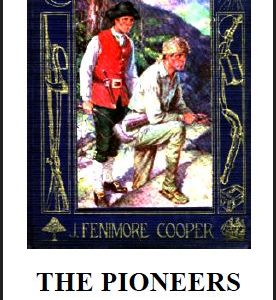
This is a downloadable copy of the book.
About the book: The book was the first of five novels published which became known as the Leatherstocking Tales.The story takes place on the rapidly advancing frontier of New York State and features an elderly Leatherstocking (Natty Bumppo), Judge Marmaduke Temple of Templeton (whose life parallels that of the author’s father Judge William Cooper), and Elizabeth Temple (based on the author’s sister, Hannah Cooper), daughter of the fictional Templeton. The story begins with an argument between the judge and Leatherstocking over who killed a buck. Through their discussion, Cooper reviews many of the changes to New York’s Lake Otsego and its area: questions of environmental stewardship, conservation, and use prevail. Leatherstocking and his closest friend, the Mohican Indian Chingachgook, begin to compete with the Temples for the loyalties of a mysterious young visitor, a “young hunter” known as Oliver Edwards. The latter eventually marries Elizabeth Temple. Chingachgook dies, representing European-American fears for the race of “dying Indians”, who appear to be displaced by settlers. Natty vanishes into the sunset.
About the Author: James Fenimore Cooper was an American writer of the first half of the 19th century. His historical romances draw a picture of frontier and American Indian life in the early American days which created a unique form of American literature.
-
$2.50Add to Cart
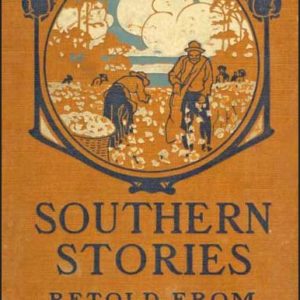
This is a downloadable copy of the book.
About the book:This collection contains many articles and a few stories. Among the articles are one about alligators and one about catching terrapins. There are also articles about New Orleans, St Augustine, an earthquake at Charleston, S.C. and American rivers. The St. Augustine article reads as though it was placed by the chamber of commerce or a tourist bureau. One of the better stories is The Watermelon Stockings by Alice Caldwell Hegan about a disobedient but brave little girl. Another is The Creature With No Claws by Joel Chandler Harris.
-
$2.00Add to Cart
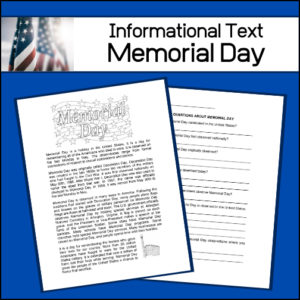
Help your students discover the true meaning behind the holiday with the Memorial Day Informational Text & Review from My Teaching Library! Perfect for a focused, project-based history lesson, this concise resource features an engaging informational text detailing the rich history of the holiday. Students will learn about its origins as “Decoration Day” in 1868 , its expansion after World War I, and the official name change in 1967.
The packet features a beautiful “You are not forgotten” American flag coloring element paired with a comprehensive reading comprehension worksheet. Students will answer seven key questions to reinforce historical facts —including government traditions at Arlington National Cemetery and the significance of flying the flag at half-mast —plus a thoughtful prompt to reflect on local community traditions. Complete with a full teacher answer key, this easy-to-use printout provides a meaningful way to honor the over one million heroes who sacrificed their lives for our freedom.
-
$2.00Add to Cart
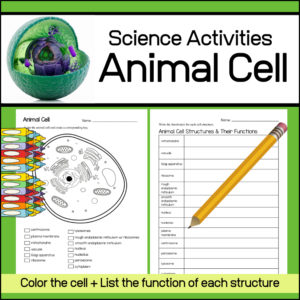
This Science / Biology resource includes 2 activity worksheets for students to help them review the structures / organelles of an animal cell and the main function(s) of each. Structures /organelles include: centrosome, plasma membrane, mitochondria, vacuole, Golgi apparatus, ribosome, lysosomes, rough endoplasmic reticulum, smooth endoplasmic reticulum, nucleus, nucleolus, peroxisome, cytoplasm
-
$2.50Add to Cart
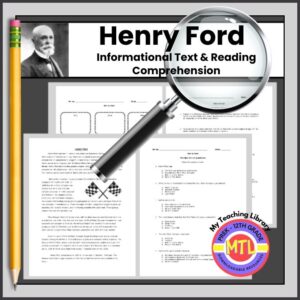
With this resource students will learn about and be tested on the life and accomplishments of Henry Ford.
Students will learn about:
– Where he was born
– What he built at the age of 15
– Where he worked as an engineer and when he built his first gasoline powered car
– What brought people to him willing to finance his new concept of manufacturing…and more!After reading, there are three worksheets for students to complete to help assess student comprehension.
– A “Who, What, When, Where, Why and How” worksheet
– A multiple-choice worksheet
– A short answer worksheetAnswer Keys provided.
-
$1.75Add to Cart
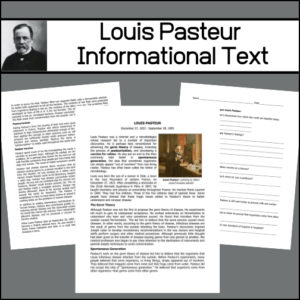
This is a resource designed to teach students about Louis Pasteur and his important contribution to science in germ theory, spontaneous generation, pasteurization and the rabies vaccine. After reading 2 pages of informational text, students will be asked 9 short answer questions to assess comprehension of the material. Answer key is provided.
-
$1.50Add to Cart
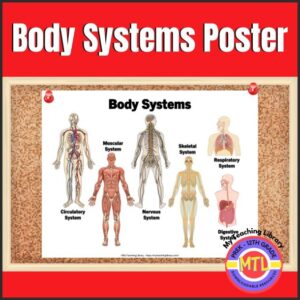
Studying anatomy? Body systems? Here is “Body Systems” poster that that illustrates these systems: circulatory, muscular, digestive, nervous, skeletal and respiratory.
-
$3.00Add to Cart
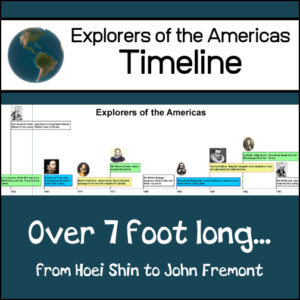
This resource will create a classroom wall timeline (over 7′ long) showing famous explorers of the Americas! The timeline begins with Hoie Shin: a Chinese monk who explored the west coast of Mexico in 499 and ends with John Fremont: nicknamed the “Pathfinder” who explored the American West in 1838. (Examples of other explorers included: Leif Ericksson, Columbus, Cabot, Cortez, Coronado, Daniel Boone, John Cook, Davy Crockett and others)
-
$3.00Add to Cart
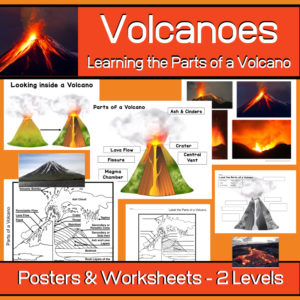
Help students master their knowledge of the parts of a volcano with these posters, handouts and worksheets! This resource provides 2 levels of learning plus worksheets come with and without terms. (Landforms, Earth Science, Geology)
-
$5.00Add to Cart
This engaging literature unit for the chapter book, “Farmer Boy” by Laura Ingalls Wilder offers a reading journal, vocabulary work, discussion questions, writing assignments and 13 reading comprehension quizzes (with keys). Designed to keep students thoughtfully engaged. 83 pages.

👈Book not included. Click to purchase the book
About the book: Farmer Boy written by Laura Ingalls Wilder was the second-published one in the Little House series. The novel is based on the childhood of Wilder’s husband, Almanzo Wilder, who grew up in the 1860s near the town of Malone, New York. It covers roughly one year of his life, beginning just before his ninth birthday and describes a full year of farming.Interest level:
Grades 4 – 8Reading level:
Grades 4 – 6BUNDLE & SAVE: Little House of the Prairie Literature BUNDLE | Laura Ingalls Wilder
-
$3.50Add to Cart
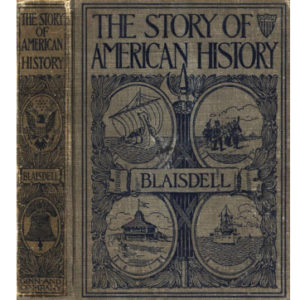
This 261 page book holds a 1900 copyright and was thought of as the ‘first book on American history used in schools in preparation for… more ‘formal’ textbook learning.’ It is however not for young readers. It is not a textbook but rather reads as an informational book that explains the history of the United States and is best read by 5th -8th graders but can also be used by high school students as a reference as well! It would be a good addition to read along side your normal curriculum.
See description below for chapter titles.
-
 $2.50Add to Cart
This is a downloadable copy of the book.
About the book: The Jungle Book (1894) is a collection of stories by the English author Rudyard Kipling. Most of the characters are animals such as Shere Khan the tiger and Baloo the bear, though a principal character is the boy or “man-cub” Mowgli, who is raised in the jungle by wolves. A major theme in the book is abandonment followed by fostering, as in the life of Mowgli, echoing Kipling’s own childhood. The theme is echoed in the triumph of protagonists including Rikki-Tikki-Tavi and The White Seal over their enemies, as well as Mowgli’s.About the Author: Joseph Rudyard Kipling was an English journalist, short-story writer, poet, and novelist. He was born in India, which inspired much of his work. Kipling in the late 19th and early 20th centuries was among the United Kingdom’s most popular writers. In 1907, he was awarded the Nobel Prize in Literature, as the first English-language writer to receive the prize, and at 41, its youngest recipient to date. He was also sounded for the British Poet Laureateship and several times for a knighthood but declined both. Following his death in 1936, his ashes were interred at Poets’ Corner, part of the South Transept of Westminster Abbey.
-
$4.00Add to Cart
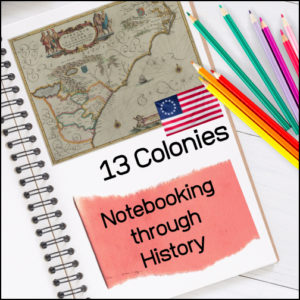
Give students a interactive way to reinforce and share their knowledge as they learn about the history of the 13 colonies by creating a fun project with this notebooking resource.
Completing this project will require students to gather, organize and present the material through writing and illustration. **It can be as thorough as you assign or you can leave the assignment completely student driven.
-
Anne Bradstreet Project-Based Unit | Research – Writing – Presentation to Pinterest (opens in a new window)$3.00Add to Cart
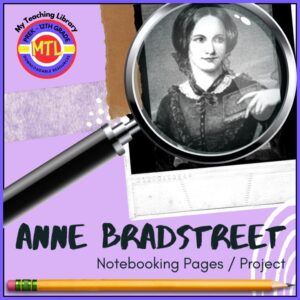
✏️A student-centered resource to help students learn and practice research skills, report writing, project and presentation skills.
Students will use this project-based unit to learn about and report on Anne Bradstreet.Anne Bradstreet was the most prominent of early English poets of North America and first writer in England’s North American colonies to be published. She is the first Puritan figure in American Literature.
✏️This notebooking project unit can be assigned individually or within cooperative groups. Use it within a Language Arts classroom or a Social Studies / U.S. History classroom. Very flexible and cross-curricular! After completing the written portion of this resource, you can grade it (or) assign students to do an oral and/or audio-visual presentation based on their findings/work.
✏️What is in this resource?
- Student instructions for using biographical notebooking, project pages
- Suggested research questions
- Student notebooking, project pages (includes covers, KWL, reference recording, report writing, and more)
- Teacher pages (instructions, assignment, evaluation)
-
Barack Obama Project-Based Unit | Research – Writing – Presentation to Pinterest (opens in a new window)$3.00Add to Cart
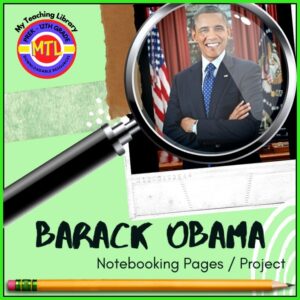
✏️A student-centered resource to help students learn and practice research skills, report writing, project and presentation skills.
Students will use this project-based unit to learn about and report on Barack Obama.Barack Obama is an American attorney and politician who served as the 44th president of the United States from 2009 to 2017. A member of the Democratic Party, he was the first African American to be elected to the presidency.
✏️This notebooking project unit can be assigned individually or within cooperative groups. Use it within a Language Arts classroom or a Social Studies / U.S. History classroom. Very flexible and cross-curricular! After completing the written portion of this resource, you can grade it (or) assign students to do an oral and/or audio-visual presentation based on their findings/work.
✏️What is in this resource?
- Student instructions for using biographical notebooking, project pages
- Suggested research questions
- Student notebooking, project pages (includes covers, KWL, reference recording, report writing, and more)
- Teacher pages (instructions, assignment, evaluation)
-
$8.50Add to Cart
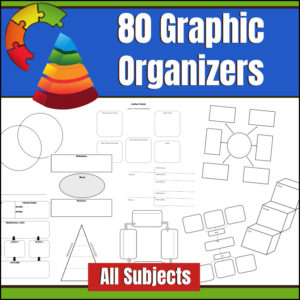
A graphic organizer, also known as knowledge map, concept map, story map, cognitive organizer, advance organizer, or concept diagram, is a communication tool that uses visual symbols to express knowledge, concepts, thoughts, or ideas, and the relationships between them. This resource gives you 80 different graphic organizers and can be used across the curriculum!
Here is a comment from a customer…
Karen E. said: “OK, at first I thought “Really? I’m going to pay for graphic organizers that I can probably find for free with some searching, etc?” Well, now I am so glad that I did. So good to have organizers available quickly BUT also several of them have variations which is helpful for “seeing” how to use them in my content area. Good value.“




&url=https://myteachinglibrary.com/product/the-pioneers-cooper/&media=https://myteachinglibrary.com/wp-content/uploads/2019/08/wy-306-g.jpg)


&url=https://myteachinglibrary.com/product/the-jungle-book-rudyard-kipling/&media=https://myteachinglibrary.com/wp-content/uploads/2019/08/wy-304-a.jpg)


